
TOSI: Redefining Social Influence through Trust and Contextual Intelligence
TOSI: A trust-oriented social influence evaluation method in contextual social networks
TOSI (Trust-Oriented Social Influence) is a novel evaluation method for contextual social networks that integrates social trust, relationships, and preference similarity. It achieves state-of-the-art results on Epinions and DBLP datasets, outperforming the SoCap baseline in precision, efficiency, and robustness against spam attacks.
TL;DR
Social influence isn't just about how many people you know; it's about who trusts you and why. This paper introduces TOSI (Trust-Oriented Social Influence), a framework that moves beyond skeletal network structures by injecting "Social Context"—trust, relationships, and preferences—into the influence equation. It beats existing state-of-the-art methods like SoCap by over 200% in precision while remaining immune to common spamming tactics.
Problem: The Blind Spots of Structural Influence
Most traditional models (like the Independent Cascade model) treat social networks as binary graphs: a link exists, or it doesn't. This oversimplification fails in two major ways:
- Uniformity Bias: It assumes every "follow" or "link" carries the same weight, ignoring that you're more likely to be influenced by a trusted colleague than a random acquaintance.
- Spam Vulnerability: In the age of "Zombie fans," spammers can easily create fake clusters (Spam Farms) to simulate high influence, tricking algorithms that rely solely on connectivity.
Methodology: The Three Pillars of Context
The authors argue that influence is a product of three distinct social dimensions. They redefine the probability of influence from node to node () as a weighted average of:
- Social Trust (ST): The level of belief based on historical interactions.
- Social Relationship (SR): The degree of intimacy (e.g., family vs. stranger).
- Preference Similarity (PS): How closely the participants' interests align.
Theoretical Framework
TOSI employs an iterative calculation where influence flows through the network until it converges. Unlike standard PageRank, the transition matrix is non-uniform, dictated by the contextual scores mentioned above.
 In the figure above, we see how different social dimensions affect the decision-making of participants.
To handle spammers, TOSI integrates Spam Mass estimation. By comparing a node's "Social Influence" score with its "TrustRank" (propagated from a set of known honest seeds), the system can flag accounts that have high influence but low actual trust.
Experimental Showdown: TOSI vs. SoCap
The researchers tested TOSI against the SoCap method on two massive datasets: Epinions (consumer reviews) and DBLP (scientific citations).
1. Accuracy and Efficiency
TOSI achieved a precision of 84% on Epinions, compared to SoCap's meager 24.7%. Remarkably, despite the added complexity of contextual data, TOSI is incredibly fast—converging in just 5 iterations and saving nearly 90% of the execution time required by predecessors.
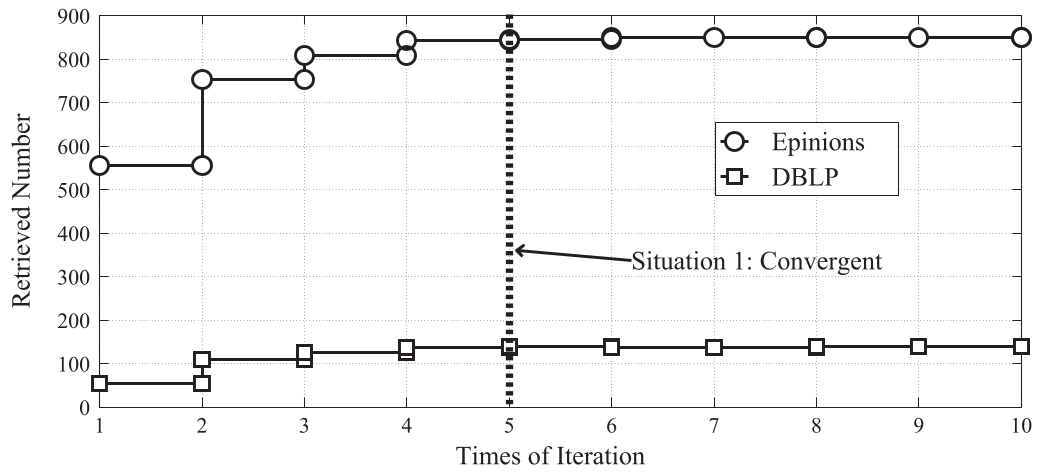 Figure: TOSI reaches stability within just 5 iterations, making it highly scalable for large-scale OSNs.
2. Diffusion Power
Under Linear Threshold (LT) and Independent Cascade (IC) models, agents selected by TOSI consistently triggered larger "information cascades" than those selected by SoCap. This proves that TOSI finds the true influencers who can actually move the needle in a network.
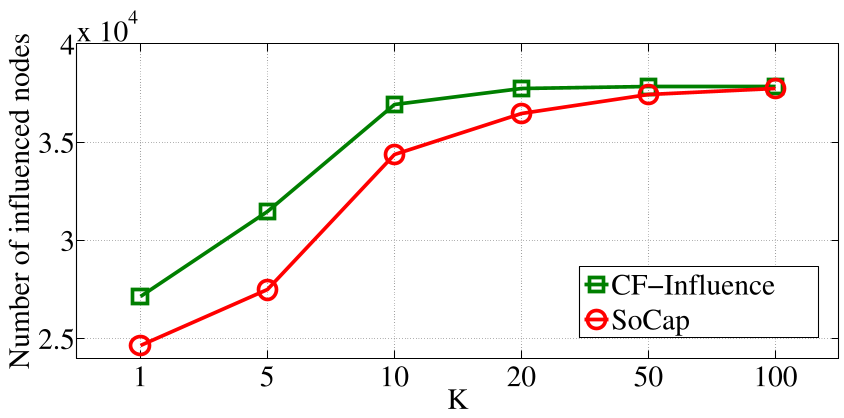 Comparison of influenced node counts across different thresholds.
Conclusion and Core Insights
TOSI represents a shift from "Quantity" to "Quality" in social network analysis. Its success highlights that:
- Context is King: Connectivity is a poor proxy for influence without trust and preference data.
- Security is Iterative: Anti-spam measures must be baked into the ranking algorithm, not added as an afterthought.
- Performance Matters: High-accuracy influence evaluation can be achieved with low computational overhead through optimized iterative convergence.
Future Outlook: The ability to distinguish "Zombie" influence from genuine trust-based influence makes TOSI a vital tool for modern e-commerce and CRM systems aiming to identify authentic brand ambassadors.