
Deciphering the Tour Guide’s Digital Pulse: A Social Network Analysis of Communication Ecosystems
Tour guides’ communication ecosystems: an inferential social network analysis approach
This study investigates the communication ecosystems of professional tour guides within the World Federation of Tourist Guide Associations (WFTGA) using Inferential Social Network Analysis. By applying Exponential Random Graph Models (ERGM), the research maps five distinct digital and traditional communication layers (in-person, e-mail, social networks, etc.) to understand how demographic and professional attributes drive network formation.
Executive Summary
TL;DR: Success in the tour guiding industry is not just about what you know, but who you talk to. This study deconstructs the communication habits of members of the World Federation of Tourist Guide Associations (WFTGA). It reveals that our digital tools—from WhatsApp to E-mail—create vastly different social architectures. While social media promotes dense, diverse connections (heterophily), traditional e-mail remains the fortress of the "old guard."
Positioning: This work moves beyond descriptive statistics to inferential network modeling, providing a mathematical "why" behind how professional communities survive and evolve in a digital-first world.
The "Why": Why Network Structure Matters
Tour guides operate in a high-stress, seasonal vacuum. Without a robust support network, knowledge of local regulations, operator connections, and emergency resources withers. Professional associations like the WFTGA attempt to bridge this gap, but they often struggle with limited budgets. The authors ask a critical question: Which communication channels actually facilitate diverse networking, and which ones just reinforce existing silos?
Methodology: The ERGM Approach
The researchers didn't just count messages; they looked at the probability of connection. By using Exponential Random Graph Models (ERGM), they could isolate specific "social forces." For instance, does having a Master's degree make you more likely to reach out to someone different (heterophily), or do you stick to your own kind (homophily)?
Mapping the Ecosystem
They analyzed 7 distinct layers:
- In-person: The traditional convention floor.
- Online-call: High-barrier, high-trust.
- Text-message: Short-range, local utility.
- E-mail: The formal backbone.
- Online Social Networks: The dense, "4 degrees of separation" hub.
- Familiarity: Who knows whom?
- No-contact: The control group for internal validity.
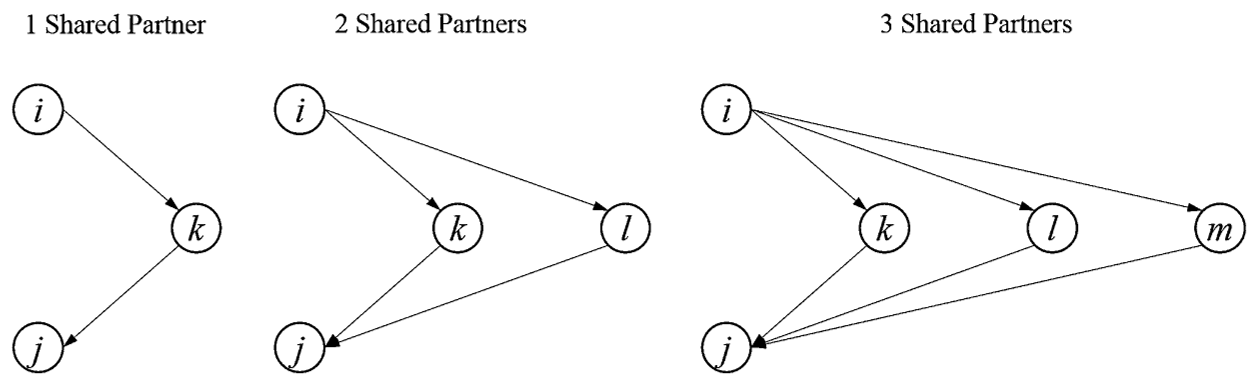 Figure 1: The GWDSP term (Geometrically Weighted Dyad-wise Shared Partners) helps explain how 'brokers' facilitate information flow between two otherwise disconnected people.
Key Insights: Demographic Drivers
- The Gender Effect: Female guides were found to be the primary drivers of heterophily. They are more likely to connect outside their immediate circles, acting as the "glue" that brings diversity to the ecosystem.
- The Education Boost: Members with a Master's degree showed a significantly higher likelihood of using Online Calls and Social Networks (OR > 2.9). Education seems to serve as a catalyst for technology adoption, bypassing the need for physical proximity.
- The Tenure Divide: Experience breeds connection, but selectively. Guides with 5+ years of experience dominate the e-mail and in-person layers, while younger generations are far more active in the Social Network layer.
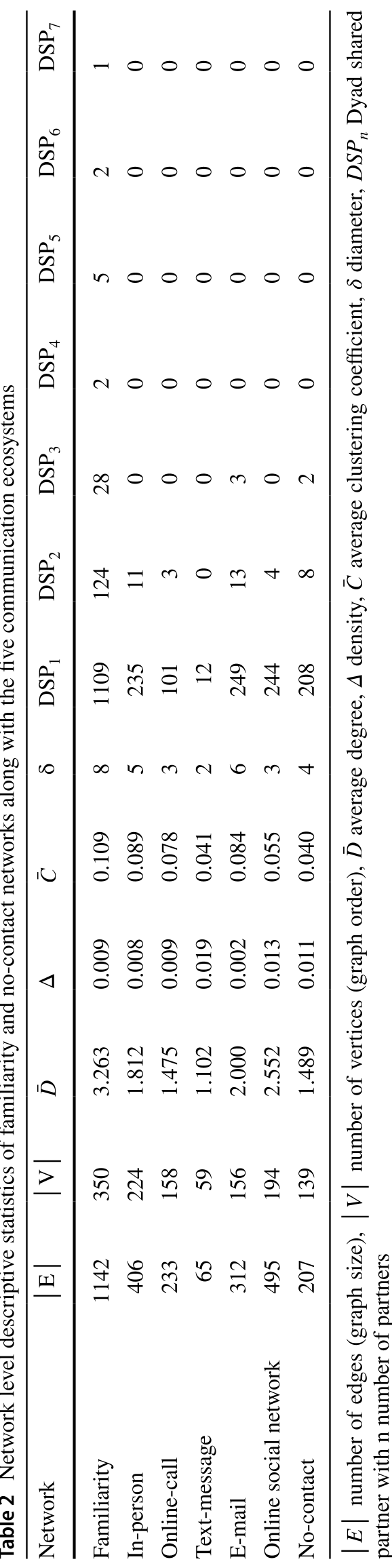 Table 1: Comparative statistics showing that Social Networks have higher density (Δ) and smaller diameters (δ) than E-mail or In-person ecosystems.
Structural Bottlenecks
The study found a negative coefficient for GWDSP across most networks. In layman's terms: the flow of information isn't as free as it should be. The network is "undershared," meaning that while people are connected, they aren't forming the dense clusters necessary for truly resilient community knowledge.
Critical Analysis & Conclusion
Takeaway
The WFTGA and similar organizations must stop viewing "communication" as a single task. E-mail is where formal power resides, but Social Media is where the network’s future diversity and sustainability are built. To prevent the "graying" of professional networks, associations need to incentivize digital-first interactions that encourage heterophily.
Limitations
A major caveat is the missing data (approx. 60%) on certain attributes, which is common in voluntary convention surveys but requires caution when generalizing. Furthermore, the study treats these networks as independent, whereas in reality, they are multiplex—a conversation might start on Facebook and move to E-mail.
Future Outlook
The next frontier is Multiplex Network Analysis, studying how these layers interact. For instance, does a strong "In-person" connection at a convention lead to more robust "Online Social Network" ties? Only by understanding the leap from physical to digital can we design truly sustainable professional ecologies.