
Towards Ecosystems for Responsible AI: Mapping the EU's Sociotechnical Blueprint
Towards Ecosystems for Responsible AI - Expectations on Sociotechnical Systems, Agendas, and Networks in EU Documents
This paper explores the emergence of "Responsible AI Ecosystems" through an analysis of key European Union (EU) strategy documents. It proposes a novel framework based on the sociology of expectations to map how the EU envisions a multi-actor network that balances AI innovation with ethical governance, positioning the EU as a global standard-setter.
TL;DR
What does it take to turn ethical AI from a buzzword into a functioning international ecosystem? This paper analyzes five years of EU strategy to reveal that Responsible AI currently exists primarily as a set of structured "expectations." The authors introduce a framework to map these expectations, arguing that the EU is meticulously constructing a narrative where trust is the engine, and ethical values are the "win-win" fuel for global competitiveness.
Problem & Motivation: The Gap Between Ethics and Action
While AI ethics guidelines are abundant, they often lack the "connective tissue" required to form a multi-actor ecosystem. The business value of responsible AI remains diffuse, and it is unclear who—beyond the regulator—should be responsible for what.
The researchers advocate for a shift in perspective: instead of looking for existing markets, we should analyze expectations. In the world of innovation, expectations are performative; they act as a blueprint that guides investments, research, and policy. By understanding the EU’s "imagined future," stakeholders can better predict the trajectory of AI governance and market demands.
Methodology: The Taxonomy of Expectations
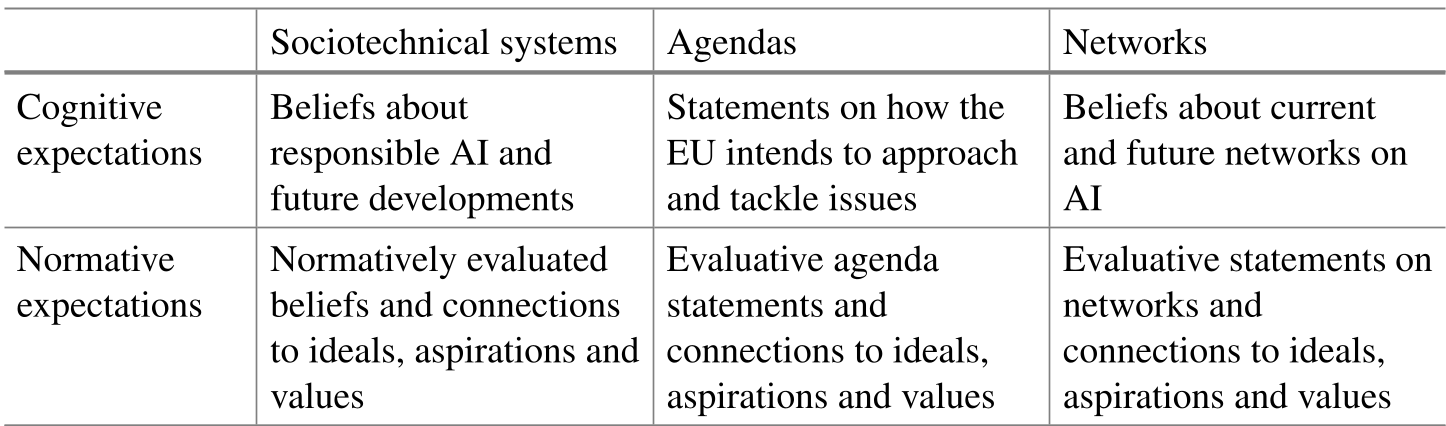
The authors build a 2x3 matrix to categorize EU rhetoric, combining the sociology of expectations with discursive institutionalism.
- Axis 1: Cognitive vs. Normative. Cognitive ideas define problems and provide solutions (the "How"), while normative ideas link those actions to aspirations and values (the "Why").
- Axis 2: Systems, Agendas, and Networks. Analyzing expectations on the technology itself, the priorities for action, and the structure of the human/organizational networks involved.
Core Analysis: The Four Pillars of the EU AI Narrative
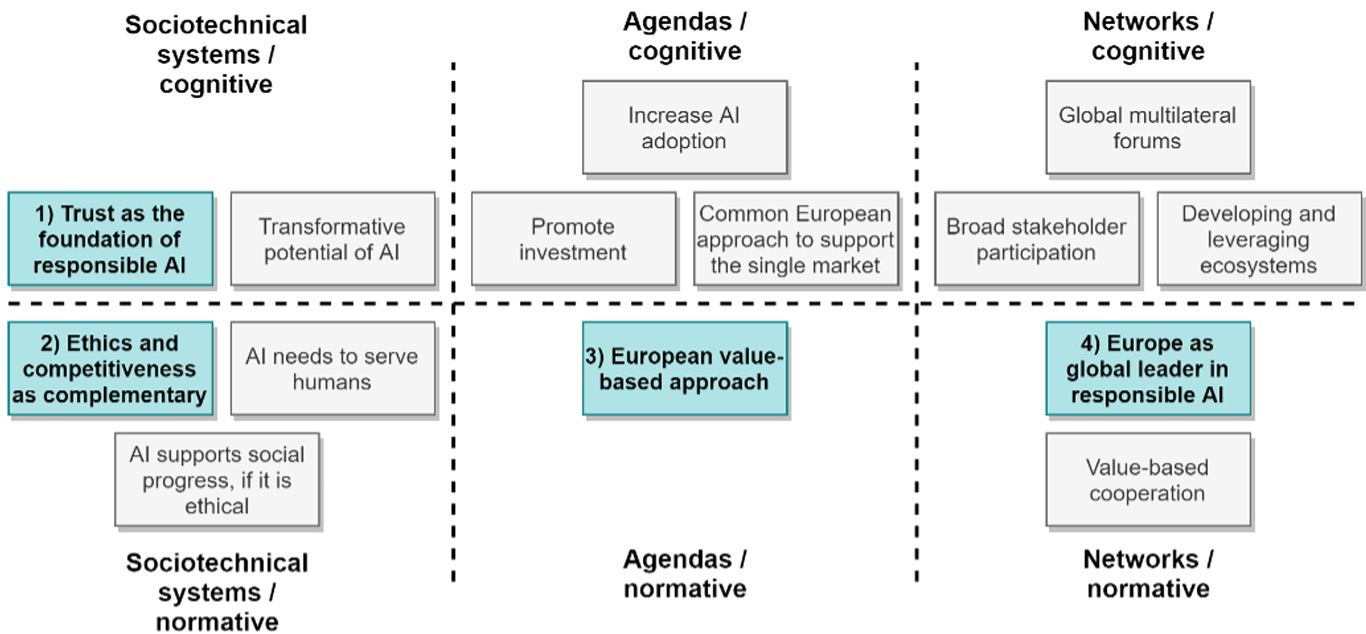
Through qualitative analysis of documents like the White Paper on AI and the Ethics Guidelines for Trustworthy AI, the authors extract four interconnected themes:
1. Trust as the Foundation (Cognitive-Systems)
The EU posits that trust is not a luxury but a "prerequisite" for adoption. Without trust (fostered by auditability, explainability, and data management), the transformative potential of AI will never be realized in the European market.
2. Ethics and Competitiveness as "Win-Win" (Normative-Systems)
The paper identifies a crucial "hero narrative": the EU argues that high ethical standards will become a global "brand" for European companies. By aligning with fundamental rights, companies gain a "responsible competitive advantage" rather than just a regulatory burden.
3. The Value-Based Agenda (Normative-Agendas)
To avoid fragmentation, the EU seeks a distinct path rooted in human dignity and privacy. This serves as an "organizing vision" to mobilize public and private investment under a single ideological banner.
4. Europe as a Global Leader (Normative-Networks)
The ultimate goal is seen as a global extension of the European model. By setting the global standard for regulation (similar to the "GDPR effect"), the EU aims to lead the international debate on AI governance.
Critical Insight: The Layered Structure of Innovation
A key finding of this paper is the layered structure of AI expectations. Network-building (the "Ecosystem") does not happen in a vacuum. It rests on a cognitive base (trust) and a normative agenda (European values).
The Hierarchy of Emerging Ecosystems:
- Individual Layer: Beliefs about technology and trust.
- Regional Layer: A shared normative vision (The "European path").
- Global Layer: Projecting that vision onto the world stage to establish leadership.
Conclusion & Future Outlook
The paper concludes that we are currently in a critical window where "path dependencies" are being set. The EU's strategy is to "tame" AI through a narrative that merges ethics with economic growth.
Limitations & Future Work: While the "hero narrative" is compelling, the authors acknowledge limitations. Will stakeholders—especially investors and offshore tech giants—genuinely buy into this "win-win" proposition? Future research must track whether these "imagined ecosystems" translate into actual business models, such as third-party AI auditing and specialized ethical consulting services.
For any AI developer or policy-maker, this paper serves as a reminder: In an emerging field, the power to define expectations is the power to design the future.