
TR-MCN: Accelerating Secure Task Recommendation in Mobile Crowdsourcing Networks
TR-MCN: light weight task recommendation for mobile crowdsourcing networks
This paper introduces TR-MCN, a lightweight privacy-preserving task recommendation protocol for Mobile Crowdsourcing Networks (MCN). It integrates pseudonym-based identity protection and a novel signcryption algorithm to ensure data integrity and confidentiality while achieving Superior efficiency (computation costs reduced by over 98% compared to bilinear pairing-based SOTA) for real-time mobile applications.
TL;DR
Mobile Crowdsourcing Networks (MCNs) are hindered by the "computation wall" of traditional security protocols. TR-MCN breaks this barrier by ditching heavy Bilinear Pairing in favor of a lightweight Bloom filter + Signcryption architecture. The result? A security protocol that is 100x faster than traditional Attribute-Based Encryption (ABE) methods while providing stronger identity anonymity through pseudonyms.
The "Bilinear" Bottleneck and Identity Vulnerability
In a typical MCN, Service Providers (SP) match Tasks from End Users (EU) to Mobile Users (MU). Historically, protecting this interaction meant using Bilinear Pairing, a mathematical heavyweight. For mobile devices with limited battery and CPU, this is a dealbreaker for real-time applications like smart parking or road safety monitoring.
Furthermore, the authors identify a critical gap in Prior Work:
- Identity Leaks: Most schemes protect the content but use real identities, allowing attackers to trace physical locations.
- Integrity Gaps: Many protocols lack robust signatures, allowing malicious actors to forge tasks.
Methodology: The TR-MCN Blueprint
The core innovation of TR-MCN lies in its "Lightweight First" philosophy. It replaces complex access control logic with two streamlined components.
1. Pseudonym Management via Bloom Filters
Instead of checking real IDs against a database, the system uses Bloom filters (a space-efficient probabilistic data structure). The SP generates root pseudonyms, maps them to a Bloom filter, and distributes it. This allows users to verify each other's legitimacy without ever revealing real identities or even storing large revocation lists.
2. High-Efficiency Signcryption
The paper proposes a novel signcryption algorithm that combines encryption and digital signatures into one step. By using standard modular exponentiation instead of pairings, the computational overhead is slashed.
 Figure 1: The TR-MCN interaction model involving the SP, EU, and MU.
Experimental Results: A 100x Leap
The evaluation compares TR-MCN against industry benchmarks like Lu et al. (2013) and Yang et al. (2013).
- Computation Speed: While previous SOTA required ~148ms for a full handshake, TR-MCN completes it in 4.6ms.
- Attribute Scalability: Traditional ABE schemes slow down linearly (or quadratically) as the number of user attributes increases. TR-MCN’s performance remains constant, making it ideal for complex matching scenarios.
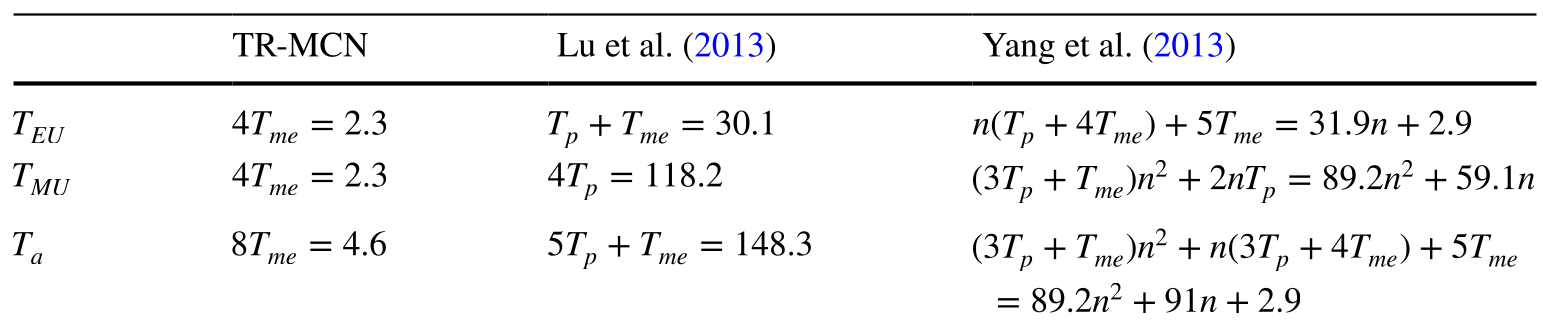 Table 1: Detailed comparison showing TR-MCN (Ta=4.6ms) vs Lu et al. (Ta=148.3ms).
Critical Insight & Analysis
The "magic" of TR-MCN comes from its acceptance of a negligible Error Rate (ERB) in Bloom filters. By allowing a mathematically controlled probability of false positives (e.g., 10^-3), it buys back massive amounts of CPU cycles. In the context of MCN, this trade-off is brilliant: the cost of a rare false matching is far lower than the cost of a system that is too slow to use.
Limitations
While the protocol is fast, the paper assumes a "secure channel" for the initial distribution of root keys, which can be a logistical hurdle in decentralized environments. Additionally, the Bloom filter's inability to easily delete elements means the system would need periodic "epoch resets" to handle user churn.
Conclusion
TR-MCN proves that we don't need "heavy math" to achieve "heavy security." By shifting the focus to lightweight primitives and pseudonyms, the authors have provided a viable blueprint for the next generation of real-time, privacy-aware mobile services.