
DITEC: Resurrecting Trace Transform for Semantic Image Domain Identification
16918_Trace Transform Based Method for Color Image Domain Identification.
The paper introduces DITEC, a novel color image domain identification method based on the Trace Transform and frequency domain statistical modeling. It achieves state-of-the-art performance in context categorization on the Corel 1000 and Geoeye datasets using short, highly discriminant feature vectors.
TL;DR
Semantic context categorization is the "North Star" for intelligent image retrieval, but local feature extractors often require knowing the context before they can be effectively tuned. This paper presents DITEC, a method that utilizes the Trace Transform combined with Frequency Analysis (DCT) and Leptokurtic distribution modeling to create a global descriptor. It avoids the "chicken-and-egg" problem of prior knowledge and achieves 94%+ accuracy on satellite imagery.
The "Chicken-and-Egg" of Semantic Context
In Content-Based Image Retrieval (CBIR), we often use local features like SIFT or SURF. However, these methods are sensitive to their input parameters, which usually need to be optimized based on the domain (e.g., urban vs. natural). If we don't know the domain, we can't optimize the features; if we can't extract good features, we can't identify the domain.
Current global descriptors like GIST or the standard Trace Transform Triple Feature attempt to solve this, but they often discard too much semantic information during the dimensionality reduction phase.
Methodology: The DITEC Framework
The DITEC method breaks down the problem into four distinct stages: Sensor Modeling, Data Transformation, Feature Extraction, and Class Assignment.
1. Robust Transformation via Trace Transform
The Trace Transform is a generalization of the Radon Transform. It calculates functionals along all possible lines crossing an image. While the Radon transform simply integrates values, the Trace Transform can use complex functionals to capture specific geometric properties.
The authors identify a critical issue in discrete implementations: Sampling Effects. High-resolution sampling doesn't always lead to better representation; it can create a "convex contribution map" where certain pixels are over-represented. DITEC optimizes these geometric parameters to ensure homogeneity.
2. Frequency-Domain Statistical Modeling
This is the core "How" of the paper. Instead of using Diametric or Circus operators (which are non-invertible and lose data), the authors apply the Discrete Cosine Transform (DCT) to the Trace Transform sinograms.
Their key insight is the Leptokurtic nature of the DCT coefficients. By analyzing over 50,000 vectors, they found the distributions have extremely high Kurtosis (). Therefore, each frequency band can be accurately represented by just two values: Mean and Kurtosis. This reduces dimensionality by a factor of 25 without sacrificing the discriminative power needed for semantic classification.
Experimental Results & SOTA Comparison
The authors validated DITEC against two vastly different datasets to prove its "domain-agnostic" robustness.
Corel 1000: Competitive Edge
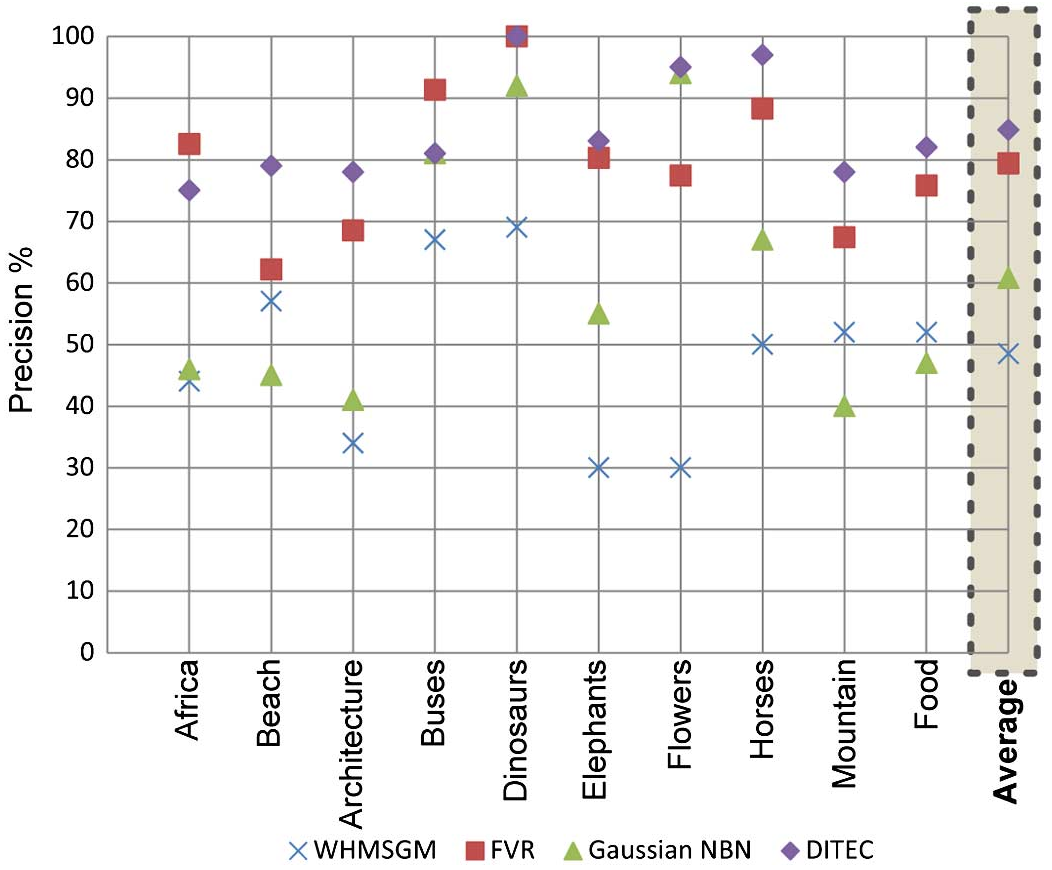
Against established benchmarks like Weighted Color Histograms (WHMSGM) and SIFT-based Naïve Bayesian Networks, DITEC showed superior precision across a majority of categories, particularly in complex classes like "Africa" and "Buses."
Geoeye Satellite Imagery: High-Stakes Accuracy
In satellite imagery, where textures and patterns are subtle, DITEC achieved an impressive 94.51% average precision. The method successfully distinguished between topographically similar cities like Athens and Rome by capturing the underlying geometric "signatures" through the Trace Transform.
| Dataset | Best Classifier | Accuracy | Final Attributes |
|---|---|---|---|
| Corel 1000 | SVM | ~85% | 117 |
| Geoeye | Bayesian Network | 94.51% | 61 |
Critical Insight & Conclusion
DITEC proves that the Trace Transform—often relegated to simple image fingerprinting—is actually a powerful tool for semantic inference when the dimensionality reduction is handled via frequency-domain statistics rather than simple geometric averaging.
Takeaway: For modern computer vision, DITEC offers a blueprint for "Semantic Middleware." It suggests that we can use global geometric transforms to identify the category of a scene first (with zero prior knowledge), then use that category to trigger specific, optimized local feature extractors for object detection.
Limitations: While the method is robust, the selection of the initial functionals remains a manual design choice. Future work might involve using Evolutionary Algorithms or Reinforcement Learning to automatically "search" for the optimal Trace functionals for a given broad domain.