
Traceable Word-of-Mouth: Unmasking the Temporal Dynamics of Influence
How Did You Get to Know That? A Traceable Word-of-Mouth Algorithm
The paper introduces a "Traceable Word-of-Mouth" (T-WoM) algorithm that models influence spreading in social networks by incorporating temporal order and causal tracking. Unlike static models, it records the exact paths and origins of influence using real-world Call Detail Records (CDRs) to identify "Alpha" users and diffusion patterns.
TL;DR
Information doesn't just spread; it travels through time and specific sequence. This paper introduces a Traceable Word-of-Mouth (WoM) algorithm that moves beyond static network analysis. By recording the "path" of influence through time-ordered interactions, the authors prove that static metrics like "how many friends you have" (degree) are insufficient to explain how influence truly flows.
The "Static" Blind Spot
Most information diffusion models operate on a flawed assumption: they treat the network as a frozen snapshot. In reality, can only influence if was "infected" before talking to . Traditional algorithms often ignore this causality, leading to inaccurate predictions in viral marketing, epidemic tracking, and customer churn analysis. Furthermore, they rarely answer the question: "Which specific interaction was responsible for this node's activation?"
Methodology: Bringing Time to the Table
The authors redefine influence as a traceable commodity. Instead of a single "energy" value, each node () carries a list of influence tuples:
The Core Insight
Unlike physical energy, influence is not a zero-sum game. When you share a secret or an opinion, you don't lose that information. The algorithm reflects this by allowing source nodes to retain their influence level while transmitting a "load" to the receiver based on the interaction duration.
 The algorithm utilizes transfer functions—like the Gompertz function—to map interaction length to influence load, ensuring that only meaningful interactions (e.g., long phone calls) drive significant spread.
Experiments: Real-World Call Data
The researchers validated their model using a massive dataset of Call Detail Records (CDRs) from 250,000 users over six months. They tested two scenarios:
- Exp1: Random 1% activation with a linear transfer function.
- Exp2: 5% activation via Random Walk with a Gompertz function.
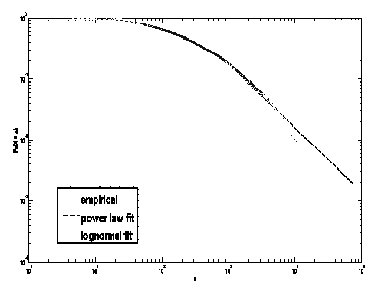 Figure 2: The underlying social network follows a Power Law for degree distribution, but the actual "influence" behavior is far more complex.
Key Findings: The Invariants of Influence
The most striking discovery is the presence of statistical invariants. Regardless of which month of data was used or how many calls were processed, certain patterns emerged:
- GPSI (Global Primary Sources of Influence): Always follows a Lognormal distribution. This suggests that in any network, a very small "elite" group of nodes is responsible for the vast majority of original influence.
- Length Paths (LP): Follows a Power Law. Most influence travels through very short chains (1-2 hops), though paths can reach up to 20 hops.
Why Static Metrics Fail
The study performed a Multiple Linear Regression (MLR) to see if degree, frequency, or duration could predict influence.
- Finding: Duration was the strongest predictor, but it still only explained about 30-60% of the variance.
- Conclusion: The "context"—the specific order of who called whom and when—holds the other 40-70% of the secret.
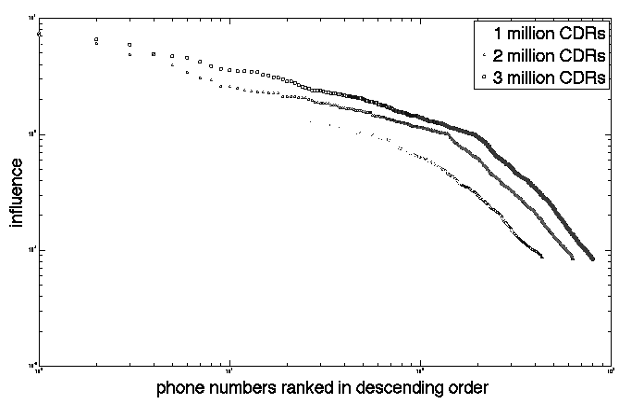 Figures 3 & 4 show the log-log rank plots of influence sources. The curves remain statistically stable over time, even as total energy increases.
Critical Insight & Future Outlook
This work shifts the focus from "Alpha Users" (static social leaders) to "Dynamic Catalysts". By being able to trace influence back to its primary source (PSI) or through its intermediaries (ISI), businesses can identify not just who has many followers, but who actually triggers the chain reaction of a purchase or a cancellation.
Limitations: The study assumes phone calls are a proxy for influence, which is a strong assumption. Future work should integrate actual content analysis (NLP) to verify if the "influence" transmitted was positive or negative.
Final Takeaway: To master viral spread, stop looking at the map (topology) and start looking at the clock (temporality).