
Denoising the Future of Neuroimaging: A Deep Learning Approach to Dynamic PET
Use of a Tracer-Specific Deep Artificial Neural Net to Denoise Dynamic PET Images
This paper introduces a tracer-specific Deep Denoising Autoencoder (DAE) designed to denoise dynamic PET images and improve voxel-level kinetic modeling. By training on simulated [11C]raclopride spatiotemporal patches, the method achieves SOTA performance in reducing image non-uniformity and noise variance compared to classical filters like HYPR and STEM.
Executive Summary
TL;DR: Researchers have developed a Deep Denoising Autoencoder (DAE) that significantly cleans up the "noise-heavy" world of dynamic PET imaging. By focusing on the temporal behavior of specific radioactive tracers, this model produces parametric images with roughly 40% less variability than previous gold-standard methods, enabling much more precise measurements of brain function.
Background: Within the academic landscape of medical imaging, this work marks a transition from general-purpose spatial filters to tracer-specific latent representations. It moves away from the "one-size-fits-all" Gaussian smoothing toward a learned, manifold-aware denoising process.
The Problem: The Voxel-Level Noise Paradox
Dynamic PET is a 4D imaging modality (3D volume + Time) essential for quantifying neurotransmitter binding in diseases like Parkinson’s. However, the data is notoriously noisy. To calculate the Binding Potential (BPND) at a voxel level, scientists often have to "smooth" the data.
The paradox? Excessive smoothing destroys the very spatial resolution required to see tiny brain structures. Prior work like HYPR and STEM tried to balance this by using temporal constraints, but they often failed to capture the non-linear "fingerprint" of specific tracers, leading to significant measurement bias.
Methodology: The Spatiotemporal Patch Insight
Instead of feeding the entire brain image into a massive network—which often leads to the model "overfitting" to specific skull shapes—the authors used a Spatiotemporal Patch approach.
1. Architecture Choice
The DAE utilizes 5 hidden layers. It takes a spatial window across all 16 time frames, vectorizing them into a single input. This allows the network to "see" how a voxel and its immediate neighbors evolve over time.
2. Physical Intuition
The network learns the underlying manifold of Time-Activity Curves (TACs). Because PET noise is random (Poisson) but the tracer signal follows strict physiological laws (Kinetic Models), the Autoencoder acts as a bottleneck that lets the "physics" pass through while filtering out the "stochastic noise."
 Figure: The sliding window processes patches through a deep bottleneck to reconstruct noise-free TACs.
Experiments: Breaking the SOTA
The DAE was compared against standard Gaussian filters, STEM, and HYPR.
- Voxel Variation: The DAE achieved a Coefficient of Variation (COV) of 0.10, whereas the best conventional method (HYPR2G) sat at 0.18.
- Quantification Accuracy: In the striatum (a key brain region), the DAE's Image Non-Uniformity was only 3.52%, nearly half that of traditional temporal smoothing.
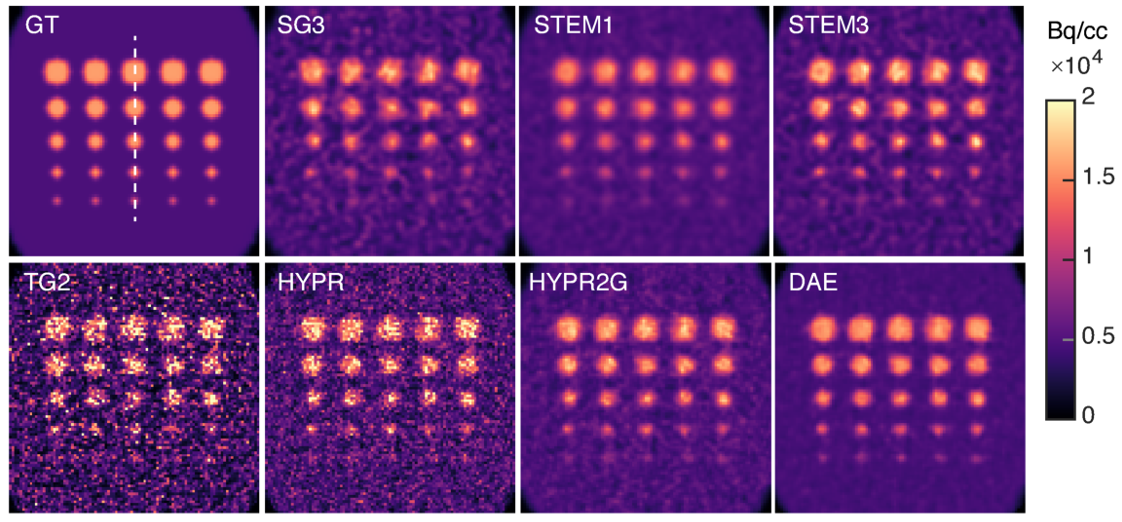 Figure: Comparative BPND maps show that DAE (bottom right) provides the cleanest, most anatomically consistent results with the least background "speckle" noise.
Critical Analysis: The "Generalization" Trap
While the DAE is a powerhouse, it has a "Tracer-Specific" catch. During the study, when the authors tested the model on data with BPND values outside the training range (e.g., BPND > 6), the model struggled.
The Takeaway: This isn't a "universal" denoiser. It is a highly specialized tool. For clinics, this means you need a specific "model weight" for each tracer (e.g., one for [11C]raclopride, one for [18F]FDG).
Conclusion
This study proves that Deep Learning can extract meaningful physiological signals from PET data that were previously considered "too noisy" for voxel-level analysis. As we move toward precision medicine, the ability to detect subtle 5% changes in brain binding with only 39 voxels—rather than 1,000—could be the difference between early diagnosis and missed opportunities.
Future Outlook: The next step is "Self-Supervised" learning (like Noise2Noise), which could remove the need for the complex simulations used as training data here.