
Tracery: Liberating Generative Text through Author-Focused Grammars
Tracery: An Author-Focused Generative Text Tool.
Tracery is an author-focused, grammar-based generative text tool designed to bridge the gap between complex academic narrative engines and the creative needs of novice bot-makers and indie developers. It utilizes a JSON-based recursive expansion system to transform simple plaintext rules into sophisticated, structured prose across platforms like Twitter, Twine, and standalone games.
TL;DR
Tracery is a groundbreaking generative text library that departs from the "knowledge-heavy" traditions of academic AI to offer a lightweight, JSON-based grammar system. By focusing on modularity and ease of use, it has become the de facto standard for bot-makers, indie game developers, and interactive fiction authors who want to blend algorithmic complexity with a distinct human voice.
Background Positioning
In the landscape of procedural content generation (PCG), Tracery represents a "rehabilitation" of formal grammars. While academic research moved toward complex planning and simulation (like MEXICA or GRIOT), Tracery occupies the sweet spot of accessible expressivity, empowering creators who may not identify as "programmers" to build rich, combinatorial worlds.
The Core Problem: The Authorial Tax
Historically, if you wanted to generate a story, you had to build a world. Prior works required authors to define deep ontologies—exhaustive lists of what a "hero" is and what "logic" they must follow. This "knowledge modeling" acted as a barrier to entry, turning authors into data entry clerks.
The authors of Tracery identified that for many creators (especially in the Twitterbot and Twine scenes), the joy of generative text lies in the unexpected juxtaposition of language, not the rigid maintenance of narrative causality.
Methodology: Simplicity as a Feature
Tracery’s architecture is built on the concept of a formal grammar, represented as a simple mapping of symbols to rewrite rules.
1. The Recursive expansion
Using a simple hashtag syntax (#mood#), Tracery recursively expands strings. An author can start with a plain sentence and "generativize" it piece by piece—a workflow the authors call additive authoring.
2. State Management via Stacks
To solve the problem of consistency (e.g., ensuring a character's name doesn't change halfway through a story), Tracery uses a push-pop stack. Rules can write to the grammar itself, "saving" a generated name to be reused later in the expansion tree.
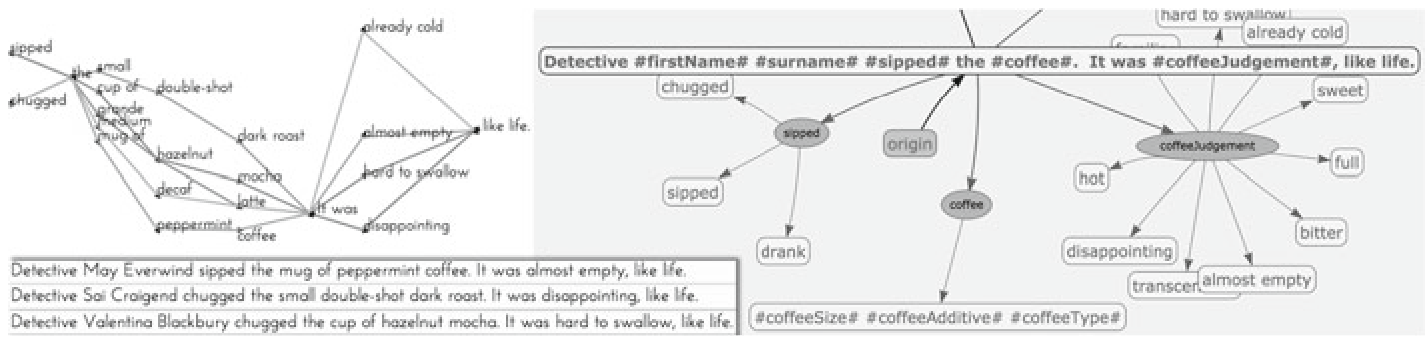 Figure 1: Tracery's visualization tools help authors understand the connectivity and reuse of symbols within complex, deeply nested grammars.
Experiments & Real-World Impact
The true evaluation of Tracery isn't a benchmark score, but its ecosystem.
- Commercial/Indie Integration: The game Interruption Junction uses Tracery to generate endless, absurd dialogue, proving the engine can handle real-time game performance.
- Modular Success: Because the authors released Tracery as a portable library, the community created "Cheap Bots Done Quick!", a platform that has hosted hundreds of bots, democratizing the creation of generative art.
- Hybrid Systems: The authors successfully integrated Tracery with MEXICA, using the latter's plot logic as a "skeleton" and Tracery as the "flesh" to provide expressive, varied descriptions.
Critical Insight: Why it Works
The genius of Tracery is its Inductive Bias toward language. Most generative systems treat text as a secondary output of logic; Tracery treats the structure of language as the logic itself. By providing built-in modifiers for common linguistic hassles (like .a, .pluralize, and .capitalize), it handles the "janitorial work" of text generation, letting the author focus on the poetry.
Conclusion & Future Outlook
Tracery has survived the test of time because it values the Author's Voice over the System's Logic. As we move into an era dominated by Large Language Models (LLMs), tools like Tracery remain vital for providing "scaffolding"—allowing creators to apply structured, deterministic constraints to the otherwise unpredictable outputs of neural networks.
Limitations
- Lack of Global Logic: Without external "plumbing," Tracery can easily generate contradictory statements (the "absurdity aesthetic").
- Manual Labor: While easier than ontology modeling, complex grammars still require significant manual rule-writing.
As the field moves toward automatic code generation, the authors suggest Tracery may soon be used to generate valid JavaScript or SVG code, expanding the horizon from generative text to generative software.