
EPDSN: Decoding the Lifecycle of Digital Communities in Social Networks
Tracing temporal communities and event prediction in dynamic social networks
The paper introduces EPDSN (Event Predicting in Dynamic Social Network), a novel framework for tracing and predicting temporal community transitions in Online Social Networks (OSNs). By utilizing a single previous snapshot and seven topological features, it achieves high-accuracy prediction across five distinct event types: Survive, Spread, Split, Decompose, and Die.
TL;DR
Predicting how online communities evolve—whether they will split, grow, or disappear—is critical for understanding social dynamics. The EPDSN method simplifies this by using non-overlapping weekly snapshots and basic structural features. It proves that you don't need years of history to predict the "near future" of a social group; often, the last seven days are enough to reach over 85% accuracy.
The Challenge: The Chaos of Dynamic Networks
Online Social Networks (OSNs) are never static. Users join, leave, and form clusters that fluctuate in density. Previous research faced three major hurdles:
- Complexity: Relying on "chains" of snapshots (long historical records) makes models slow and data-heavy.
- Snapshot Overlap: Using overlapping windows often creates an artificial "smoothness" that doesn't reflect the abrupt changes in real human interaction.
- Ambiguous Events: Standard definitions like "Merge" often fail to distinguish between two groups truly becoming one versus one group simply absorbing a few new members (Growth).
Methodology: The EPDSN Approach
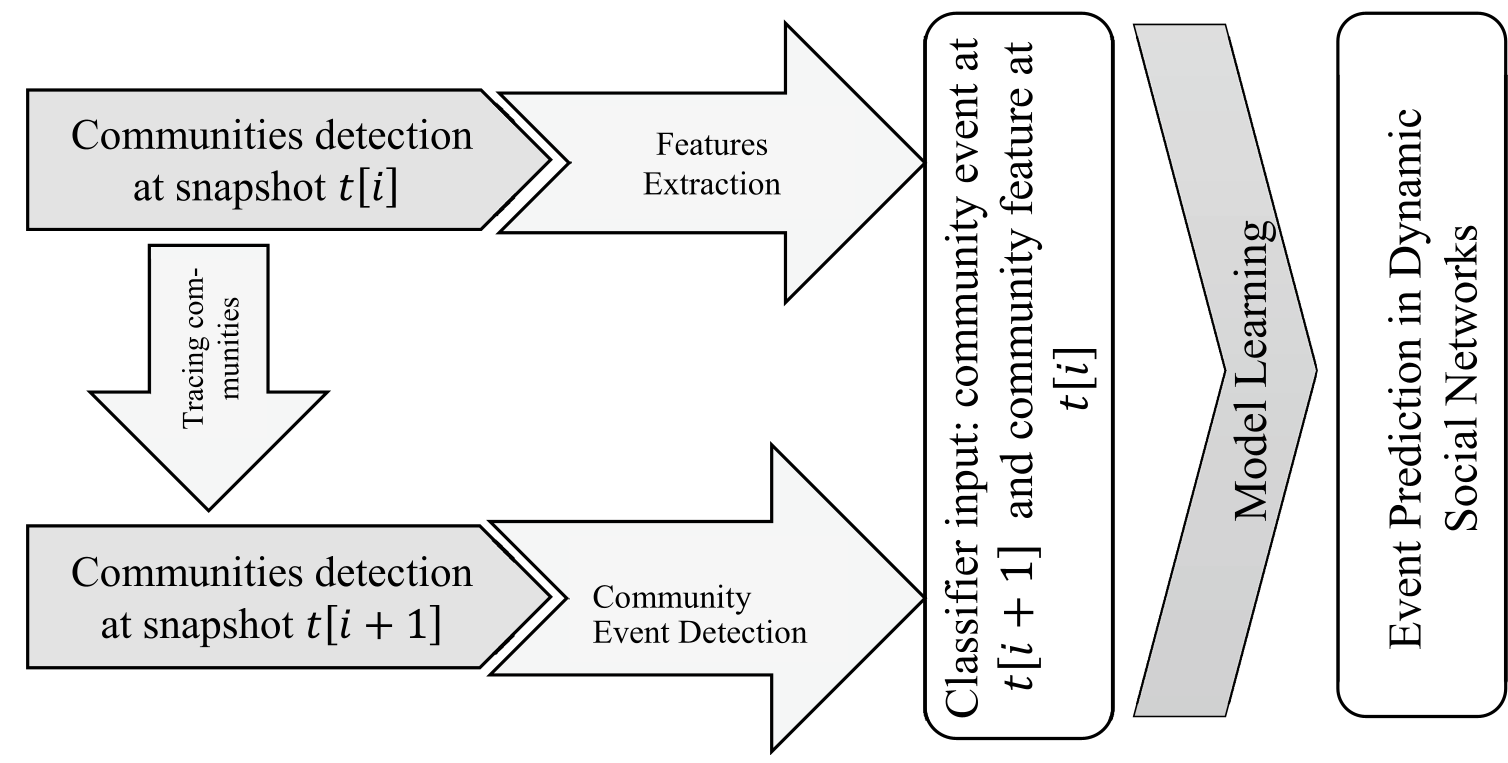
The authors propose a streamlined pipeline that focuses on Generality and Reality. By setting a fixed 7-day window for all datasets (Facebook, Wikipedia, CollegeMsg), they ensure the model isn't overfitted to a specific platform's rhythm.
1. Defining the "Event"
The core of the method lies in the P value calculation, which measures node overlap between a community at time and at .
- Survive/Spread: Defined by high overlap but differentiated by Variance. If a community has high overlap with many groups (low variance), it's "Spreading."
- Split: When a community effectively divides into two distinct new entities.
- Decompose/Die: Tracking the gradual or sudden disappearance of members.
2. Feature Engineering
Instead of complex embeddings, the model uses seven "tried and true" topological metrics:
- Closeness Centrality (CC/ACC): Speed of information spread.
- Betweenness Centrality (BC): Control over communication paths.
- Eigenvector Centrality (EC/AEC): Connection to other influential nodes.
- Leader Nodes: The number of "anchors" holding the community together.
Experimental Insights
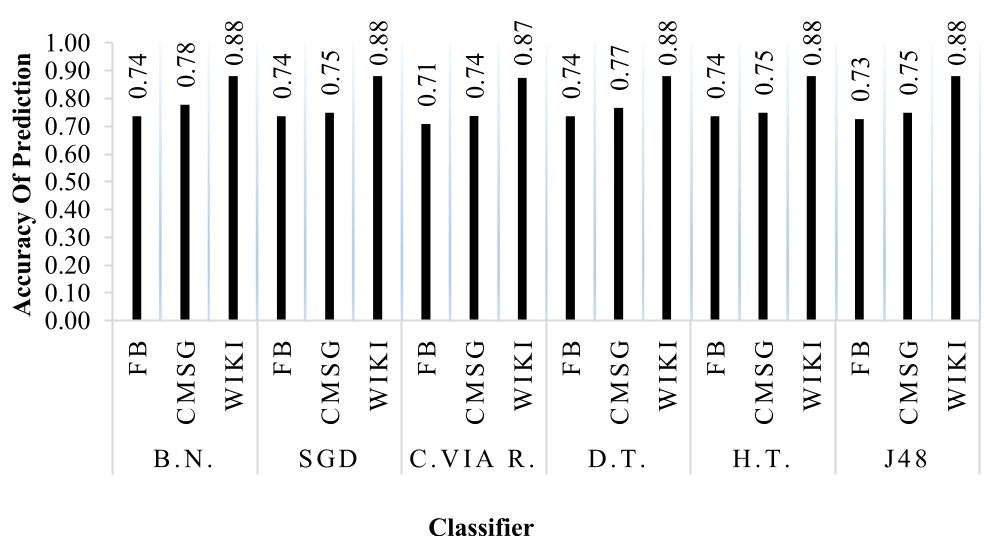
The method was tested across three vastly different interaction types: wall posts (Facebook), talk-page edits (Wiki), and private messages (CollegeMsg).
Key Performance Metrics:
- Die Events: Predicted with nearly 100% accuracy on Wikipedia data, suggesting that the "death" of a community is strongly signaled by its structural decay in the preceding week.
- Spread Events: Saw high success (92%) on Facebook, indicating that "popular" growth is highly predictable.
- The Facebook Exception: The "Decompose" event was harder to predict on Facebook (59% accuracy). The authors attribute this to "external factors"—real-world events or trending topics that drive temporary, erratic interactions.
Critical Analysis: Why This Matters
The most striking takeaway is Property 3: Using the same length of snapshots for different datasets. In most network science papers, researchers "tune" the window length to make their results look better. EPDSN takes a stance on generality, proving that a 7-day cadence is a "natural frequency" for human social behavior across different mediums.
Limitations: The model relies on non-overlapping community detection (specifically the Louvain method). In reality, users often belong to multiple communities simultaneously. Extending EPDSN to "Overlapping Community Discovery" (OCD) would be the next logical step to capture the true complexity of social life.
Conclusion
EPDSN offers a lightweight, highly accurate framework for temporal tracing. By focusing on the structural "vibe" of a community in the present, we can accurately forecast its fate in the immediate future, providing valuable insights for platform moderators, marketers, and sociologists alike.