
Tracking Communities in Dynamic Social Networks: Stability through Adaptive Evolution
Tracking Communities in Dynamic Social Networks
This paper introduces an adaptive evolutionary clustering framework for tracking communities in dynamic social networks. By utilizing a smoothed adjacency matrix with an optimally estimated forgetting factor, the method enables stable and accurate observation of community evolution over time.
TL;DR
Social networks are rarely static, yet most algorithms treat them as such. This paper presents an Adaptive Evolutionary Clustering framework that tracks how communities grow, merge, or split. By mathematically optimizing the balance between historical data and new observations (the "forgetting factor"), the authors achieve unprecedented stability in community tracking, even in noisy environments like mobile proximity data or spammer networks.
Problem & Motivation: The Noise of the "Now"
Detecting communities—groups of nodes with dense internal connections—is a solved problem for static snapshots. However, when we look at networks over time (e.g., weekly snapshots), two problems arise:
- Instability: Applying static clustering to each snapshot independently results in "jitter." Small changes in data cause the algorithm to output vastly different group memberships, making it impossible to track a single community's identity.
- Hard-coded Smoothing: Previous "evolutionary" methods used fixed weights to smooth data. Too much history makes the model lag; too little makes it hyper-sensitive to noise.
The authors' insight is that the forgetting factor (how much we ignore the past) should not be a constant. It should be a dynamic variable that adapts based on how much the network's underlying structure has actually changed.
Methodology: Adaptive Temporal Smoothing
The core of the approach is the creation of a smoothed adjacency matrix :
Here, is the forgetting factor.
The Math of Intuition
The authors derive an optimal by minimizing the Mean-Squared Error (MSE) between the estimated and the "true" expected adjacency matrix.
- If the current data is noisy but the underlying structure is stable, increases to rely more on history.
- If a major event occurs (e.g., a school semester starts), decreases, allowing the model to quickly "forget" the old structure and adapt to the new reality.
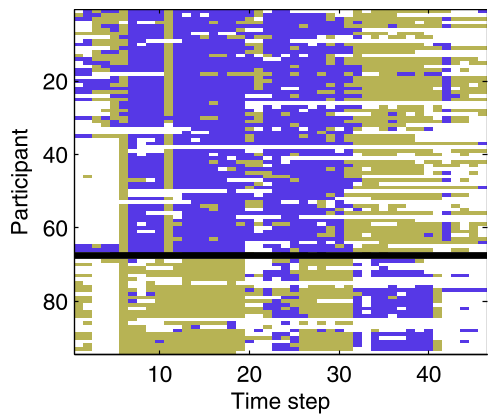 Fig 1: Heat maps comparing the proposed method (left) with high stability vs. ordinary detection (right) showing chaotic transitions.
Handling Node Dynamics
Unlike many graph algorithms that require a fixed set of nodes, this framework handles "birth" and "death" of nodes.
- Leaving nodes: Removed from the historical matrix.
- Entering nodes: Added after the smoothing step, ensuring they don't skew the forgetting factor calculation but still contribute to the current community structure.
Experiments & Results
1. Reality Mining (MIT)
The authors utilized Bluetooth proximity data from MIT students and staff. Because they had the academic calendar as ground truth, they could verify if the algorithm detected changes.
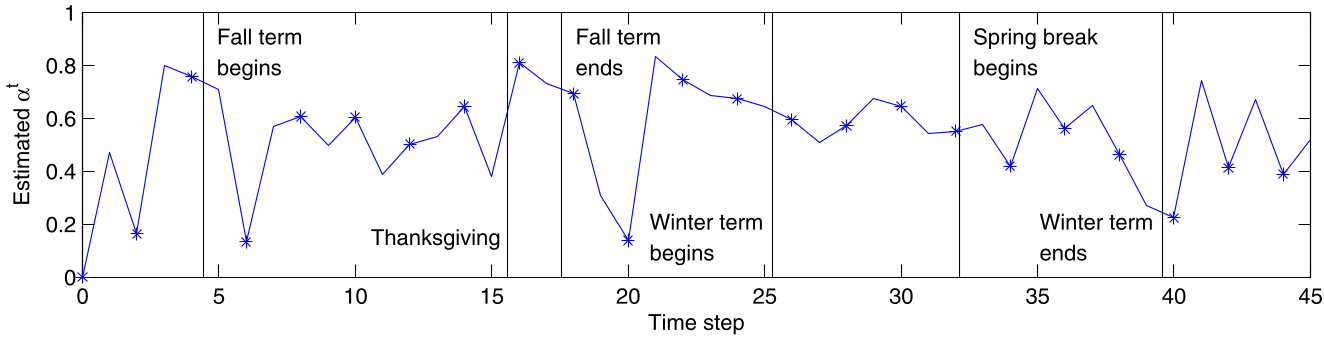 Fig 2: The forgetting factor drops significantly during winter break and semester starts, acting as an automated "change point" detector.
2. Project Honey Pot (The Spammer "Staircase")
Tracking spammers is difficult because they often change IDs. The authors discovered a "staircase" pattern: communities where members are continuously replaced, yet the functional community persists. This suggests the algorithm can track underlying entities even when they assume multiple digital identities.
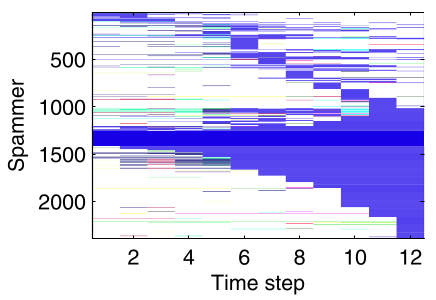 Fig 3: Visualizing the "staircase" community (right) where members change but the collective behavior remains trackable.
Critical Analysis & Conclusion
The Takeaway: This work bridges the gap between signal processing (filtering noise) and social science (tracking groups). Its strongest contribution is the statistical derivation of , which removes the "guesswork" from dynamic graph analysis.
Limitations:
- Complexity: While the smoothing is efficient, the spectral clustering step at every time step is still computationally expensive for billion-node graphs.
- Hyperparameter : The number of communities still relies on heuristics like the "eigengap," which can be unstable in dynamic settings.
Future Outlook: The interplay between the forgetting factor and the number of communities is a fascinating frontier. Could we allow to also be an adaptive variable driven by the same MSE-minimization framework? This paper provides the foundation for truly autonomous, real-time social network monitoring systems.