
Tracking and Predicting Community Evolution: The Power of the Weakest Link
Tracking and Predicting Evolution of Social Communities
This paper introduces an axiomatic framework and a polynomial-time dynamic programming algorithm for tracking community evolution in dynamic social networks. By defining evolution strength through three core axioms—Identity, Monotonicity, and Extension—the authors demonstrate that a chain's validity is determined by its "weakest link," enabling efficient identification of maximal evolutionary sequences across large-scale datasets like DBLP and IMDB.
TL;DR
How long will an online community last? This paper provides a rigorous mathematical foundation to answer that question. By proving that a community's evolutionary "strength" is only as strong as its weakest transition (the Weakest Link principle), the authors developed a fast algorithm to track groups over time. Their findings are striking: the most resilient communities aren't the biggest ones, but the smallest, densest, and most stable "inner cores."
The Evolution Problem: Why Is It Hard?
In a dynamic social network, users join, leave, and form new bonds every day. Tracking a community as it morphs through time is like trying to follow a cloud in a storm.
Existing methods often struggled with:
- Computational Explosion: Verifying every possible sequence of communities over time leads to an exponential search space.
- Definitional Ambiguity: What constitutes a "valid" change? Is it still the same group if 50% of the members leave?
The authors circumvented these issues by stepping back and asking: What fundamental axioms must any evolution measure satisfy?
Methodology: The Axiomatic Foundation
The researchers proposed three intuitive axioms for an "Evolution Oracle" ():
- Identity: Repeating the exact same community results in perfect evolution strength ().
- Monotonicity: A chain cannot be stronger than its parts.
- Extension: If two valid evolution chains overlap, their combination is also a valid evolution.
The mathematical breakthrough here is Theorem 1: if these axioms hold, the strength of an entire chain is simply the minimum strength of its links. This simplifies a complex global problem into a series of local, pairwise comparisons.
 The figure above illustrates the multipartite graph structure used to find maximal chains. By connecting communities in consecutive time steps based on an overlap threshold (), the "weakest link" theorem allows for efficient pathfinding.
Predicting the Future: What Makes a Community Last?
After tracking thousands of evolutions in DBLP (academic co-authors) and IMDB (actors), the authors looked at the first four steps of a community’s life to predict its ultimate lifespan. They defined several structural features:
- Density: The ratio of internal interactions vs. external ones.
- Cores: The persistent intersection of members across three or more time steps.
- Size: Total number of members.
Key Experimental Results
The study utilized a linear regression framework with Leave-One-Out Cross-Validation (LOO-CV). The results revealed a clear "survival of the tightest" pattern:
| Feature | Significance | Average Weight |
|---|---|---|
| Density | 74% | +0.22 |
| Intersection | 57% | +0.29 |
| Size | 48% | -0.22 |
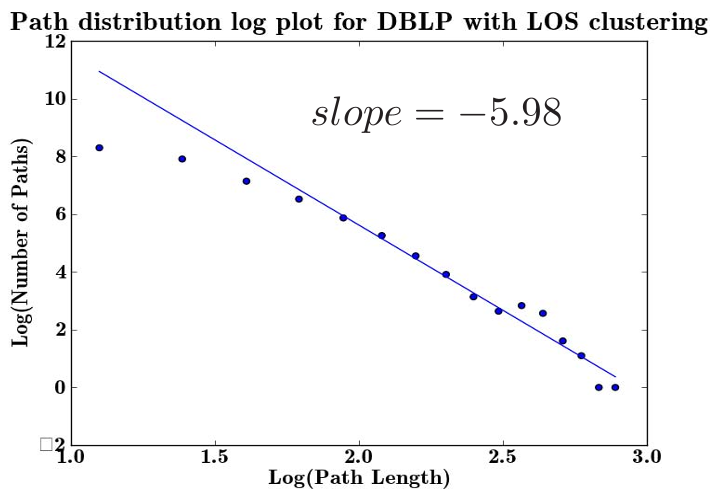 The lifespan of communities follows a classic power-law decay, meaning most communities are short-lived, while a rare few persist for a very long time.
Academic Insight: Why Small and Dense Wins
The most profound takeaway is the negative correlation between Size and Lifespan. While intuition might suggest that larger groups are more stable, the data shows that massive communities often suffer from "dilution."
Conversely, high Density and Core Size are the strongest predictors of longevity. A small, highly interactive group with a stable "hyper-core" of members who stay together across multiple time steps is far more likely to survive the churn of the network.
Critical Analysis & Conclusion
This work stands out because it doesn't just present a "black box" predictor; it establishes a theoretical framework that justifies the use of dynamic programming for temporal tracking.
Limitations: The current approach relies on a pre-defined threshold. If is too high, it breaks long-term evolutions too early; if too low, it creates false positives. Furthermore, the model primarily tracks "chains" rather than complex "mergers and splits," which are common in real-world social dynamics.
Future Outlook: In the age of AI-driven social platforms, this "Weakest Link" theory could be used to identify fragmenting communities before they collapse, allowing platform moderators or community managers to intervene and foster the "internal density" required for long-term survival.