
Tracking Triadic Cardinality: A Structural Shield Against Bot-Driven Bursts
17279_Tracking Triadic Cardinality Distributions for Burst Detection in Social Activity Streams.
The paper introduces a robust burst detection framework for social networks based on Triadic Cardinality Distributions. It identifies that both user-user and user-content activity surges are accompanied by the formation of "interaction" or "influence" triangles, allowing for detection that is resilient to social-bot attacks.
TL;DR
Unusually high activity in social networks—bursts—often signals significant real-world events. However, raw volume is easily gamed by bots. This paper argues that true human bursts are defined by triadic closures (friends of friends interacting). By tracking the "Triadic Cardinality Distribution" through a high-speed "sample-estimate" pipeline, the authors provide a method to detect events like the Hong Kong Occupy Central movement while remaining immune to spam.
The Core Insight: Triangles as Human Fingerprints
Most burst detection algorithms answer the question: "How much activity is happening?" This is prone to false alarms because bots can generate volume effortlessly.
The authors shift the question to: "What is the structure of this activity?"
- Interaction Triangles: In user-user interactions (e.g., emails), humans tend to cluster. If A talks to B and B talks to C, A is likely to talk to C.
- Influence Triangles: In user-content interactions (e.g., hashtags), if user A follows B, and both interact with content C, it suggests a "word-of-mouth" cascade.
Bots typically target users randomly, meaning they fail to form these dense triadic structures. Thus, a shift in the distribution of triangles is a much more robust indicator of a genuine social event than a simple spike in message counts.
Methodology: The Sample-Estimate Pipeline
Handling a live stream like Twitter (thousands of events per second) makes exact triangle counting computationally prohibitive. The paper proposes a two-stage solution:
1. Bernoulli Sampling
Each activity in the stream is sampled with probability . For user-user interactions, a triangle is sampled if all three edges are picked (). For influence triangles, the system samples two user-content interactions and then queries the social graph for the third edge with probability .
2. The EM Estimation Engine
The core challenge is that sampling "thins" the distribution. A node that appears to have 1 triangle in a sampled stream might actually have 10 in the original.
- The Dependence Problem: Triangles are not independent; they often share edges.
- The Solution: The authors use a Beta-binomial distribution to model this dependence, allowing for a more accurate reconstruction of the original triadic cardinality () from the observed sampled count ().
 Figure: The Sample-Estimate workflow, translating raw streams into estimated global distributions.
Experiments & Real-World Validation
The authors validated their model using the Enron Email Dataset and the 2014 Hong Kong Occupy Central Twitter stream.
- Robustness to Spam: When simulating "Random" and "Random-Friend" spam attacks, the Triadic Cardinality Distribution remained remarkably stable, with very low KL divergence compared to the original distribution.
- Efficiency: As shown in the performance charts, the method achieves massive speedups.
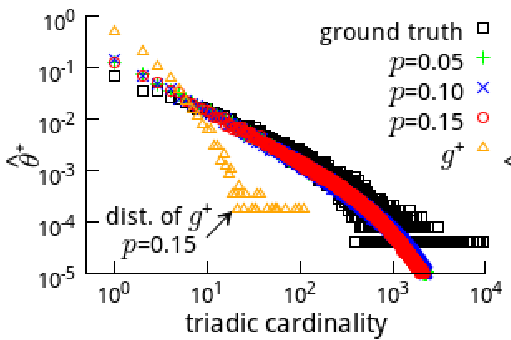 Figure: Comparison of estimation accuracy across different sampling rates (p) for various datasets.
In the Hong Kong case study, the triadic distribution "shifted to the right" exactly when the movement broke out (Sept 28), successfully tracking the peak periods of the social unrest through structural changes rather than just volume.
Critical Analysis & Takeaways
The brilliance of this work lies in its Inductive Bias: it bakes a fundamental truth of sociology (clustering) into a data stream algorithm.
Strengths:
- Anti-Spam by Design: It doesn't try to "filter" bots; it ignores them by focusing on a structure they naturally lack.
- Mathematical Rigor: Using EM to solve the "inverse problem" of sampling in the presence of dependent variables (Beta-Binomial) is a sophisticated choice.
Limitations:
- Graph Access: The "Influence Triangle" detection requires querying the social graph (Who follows whom?). If that graph isn't available or is outdated, the accuracy drops.
- Sophisticated Bots: While it stops "random" bots, a fleet of bots programmed to simulate triads could theoretically bypass this, though at a much higher cost to the attacker.
Final takeaway: For anyone building monitoring tools for OSNs, moving from "Volume Tracking" to "Motif Tracking" using the triadic cardinality distribution is the most effective way to separate signal from noise.