
Crossing the Data Chasm: Detecting Phishing in Small Populations via Transfer Learning
Using Transfer Learning to Detect Phishing in Countries with a Small Population
This paper introduces the Adaptive Phishing Detection Technique (ADPT) and leverages transfer learning to detect phishing tweets in small-population regions like New Zealand. By using a pre-trained model and instance-based transfer from a large-scale US dataset, the authors achieve robust detection performance despite local data scarcity.
TL;DR
Phishing attacks on social media are a global menace, but for smaller nations like New Zealand, the lack of local training data makes building effective AI detectors nearly impossible. This paper presents ADPT (Adaptive Phishing Detection Technique) and a transfer learning framework that "borrows" intelligence from the United States' vast data pool to secure smaller digital borders. By combining Isolation Forests and Instance Transfer, the authors boosted phishing recall by nearly 20%.
Background: The Problem of "Data Poverty"
In the world of cybersecurity, data is the ultimate currency. Large nations like the US generate millions of tweets daily, providing ample ground truth to train robust ML models. Smaller countries, however, face Data Scarcity. If a phisher launches a new campaign in a small region, there might not be enough historical samples for a local model to "learn" the pattern before the damage is done. Furthermore, existing detectors often use "post-event" features (like the number of retweets) which are useless for real-time prevention.
Methodology: ADPT and Intelligent Knowledge Transfer
The authors tackle this with a two-pronged strategy:
1. The ADPT Architecture
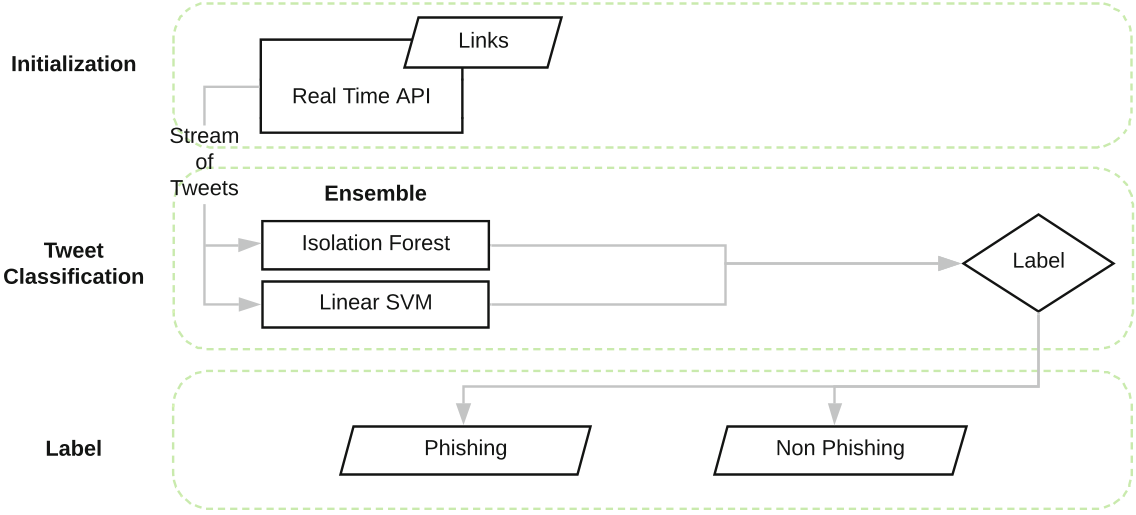
Instead of a single "silver bullet" classifier, the Adaptive Phishing Detection Technique (ADPT) uses a modified stacked generalization.
- Isolation Forest (IF): Detects structural outliers. It looks for anomalies in account age, follower counts, and URL redirection chains.
- Linear SVM (LSVM): Handles the "Bag of Words" (unigrams/bigrams) to spot linguistic patterns common in phishing templates.
- Ensemble Logic: If either IF or LSVM flags a tweet, it is marked as suspicious.
2. Selective Instance Transfer
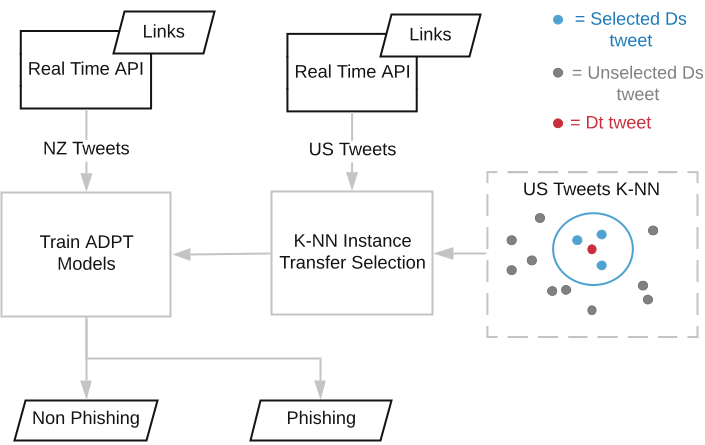
To bridge the gap between the US (Source) and NZ (Target), the authors didn't just dump all US data into the NZ model—that would cause "negative transfer." Instead, they used an ε-bounded k-NN approach. Only US instances that are mathematically similar (within a Euclidean distance threshold) to NZ samples are transferred. This ensures the model learns relevant global patterns without being overwhelmed by region-specific noise.
Experimental Results
The study utilized a real-world dataset of ~1.4 million tweets. The findings were stark:
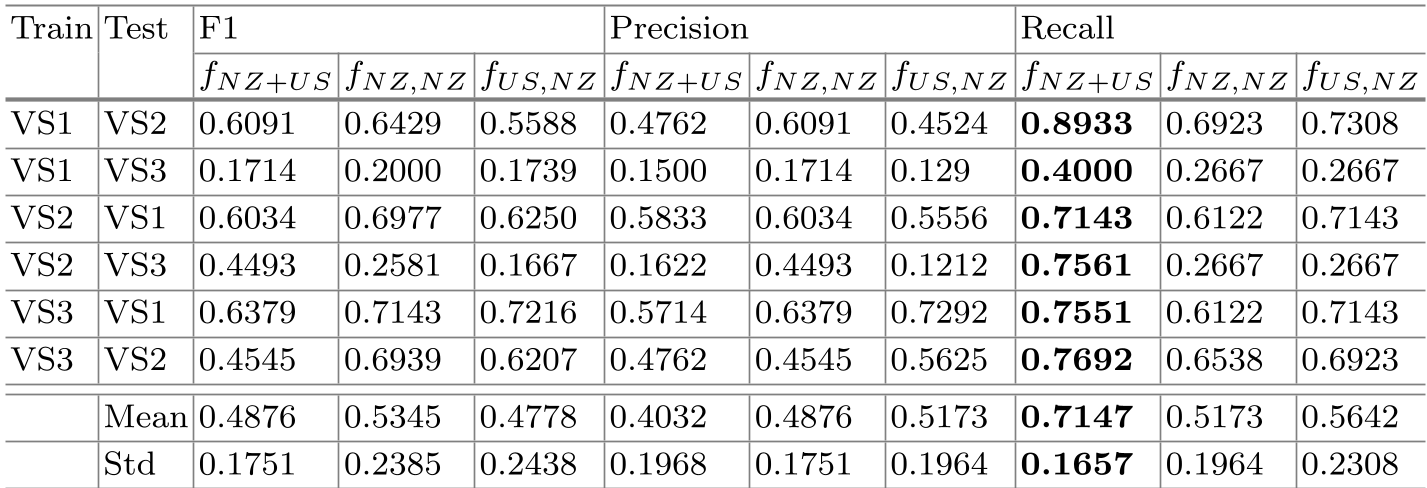
- Baseline (NZ data only): Struggled with high bias and low recall (0.5173).
- Pure Model Transfer (US model on NZ data): Performed better but missed local nuances.
- Inductive Transfer (Combined): Emerged as the winner with the highest Recall (0.7147).
The authors observed that while precision took a slight hit (due to a wider "net" being cast), this is a desirable trade-off for a moderator-assistance tool where missing a threat is more dangerous than a false alarm.
Deep Insight: Why It Works
The paper reveals a fascinating "behavioral DNA" in phishing. By analyzing pairwise attributes (e.g., URL Dot Count vs. Tweet Length), the authors found that phishers tend to use rigid templates. For instance, as a URL's complexity increases, a phisher's tweet length remains consistent due to automated scripts. Genuine users, conversely, exhibit much more varied and "noisy" behavior.
Critical Analysis & Conclusion
This work is a vital step for regional cybersecurity. It proves that we don't need "Big Data" for every single country if we can intelligently transfer knowledge across borders.
Limitations: The reliance on a 14-day "deletion period" as a ground truth for phishing (assuming Twitter's internal systems eventually catch them) is a clever proxy but might include some edge cases of non-malicious deleted tweets.
Future Outlook: Integrating Concept Drift detection into this transfer learning pipeline could allow the model to automatically decide when to pull new data from the source domain as attackers evolve their tactics.