
Beyond AUROC: Navigating the Translational Gaps in Graph-Transformer EHR Models
Translational Gaps in Graph Transformers for Longitudinal EHR Prediction: A Critical Appraisal of GT-BEHRT
This paper provides a critical appraisal of GT-BEHRT, a state-of-the-art hybrid Graph-Transformer model for longitudinal Electronic Health Record (EHR) prediction. While GT-BEHRT achieves SOTA results on heart failure prediction (AUROC 94.37), the review identifies six critical "translational gaps" that hinder its clinical adoption.
TL;DR
The medical AI community has a "discrimination obsession." We celebrate high AUROC scores (discrimination) while ignoring whether a model's predicted 80% risk actually means an 80% chance of disease (calibration). This critical appraisal of GT-BEHRT—a powerful Graph-Transformer hybrid—reveals that while it sets new performance benchmarks for heart failure prediction, it still lacks the evidentiary rigor required for clinical deployment, specifically in fairness, calibration, and decision utility.
Background: The Structural Blind Spot of Transformers
Standard Transformers (like BEHRT or Med-BERT) view Electronic Health Records (EHR) as a flat sequence of tokens. This "bag of codes" approach ignores the rich, relational structure within a single hospital visit—such as the explicit link between a specific diagnosis and the medication prescribed to treat it.
GT-BEHRT was designed to solve this via a dual-layered approach:
- Visit-as-Graph: Each encounter is a graph where medical codes are nodes.
- Hierarchical Factorization: A Graph Transformer encodes the visit structure, and a Temporal Transformer (BERT-style) models the patient's longitudinal journey.
Methodology: The Seven-Dimension Audit
The study doesn't just look at the code; it audits GT-BEHRT against the TRIPOD guidelines and contemporary fairness frameworks. The goal is to determine if "Superior Representation" translates to "Better Medicine."
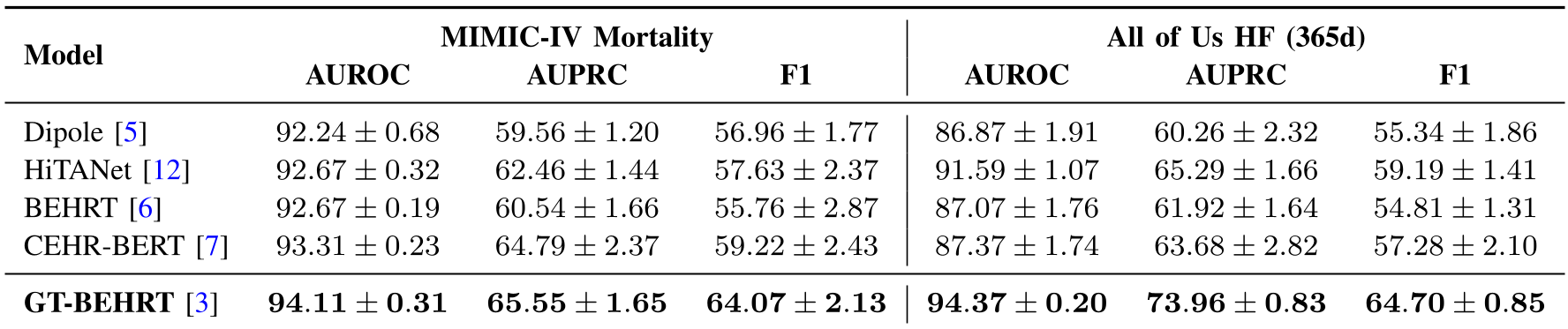 Table 1: GT-BEHRT vs. Baselines on MIMIC-IV and All of Us datasets.
The Core Conflict: Accuracy vs. Actionability
GT-BEHRT's performance is undeniable. With an AUROC of 94.37% on heart failure prediction, it outperforms traditional RNNs (Dipole) and earlier Transformers (BEHRT). However, the appraisal identifies six translational gaps that keep this model in the lab and away from the bedside:
1. The Calibration Void
GT-BEHRT lacks calibration curves. In clinical settings, a model that is "accurate" but uncalibrated is dangerous. If a model overestimates risk, it leads to overtreatment and "alarm fatigue." If it underestimates, it delays life-saving interventions.
2. Incomplete Fairness Auditing
While GT-BEHRT reports performance across subgroups, it misses formal metrics like Equal Opportunity or Equalized Odds. Without these, we cannot know if the model is systematically misdiagnosing underrepresented populations—a critical failure for a model intended for the "All of Us" diverse cohort.
3. Selection Bias & Sparse Histories
The model excludes patients with fewer than two visits. This creates a "goldilocks" cohort but ignores the most vulnerable: those with care fragmentation or sparse data. A model that only works on "well-documented" patients might fail exactly where it is needed most.
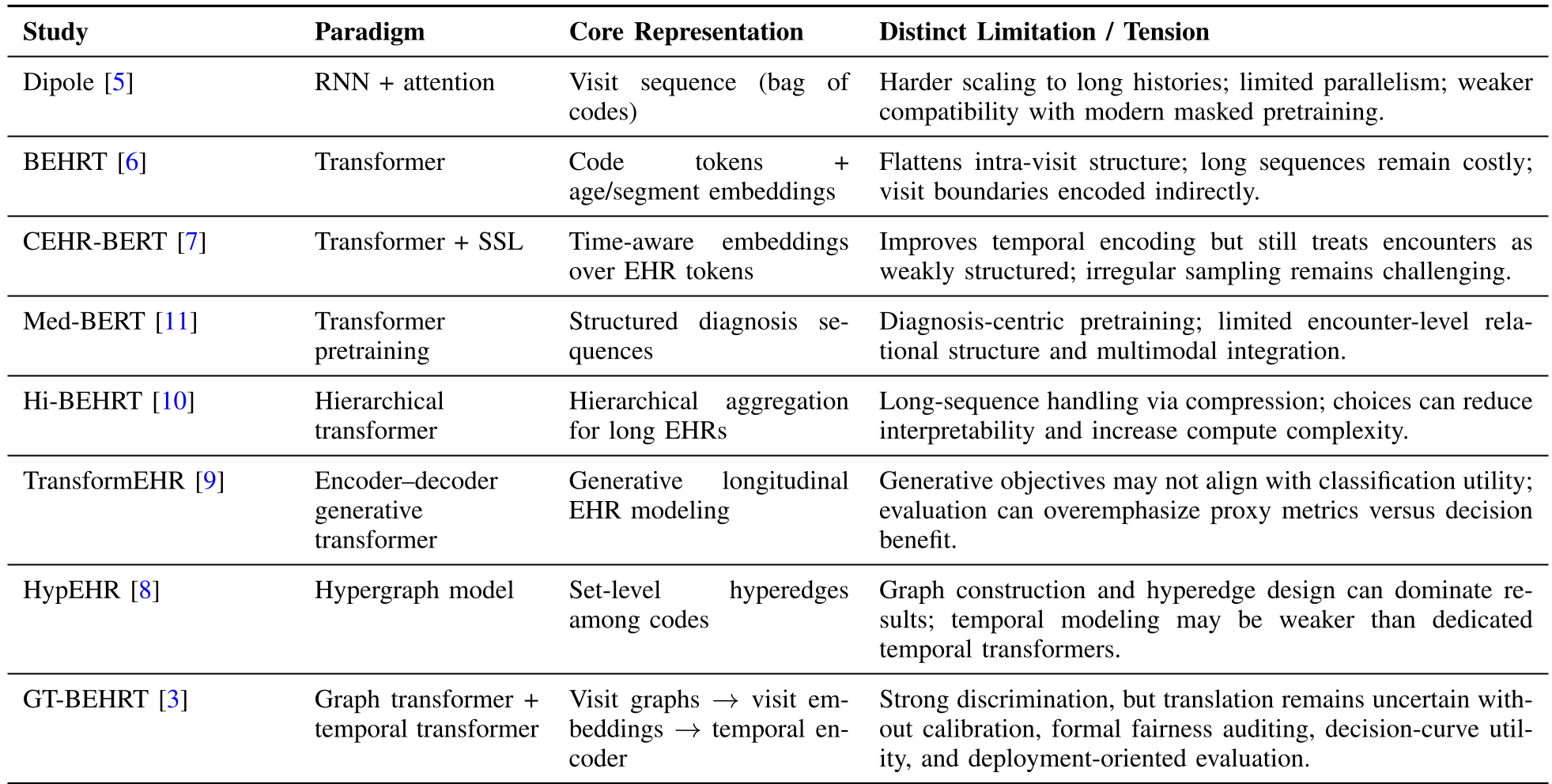 Table 2: Evolution of EHR Modeling Paradigms and their inherent limitations.
Deployment Feasibility: The "Real World" Wall
High-flying papers often ignore the "plumbing." GT-BEHRT requires building graphs for every patient encounter. The appraisal highlights that end-to-end latency—from data retrieval in the hospital SQL database to actual prediction—remains uncharacterized. For a clinical decision support (CDS) system, a 94% AUROC means nothing if the inference takes 10 minutes while the doctor has 30 seconds.
Critical Insight & Future Outlook
The takeaway for the AI research community is clear: Architectural innovation has outpaced evidentiary rigor. We are very good at building complex "Visit-as-Graph" encoders, but we are still lagging in proving they are safe and equitable.
Future Research Priorities:
- Calibration-First Evaluation: Brier scores and ECE should be as standard as AUROC.
- Decision-Curve Analysis (DCA): Quantifying the "Net Benefit" of using the model vs. a "treat-all" or "treat-none" strategy.
- Drift Monitoring: Ensuring that as clinical coding practices change, the Graph Transformer doesn't "hallucinate" risk.
Conclusion
GT-BEHRT is a brilliant architectural step forward. It proves that relational inductive biases (graphs) improve representation. However, until researchers treat Calibration, Fairness, and Utility as "first-class outcomes," these models will remain research prototypes.
Note: The code for GT-BEHRT is publicly available on GitHub, providing a foundation for others to fill these translational gaps.