
Trapping the Predator: A Strategic Shield Against Malicious Crawlers in Social Networks
Trapping Malicious Crawlers in Social Networks
This paper introduces an optimization framework for trapping malicious crawlers in Online Social Networks (OSNs) to protect user privacy. It models crawlers as random walks with finite random lifetimes and proposes a greedy algorithm to strategically place "traps" (e.g., honeypots or access controls) to minimize victimized nodes.
TL;DR
Social networks are under constant siege by malicious crawlers designed to scrape private user data. Unlike previous studies that treat network defense as an epidemic control problem, this research treats crawlers as finite-time random walks. The authors prove that the optimal placement of "traps" is an NP-hard problem but solvable via monotone submodular maximization, offering a greedy algorithm that achieves 63% of the optimal performance with provable scalability.
Background: Why Centrality Isn't Enough
Most OSN administrators rely on "Centrality Measures" (like PageRank or Degree Centrality) to identify important nodes. The intuition is simple: protect the "hubs," and you protect the network.
However, this paper argues that malicious crawling is a localized, trajectory-driven threat. A crawler doesn't care about the global importance of a node; it cares about the neighbors it can reach within its limited "rate-limit" lifetime. Therefore, generic defenses often leave critical "launch pads" unprotected, allowing adversaries to harvest data from specific communities efficiently.
The Core Methodology: Traps as Submodular Functions
The authors define the problem by placing traps in a graph to minimize the expected number of unique nodes visited by crawlers.
1. The Mathematical Insight
The breakthrough here is the proof that the Loss Reduction Function —the difference between victims without traps and victims with traps—is monotone and submodular.
In plain English, "Submodularity" is the law of diminishing returns. Adding a trap to a small set of existing traps provides more benefit than adding that same trap to a large set. This property is crucial because it allows us to use a Greedy Algorithm:
- Start with an empty set of traps.
- Iteratively add the node that provides the maximum "marginal gain" in trapping crawlers.
- Stop when the budget is reached.
2. Scaling to Millions of Nodes
Calculating the "Expected Number of Victims" () is computationally expensive on large graphs. The authors introduce a Monte Carlo Estimator with a provable bound. By simulating a finite number of random walks, the algorithm can approximate the best trap locations without needing to solve the exact hitting-time equations for the entire graph.
 Figure 1: The Greedy Search Process for optimal trap placement.
Experiments: Real-World Performance
The authors tested their approach on datasets like Facebook (22k nodes) and EmailEnron (33k nodes).
Key Findings:
- Superiority over PageRank: In almost every scenario, the Greedy Algorithm resulted in significantly fewer victims than PageRank or Betweenness Centrality.
- Source-Awareness Matters: One of the biggest advantages is that this method is "Source-Aware." If you know where crawlers are likely to start (the "launch set" ), the traps are strategically placed to "encircle" that area.
- Robustness: Even when the crawler's lifetime distribution changed, the greedy placement remained effective.
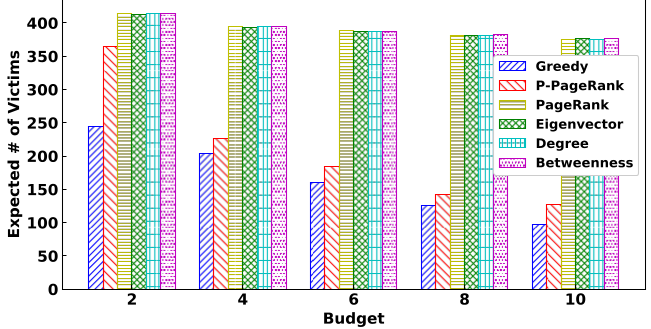 Figure 2: Performance comparison across different social graphs showing the expected number of victims vs. trap budget.
Critical Analysis & Takeaways
This paper moves the needle from "passive monitoring" to "active strategic defense."
Strengths:
- Rigorous Proofs: Converting a security problem into a submodular optimization problem provides a "gold standard" for approximation.
- Scalability: The Monte Carlo approach ensures this isn't just a theoretical exercise but a deployable solution.
Limitations:
- Random Walk Assumption: While adversarial crawlers should use random walks for unbiased sampling, sophisticated attackers might use more directed, "greedy" search patterns (e.g., BFS or heuristic-based scraping), which might bypass these specific trap placements.
- Static Topology: The model assumes the social graph is static, whereas OSNs evolve daily.
Future Work: The next frontier for this research is adapting to dynamic graphs and adversarial learning, where the crawler learns to avoid nodes it suspects are traps.
Conclusion
"Trapping Malicious Crawlers" provides a vital blueprint for OSN privacy. By moving away from generic centrality and towards submodular optimization, the authors provide an efficient, scalable, and mathematically sound way to build a "digital minefield" that protects user data from automated theft.