
Travel History: Bridging the Gap Between GPS Logs and Social Memories
Travel History: Reconstructing Semantic Trajectories Based on Heterogeneous Social Tracks Sources
The paper introduces "Travel History," a conceptual model and methodology for automatically reconstructing semantic-rich travel itineraries. It integrates heterogeneous data sources including Raw Trajectory Data (GPS), Semantic Trajectory Data (Cloud services like Google Takeout), and Georeferenced Social Interactions (Facebook, Instagram, Twitter) to create a structured timeline of movements and activities.
TL;DR
Reconstructing a vacation itinerary from digital footprints is often a manual, fragmented task. This paper presents Travel History, a framework that automatically synthesizes GPS logs, cloud location history, and social media posts (Facebook, Instagram, Twitter) into a coherent, semantic trajectory. By combining the "Where" (GPS) with the "What" (Social Media), the system achieves an 80% accuracy in reflecting real-world travel experiences.
Context & Motivation: The Semantic Gap
In the era of big data, we face a paradox. On one hand, we have Raw Trajectory Data (RTD) from GPS—precise but "dumb," knowing coordinates but not the beauty of the museum visited. On the other, we have User Generated Content (UGC)—semantically rich "check-ins" and photos that are high-level but spatially sparse.
The authors identify a clear pain point: travelers want to share experiences, but generating structured content is tedious. The goal is to bridge this gap by automatically "gluing" raw movement onto social interactions to build a Semantic Trajectory.
The "Travel History" Conceptual Model
The core of the methodology lies in three fundamental entities:
- Stays: Points where the user remains stationary or changes transportation mode.
- Visits: A specialized version of a Stay that carries high significance, determined by time spent and the volume of associated social interactions.
- Trails: The movement segments connecting Stays, enriched with Transportation Mode (walking, driving, train).
Methodology: From Raw Points to Semantic Visits
The reconstruction process follows a sophisticated pipeline to handle data "gaps" and "overlaps":
- Stay Identification Techniques: The system looks for clusters of points (dense formations) or isolated "inflection" points where speed or direction changes.
- Transportation Mode Detection: Using speed, acceleration, and orientation variations, the algorithm infers how the user moved between points.
- Merging & Integration: Since data comes from heterogeneous sources (e.g., a GPS log and an Instagram post at the same site), the system merges candidates based on spatio-temporal thresholds.
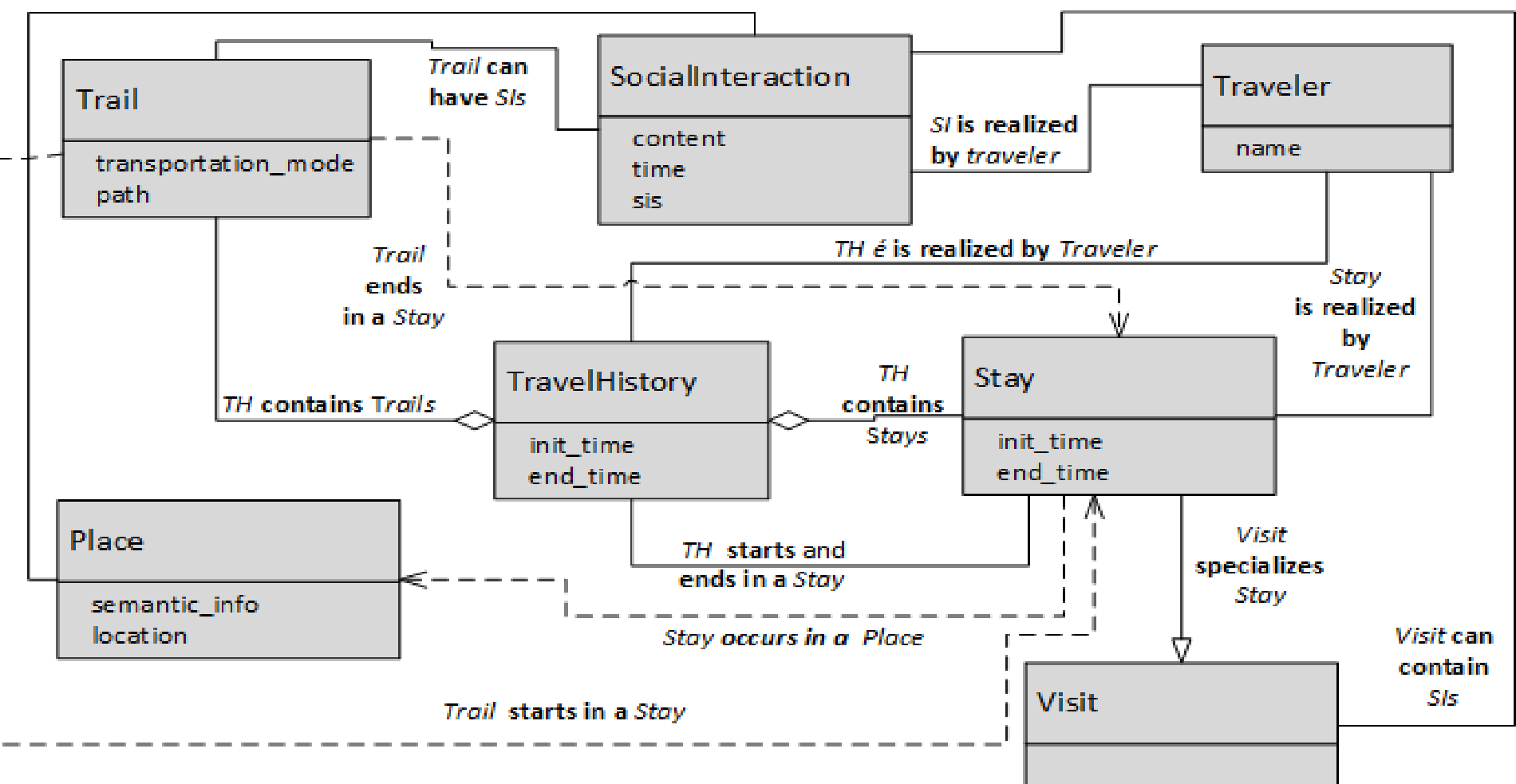 Figure 1: The UML diagram outlining the relationships between Travels, Stays, Visits, and Social Interactions.
Experimental Results: Real-World Latency and Accuracy
The researchers tested their prototype on real travelers. One highlighted case involved a five-day trip through Southern Brazil. By pulling data from Google Takeout and various social APIs, the tool visualized an interactive map that was not just a line on a screen, but a series of meaningful "Moments."
| Aspect | Success Rate (%) |
|---|---|
| Visit Identification Accuracy | 78.25% |
| Temporal Order Accuracy | 82.60% |
| Overall Trip Representation | 95.65% |
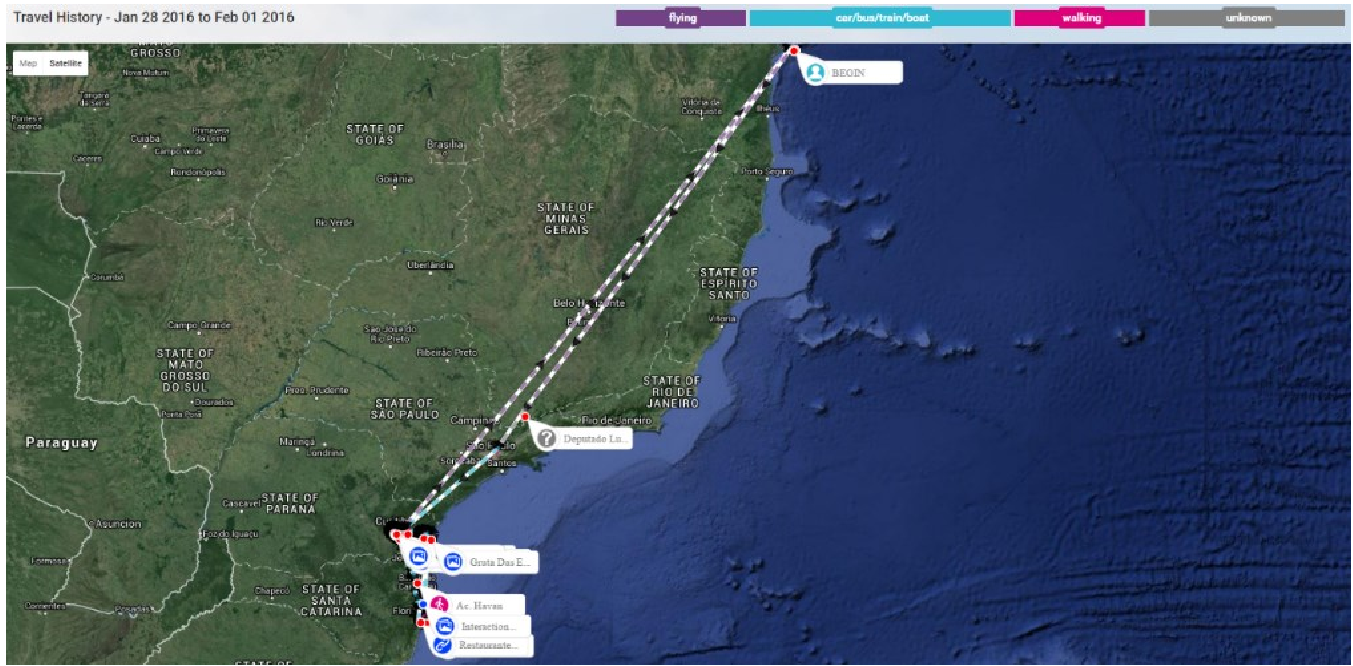 Figure 2: A reconstructed travel history showing the fusion of GPS paths (RTD) and social annotations (GSI).
Critical Insight: Why This Works
The brilliance of the Travel History approach isn't just in the GPS tracking—it's in the Inference of Relevance. By treating a social interaction (like a tweet or a photo) as a weight that "promotes" a boring Stay into a "Visit," the model mimics human memory. We don't remember the traffic light we stopped at (a Stay); we remember the cafe where we took a photo (a Visit).
Limitations & Future Horizon
While the system is robust, it has two primary limitations:
- Data API Dependency: Increasing privacy restrictions by social platforms (like Facebook's API changes) makes data acquisition harder for third-party apps.
- Textual Nuance: The current model focuses on the presence of an interaction. Future iterations could use Natural Language Processing (NLP) to understand the sentiment of the post—distinguishing between "I hate this muddy beach" and "This is the best beach ever."
Final Takeaway
This paper serves as a blueprint for the future of "Digital Memories." By moving beyond raw coordinates to focus on Semantic Trajectories, the authors have paved the way for automated journaling and more intelligent, context-aware travel recommendation systems.