
Decentralized Buzz: Identifying Trending Topics in P2P Social Networks
Trending topics in a peer-to-peer micro-blogging social network
This paper proposes an aggregation-based method to identify trending topics in a decentralized, unstructured Peer-to-Peer (P2P) micro-blogging network. By piggybacking keyword exchange onto existing "rapid-yet-restrained" dissemination protocols, individual nodes can detect global trends without centralized coordination.
Executive Summary
TL;DR: This paper tackles the challenge of trend detection in a world without central servers. By leveraging unstructured P2P gossiping and probabilistic search, the authors demonstrate that individual nodes can "sense" a global trend simply by aggregating recent keywords from their neighbors.
Background Positioning: This work is a critical architectural study in the P2P space. It moves beyond simple data storage (like Diaspora or PeerSoN) and addresses the dynamic discovery of information, bridging the gap between decentralized privacy and the "global pulse" of modern social media.
The "Blind Men and the Elephant" Problem
In a centralized system like Twitter, a central database sees every tweet. Identifying a trend is just a matter of running a COUNT BY keyword query. In a Peer-to-Peer (P2P) network, however, each node is like a blind person touching one part of an elephant. No node knows the total frequency of a hashtag like #BreakingNews.
Existing solutions using Distributed Hash Tables (DHTs) fall short because micro-blogging generates massive volumes of tiny updates. The bandwidth required to keep a global DHT index updated in real-time is often prohibitive.
Methodology: Rapid-Yet-Restrained Dissemination
The authors build upon their previous "PAC'npost" framework. The core idea is to treat information spread like a biological epidemic, but with a twist: stifling.
1. Probabilistic Search (PAC)
The system relies on "Probably Approximately Correct" search. If a post is replicated on nodes in a network of nodes, querying random nodes gives a predictable probability of success:
2. The Aggregation Mechanism
Instead of just asking for posts from friends, nodes "piggyback" keyword metadata onto their regular queries.
- The Parameter: Nodes exchange keywords from the last iterations.
- Convergence: If a node sees a keyword appearing consistently over iterations, it flags it as "Trending" locally.
 Fig 1: The target behavior — reproducing Twitter-like trends in a decentralized environment.
Experiments: Scalability and Accuracy
The authors simulated a 10,000-node network with a post creation rate 100 times higher than Twitter's average. They injected "tracer" hashtags at different frequencies () to see if nodes could detect them.
Key Findings:
- Sensitivity to : As the exchange window increases, nodes detect trends much faster and more reliably.
- Bandwidth Trade-off: High values improve detection but increase data usage. The study suggests as a sweet spot for 95%+ detection accuracy.
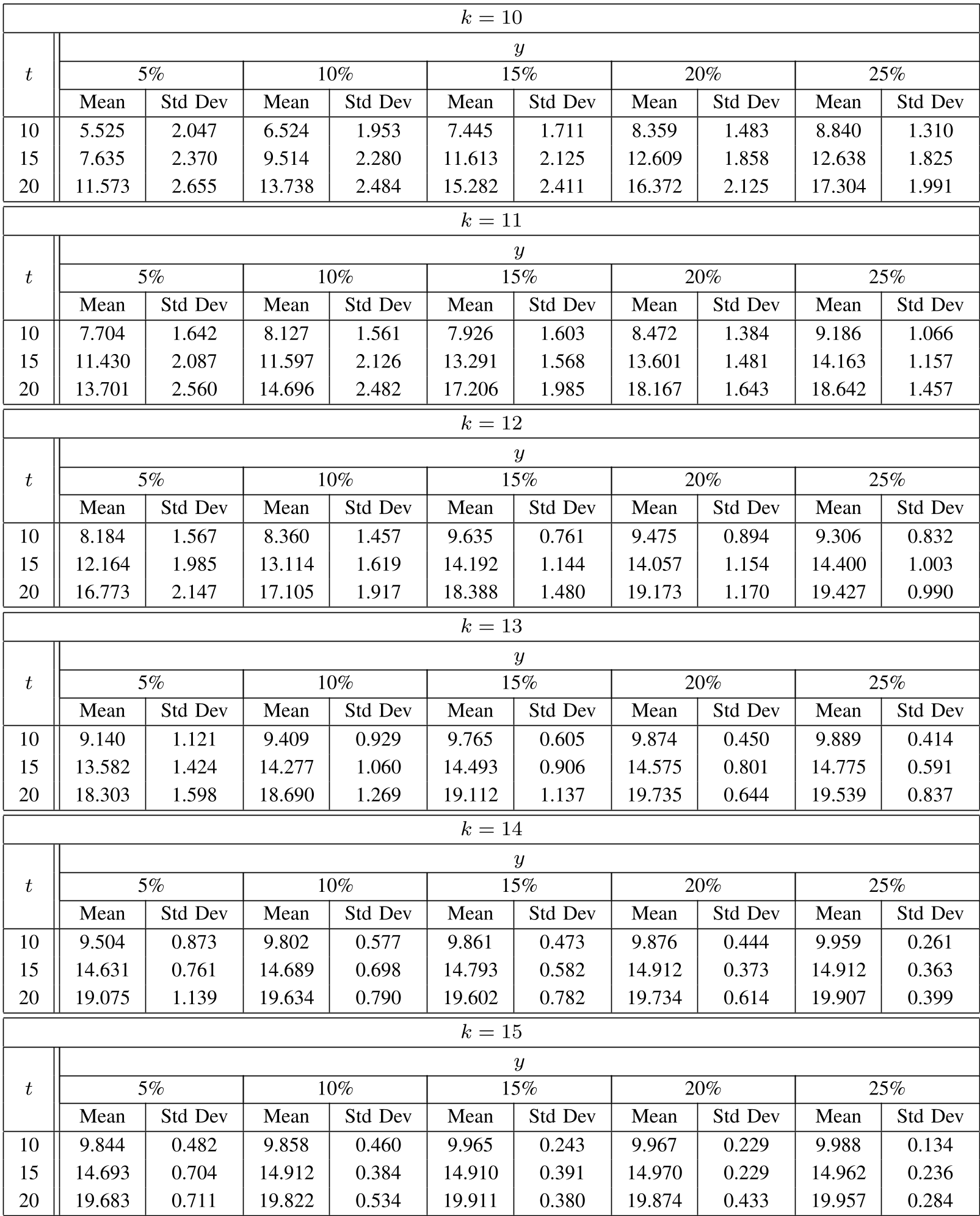 Table 1: Mean detection rates across different time windows () and injection rates ().
Critical Insight: The "Justin Bieber" Problem
The authors conclude with a fascinating look at the limitations of decentralized trends:
- Latency: Unlike a central server, P2P trends take a few "iterations" to "warm up" across the network.
- The Britney Spears/Justin Bieber Problem: Constant background noise from celebrities can drown out actual breaking news.
- Spam Vulnerability: Without a central authority to ban botnets, "Sybil attacks" could easily manipulate trending topics by flooding nodes with specific hashtags.
Conclusion
This research proves that you don't need a billion-dollar data center to know what the world is talking about. Through clever probabilistic modeling and epidemic protocols, the authors have provided a blueprint for social networks that are both "social" and truly "private."
Main Source: H. Asthana & Ingemar J. Cox, University College London.