
From Dyads to Destiny: How Micro-Interactions Shape Social Macrostructures
On a Triadic Approach to Connect Microstructural Properties to Social Macrostructural Patterns
This paper investigates the connection between microstructural properties (nodal degree and dyadic features) and social macrostructural patterns (structural balance, transitivity) in Online Social Networks (OSNs). By utilizing a triadic approach and a novel clustering coefficient-based sampling method, the researchers demonstrate that observed triad distributions in OSNs are low-dimensional and primarily determined by dyadic properties.
TL;DR
Why do online social networks evolve toward specific global structures like "balance" or "transitivity"? This paper explores the micro-macro linkage, proving that the complex global architecture of a network like Facebook can be predicted with over 94% accuracy simply by looking at dyadic properties (the relationships between pairs). By leveraging a triadic census approach and a smart sampling technique, the authors bridge the gap between individual interactions and the emergence of social order.
The "Scale" Problem in Social Physics
In the realm of Online Social Networks (OSNs), we often track global metrics (like degree distribution) or local behaviors (like "liking" a post). However, the "middle ground"—how local interactions aggregate into macro-patterns like Structural Balance (friend of my friend is my friend) or Ranked Clusters—is often ignored due to computational complexity.
The core challenge is sparsity. In a typical OSN, most potential connections don't exist, leading to a "003-triad dominance" where the vast majority of node triplets have no edges, masking the important social signals.
Methodology: The Triadic Lens
The authors argue that Triads (groups of three nodes and their directed links) are the fundamental building blocks of social structure.
1. Smart Sampling via Clustering Coefficient
To avoid the noise of empty space, the authors used a local clustering coefficient-based sampling. They categorized nodes by their neighborhood density and extracted ego-centric networks. This ensured they captured regions with varied interaction intensities, rather than just the sparse global average.
2. Identifying the "Social DNA" via SVD
Using Singular Value Decomposition (SVD), the researchers found that triad distributions are surprisingly low-dimensional. Only three dimensions are needed to account for nearly 99% of the structural information.
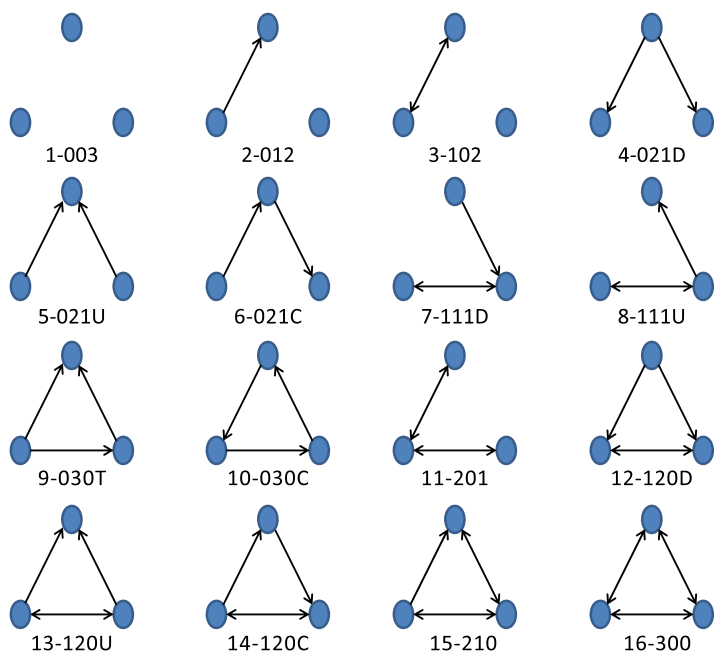 Figure 1: The 16 possible triad configurations that serve as the "basis vectors" for social structure analysis.
Key Insight: The Power of the Dyad
One of the most profound findings is the comparison between different micro-features. The authors tested three "expectations":
- Nodal Indegree/Outdegree: Does who is "popular" or "active" define the structure?
- Dyad Census (MAN): Does the nature of pair-wise links (Mutual, Asymmetric, Null) define the structure?
The Result: The Dyad Census (MAN) explained 95.04% of the variance in the network space. This suggests that the "symmetry" or "mutuality" of relationships is a far more powerful predictor of global social shape than individual popularity.
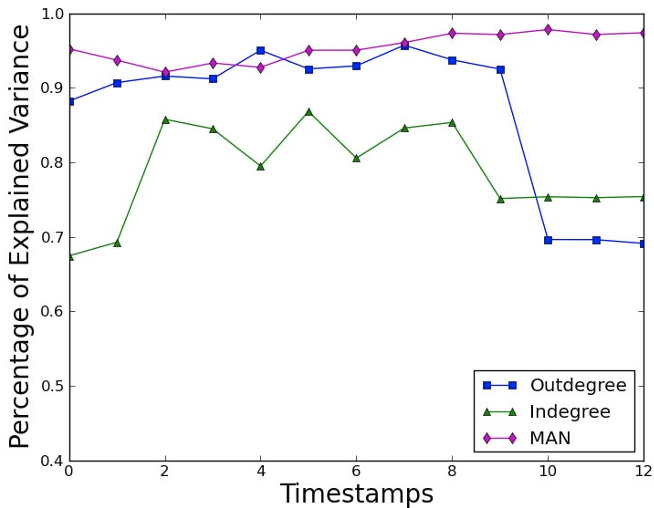 Figure 2: Projection of observed vs. expected distributions. The alignment between observed data and dyadic expectations is nearly perfect.
Evolution Toward Balance
By analyzing a Facebook dataset over 13 months, the authors tracked the Tau Statistic—a measure of how much a network deviates from random expectations toward a specific model.
Experimental results showed a clear trend: as time passes, the network exhibits a stronger tendency toward Transitivity and Structural Balance. This means that as an online community matures, it naturally organizes itself into more stable, "closed" psychological structures.
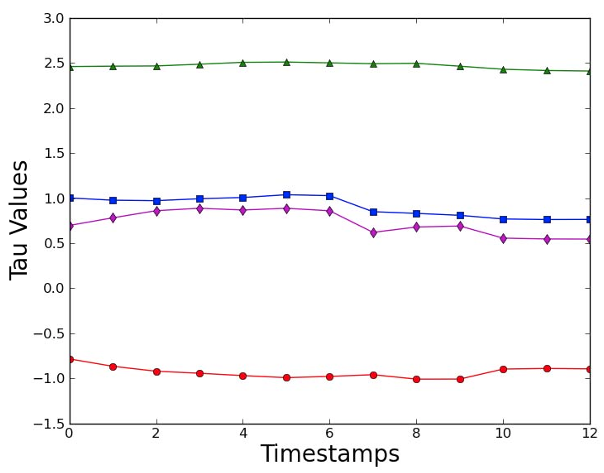 Figure 3: Boxplots of Tau values showing the network's inclination toward Balanced (BA), Ranked Clusters (RC), and Transitive (TR) models.
Critical Analysis & Conclusion
Takeaway
This work provides a rigorous mathematical framework for the micro-macro linkage. It tells us that if you want to understand where a social network is heading, don't just look at the "influencers" (nodes); look at the "interaction styles" (dyads).
Limitations
- Single Platform: The results are based on Facebook wall-post data from 2006-2009. Modern algorithmic feeds (like TikTok or X) might disrupt these "natural" triadic evolutions.
- Unweighted Arcs: The model treats all interactions as equal, whereas "intensity" or "sentiment" of ties would likely add another layer of complexity.
Future Outlook
This triadic approach could be a game-changer for Community Detection and Link Prediction algorithms, moving beyond simple proximity to understanding the "sociological intent" behind network growth.