
TriggerTV: Predicting the Next Viral Hit Through the Social User Journey
TriggerTV: exploiting social user journeys within an interactive TV system
This paper presents TriggerTV (ResNet.TV), an innovative IPTV system that integrates social network data (Facebook) to track "social user journeys." By analyzing interaction events, the authors identify early-warning "triggers" that allow Content Distribution Networks (CDNs) to predict and optimize for upcoming content popularity.
TL;DR
Researchers at Lancaster University have developed TriggerTV, a system that proves your Facebook friends' viewing habits and your own UI interactions are "crystal balls" for network traffic. By identifying "representative users"—those whose personal viewing journey mirrors future mass trends—they provide a mechanism for Content Distribution Networks (CDNs) to prepare for traffic spikes before they actually happen.
Background: The "Black Box" Problem in IPTV
In 2010, as internet television began to challenge traditional broadcasts, engineers faced a massive headache: predicting demand. Standard CDNs were reactive; they scaled only after the load hit. While researchers had studied "what" people watched, they rarely understood "how" they got there. Most measurement studies were "black-box" analyses, looking at packet traces rather than the human intent behind the click.
The authors of TriggerTV argued that to truly optimize a network, we must understand the User Journey—the sequence of interactions, from browsing the carousel to checking social "buzz" panels—and how these journeys are influenced by the social graph.
Methodology: Instrumentation and Social Integration
The team built ResNet.TV, a full-stack IPTV service deployed at Lancaster University. Unlike a standard player, every element was instrumented using JavaScript to capture:
- Media Events: Plays, pauses, and exact duration watched.
- Navigation Events: How users filtered their content (e.g., by "Popularity" or "Facebook Friends").
- Social Interactions: Clicks on YouTube widgets or Facebook "Who’s watching" status.
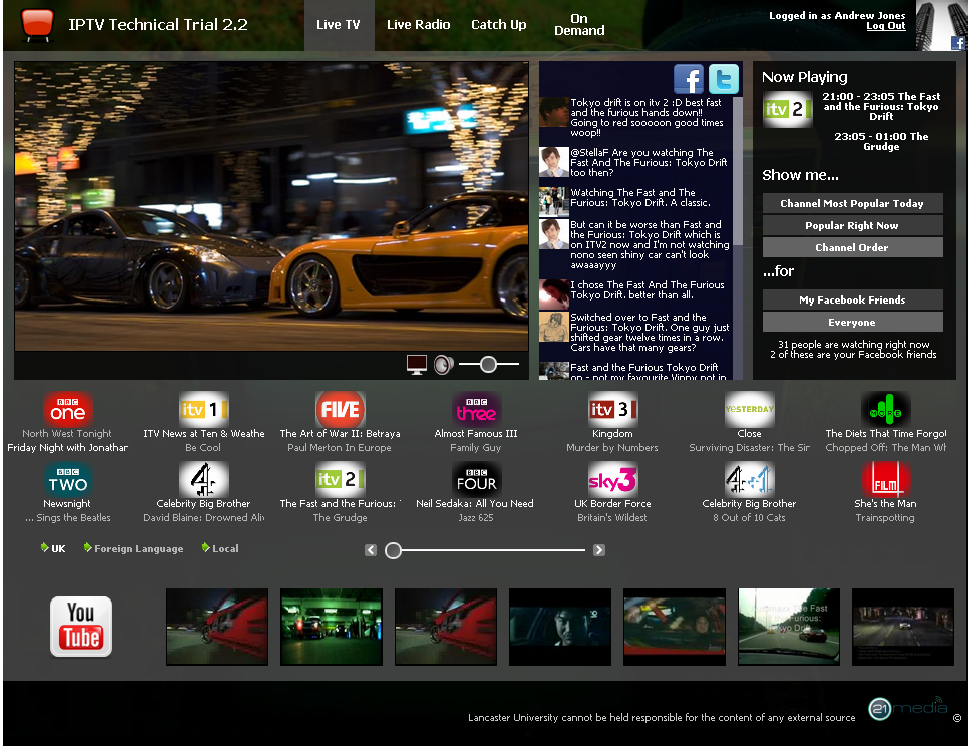 Figure 1: The ResNet.TV interface, featuring the integrated social buzz panel and content carousel.
The "secret sauce" was the Social User Journey. By linking accounts to Facebook, the system could see if a user's behavior was influenced by their peers. This allowed the researchers to look for "Triggers"—specific actions by specific users that signaled a program was about to go viral.
Key Insights: Who is the "Representative User"?
After a 5-month trial with nearly half a million events, the study found that not all viewers are created equal when it comes to predicting traffic. They identified three critical correlations:
- The "Dedicated Viewer" Trigger: Users who historically watch a high percentage of a show (rather than channel-hopping) are strong predictors. If they start a program, it’s a high-confidence signal that the general population will stick with it too ().
- The "Social Hub" Trigger: There is a strong correlation between the number of Facebook friends a person has using the service and the maximum simultaneous viewership of the content they watch (). Socially connected users act as "multipliers."
- The "Active Explorer" Trigger: Surprisingly, users who frequently reconfigure their UI (changing content filters) are more likely to land on popular content quickly, making their early choices a valuable lead indicator for CDNs.
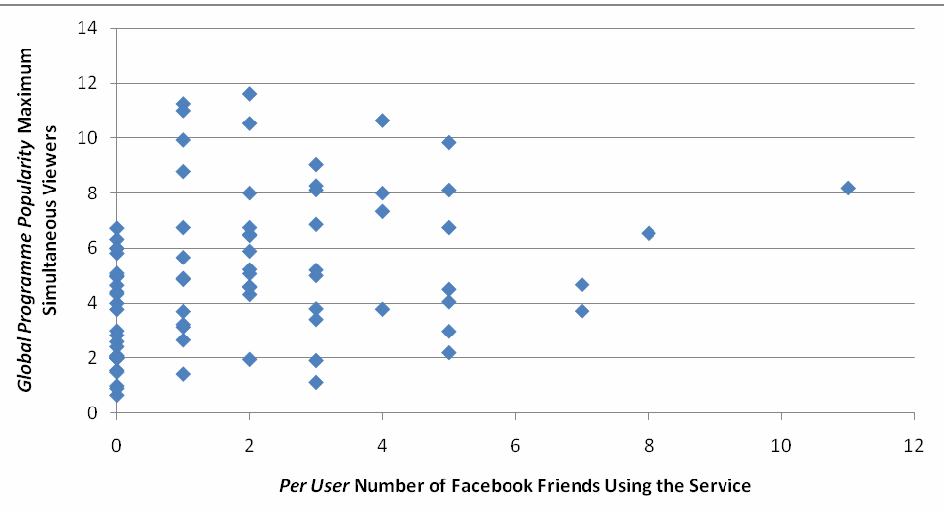 Figure 2: Correlation between the number of Facebook friends using the service and global program popularity (maximum simultaneous viewers).
Critical Analysis & Future Outlook
The brilliance of TriggerTV lies in its shift from content-centric to user-centric analysis. By treating the user interface as a sensor, the network gains an "early warning system."
Limitations
- Privacy Trends: In the current era of GDPR and increased privacy awareness, the level of Facebook integration used in 2010 might face significant regulatory and user-adoption hurdles today.
- Scale: The study was conducted in a university environment; whether these "social triggers" hold true across a global, heterogeneous population remains an open question.
The Future: Socially-Aware Networks
This work lays the groundwork for Socially-Aware CDNs. Imagine a network that doesn't just cache what is popular now, but looks at what "trendsetters" are clicking on and begins warm-starting caches in anticipation. In the age of TikTok and viral streaming, the lessons of the "Social User Journey" are more relevant than ever.
Takeaway: If you want to know what the world will watch in an hour, don't look at the charts—look at what the socially connected, active explorers are watching right now.