
TRUMP: Decoding User Mobility through Pattern Mining and Spatiotemporal Graphs
TRUMP: Trace Revisitation for User Mobility Prediction
TRUMP (Trace Revisitation for User Mobility Prediction) is a deep learning framework designed for next-location forecasting. It combines time-series clustering with Spatio-Temporal Graph Convolutional Networks (STGCN) to achieve state-of-the-art accuracy on LBSN datasets like Gowalla and Foursquare.
TL;DR
Predicting where a user will go next is a cornerstone of personalized services, yet the non-linear nature of human movement makes it notoriously difficult. TRUMP (Trace Revisitation for User Mobility Prediction) tackles this by first clustering users into behavioral groups using Soft-DTW and then applying Spatio-Temporal Graph Convolutional Networks (STGCN) to capture fine-grained movement dynamics. It proves that knowing who behaves like whom is just as important as knowing where they have been.
Problem & Motivation: Beyond the Limits of RNNs
Most existing mobility models are built on Recurrent Neural Networks (RNNs) or their variants (LSTM/GRU). While effective for sequences, they often fall short in mobility tasks for two reasons:
- Spatial Complexity: Mobility isn't just a sequence; it's a traversal through a complex geographical graph.
- Sparsity & Noise: Individual traces are often sparse. Standard attention mechanisms look for local patterns but ignore the broader "mobility types" (e.g., commuters vs. tourists).
The authors' core insight is that users with similar mobility patterns exhibit similar future movements with high probability. By grouping these patterns, a model can learn more robust representations even when individual data is sparse.
Methodology: The TRUMP Architecture
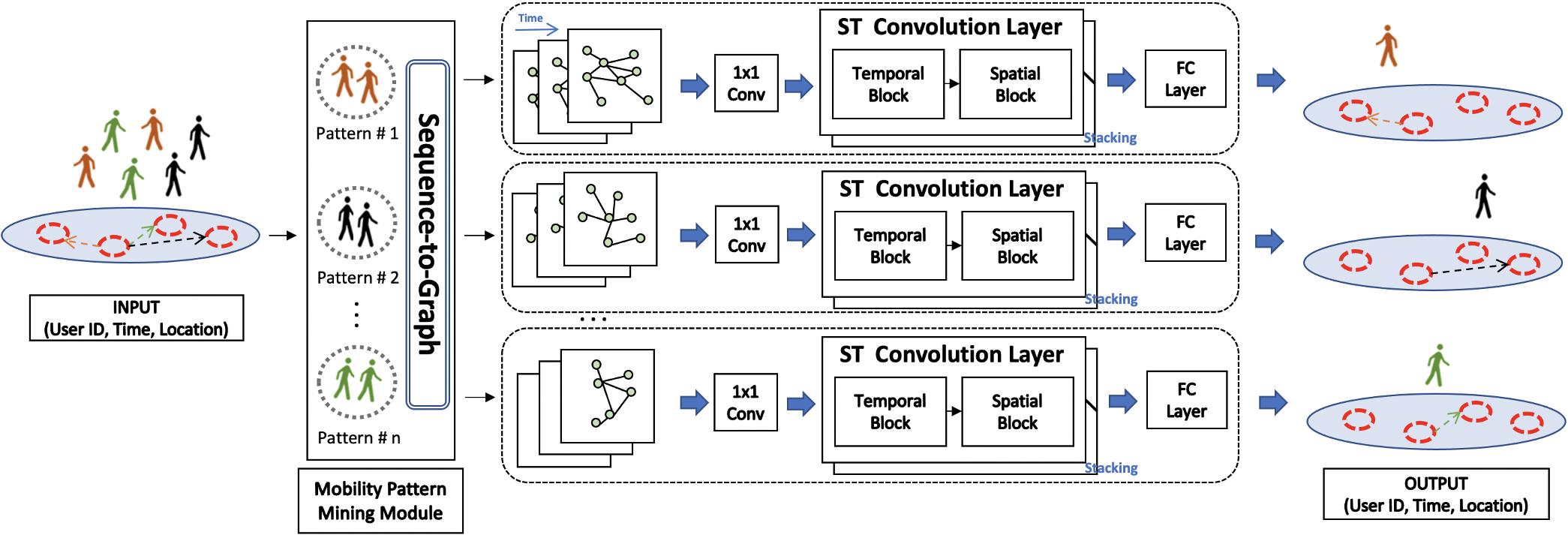
TRUMP operates through a two-stage end-to-end framework:
1. Mobility Pattern Mining Module
Before the heavy lifting of deep learning, TRUMP organizes the data. It uses k-means clustering with a Soft-DTW (Dynamic Time Warping) metric. Unlike Euclidean distance, Soft-DTW can find similarities between trajectories that are shifted in time or have varying speeds. The optimal number of clusters is determined by silhouette scores, ensuring each group represents a distinct behavioral archetype.
2. Spatio-Temporal Convolution Layer
The clustered data is transformed into a graph structure where waypoints are vertices and paths are edges. TRUMP then employs an STGCN architecture, which consists of:
- Temporal Block: Gated convolutions to capture long-term dependencies.
- Spatial Block: Graph convolutions to extract features from the weighted adjacency matrix representing the physical/logical movement network.
Experiments and Results
TRUMP was evaluated on two massive Location-Based Social Networks (LBSNs): Gowalla and Foursquare, featuring millions of check-ins.
Performance Comparison
The results demonstrate that TRUMP is a top-tier performer, particularly in high-recall scenarios (Acc@10) and ranking (MRR). By specializing the graph convolution filters on specific mobility clusters, the model avoids the "one-size-fits-all" trap that plagues simpler RNN models.

Key Highlights:
- Gowalla: Achieved the highest Acc@1 (0.1162) and Acc@10 (0.3554) among all tested methods.
- Foursquare: Showed comparable performance to state-of-the-art RNN-based attention models (Flashback) but with the added structural benefit of graph convolutions.
Critical Analysis & Conclusion
TRUMP represents a shift from purely sequential modeling to structure-aware behavior modeling. By integrating clustering directly into the pipeline, it addresses the inductive bias needed to understand human navigation.
Limitations: Currently, TRUMP focuses primarily on the spatiotemporal coordinates. However, human mobility is also deeply influenced by social networks. The authors acknowledge this and suggest that future work should incorporate social interactions to further refine the clustering process.
The Takeaway: For practitioners building location-aware AI, TRUMP demonstrates that "Divide and Conquer"—clustering behaviors before applying complex spatio-temporal convolutions—is a powerful strategy for handling the noise and complexity of real-world movement.