
OpinionWalk: Deciphering Trust in the High-Speed Realm of Vehicular Social Networks
11761_Trust Assessment in Vehicular Social Network Based on Three-Valued Subjective Logic.
This paper proposes a holistic trust assessment framework for Vehicular Social Networks (VSNs) using Three-Valued Subjective Logic (3VSL). It introduces the "OpinionWalk" algorithm and a community-based hierarchy to efficiently calculate both subjective and objective trustworthiness of vehicles in a distributed manner.
TL;DR
As we move toward a future of Connected and Autonomous Vehicles (CAV), the critical question shifts from "Is the data encrypted?" to "Is the sender lying?" This paper introduces a robust framework using Three-Valued Subjective Logic (3VSL) and a distributed algorithm called OpinionWalk to measure trust in Vehicular Social Networks (VSNs). By grouping vehicles into communities, it achieves high precision in identifying "bad actors" with minimal computational overhead.
Context & Motivation: Why Security is Not Enough
In a typical Intelligent Transportation System, we rely on PKI (Public Key Infrastructure) to verify identities. However, a "verified" vehicle can still broadcast dangerous misinformation due to sensor failure, software bugs, or malicious hijacking.
The authors propose a Vehicular Social Network (VSN) lens: if vehicle A receives data from vehicle B, they have had a "social interaction." Over time, these interactions form a graph where trust can be propagated (A trusts B, B trusts C, so A can infer trust in C). The challenge lies in the high mobility—how do you calculate this trust when the network topology changes every few seconds?
Methodology: The 3VSL and OpinionWalk
The research leverages Three-Valued Subjective Logic (3VSL), which represents an opinion as a quadruple: representing belief, disbelief, uncertainty, and prior uncertainty.
1. OpinionWalk Algorithm
To handle multi-hop trust, the authors developed OpinionWalk. It functions like a Breadth-First Search (BFS) but replaces standard arithmetic with 3VSL operations:
- Discounting (): Models the "decay" of trust as it passes through intermediaries.
- Combining (): Fuses multiple recommendations into a single, stronger opinion.
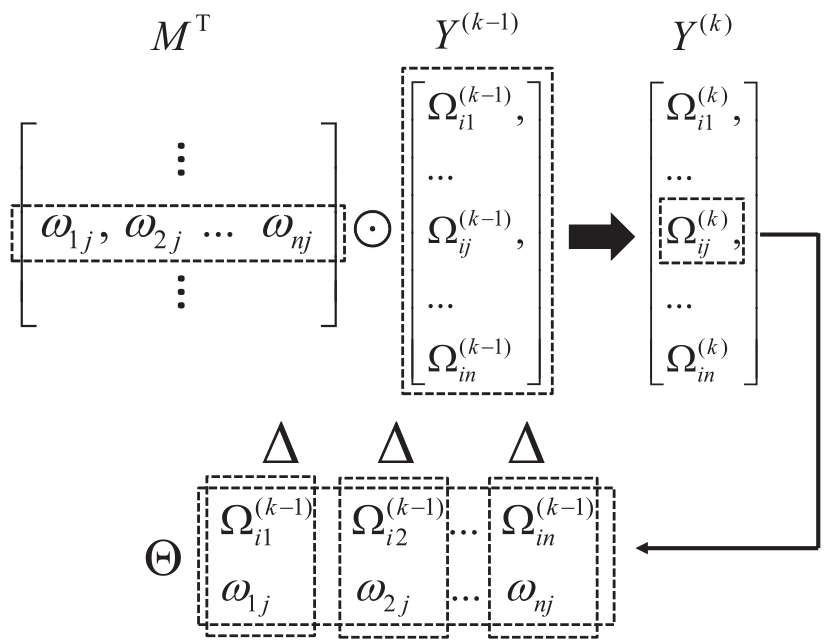 Fig 1: The principle of the ⊗ operator in OpinionWalk, mimicking matrix multiplication through trust propagation.
2. Subjective vs. Objective Trust
- Subjective Trust: Based on how much your own sensors agree with the sender.
- Objective Trust: A self-correcting mechanism where a vehicle estimates its own "sensing accuracy" by comparing results with a cluster of highly trusted neighbors.
Scaling with Community Division
Computing trust for every vehicle on the road is an problem that would crash local processors. The authors solve this by introducing Asynchronous Label Propagation to divide the VSN into communities (e.g., vehicles sharing a common commute route).
- Intra-community: Deep trust calculation using local opinion matrices.
- Inter-community: Limited trust exchange when two vehicles from different groups meet.
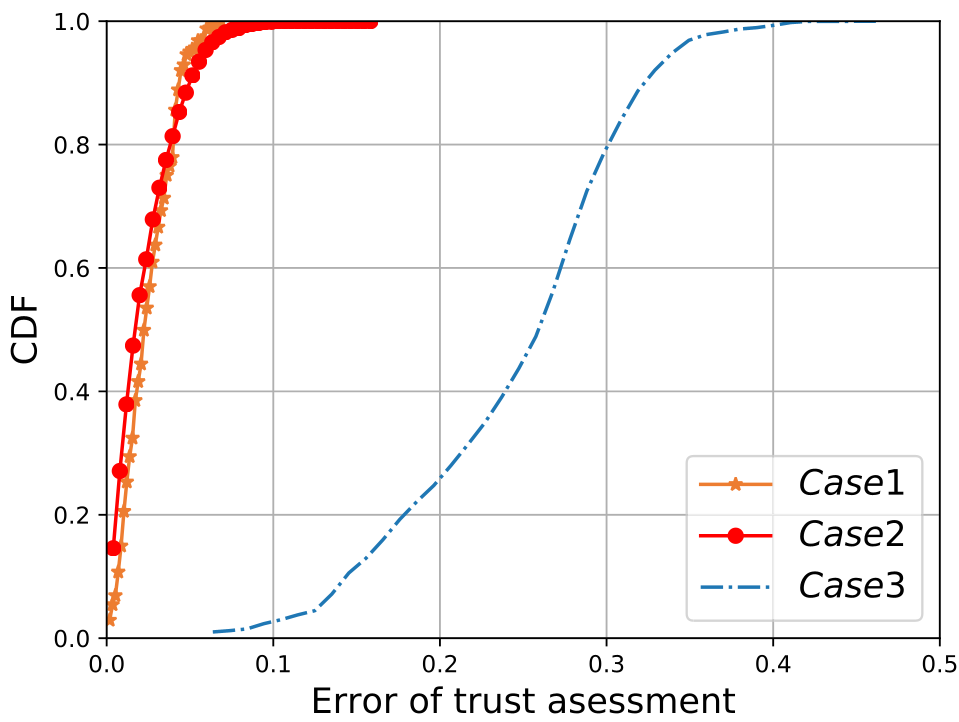 Fig 2: A snapshot of the VSN divided into non-overlapping communities based on mobility patterns.
Experimental Results
The framework was tested in a simulated 1000m x 1000m area. The findings were compelling:
- Accuracy: The objective trust estimation error dropped to nearly 0.025 as the number of interactions increased.
- Efficiency: Without community division, the execution time spiked exponentially as more vehicles were added. With the proposed community strategy, the time remained manageable and scaled linearly.
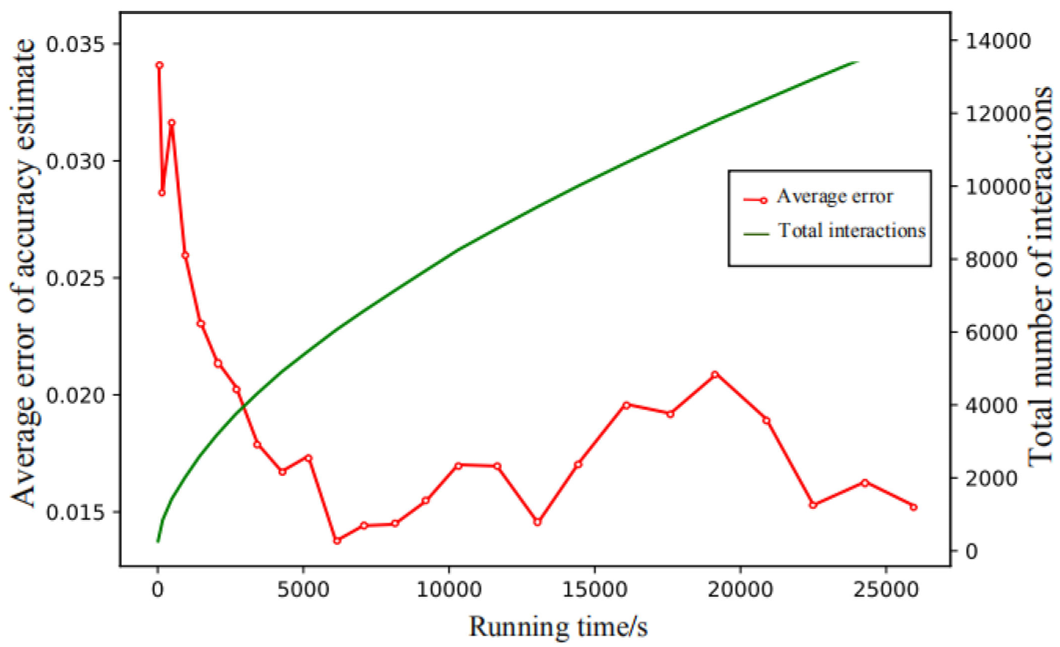 Fig 3: Objective trust assessment error reduces significantly over time as "social" edges are established.
Critical Insight & Conclusion
The genius of this work lies in treating physical proximity as a social bond. By using 3VSL, the model explicitly accounts for uncertainty—a vital factor in the noisy environment of road sensors.
While the community division introduces a minor error (approx. 5%), it is a necessary trade-off for real-world deployment. Future autonomous fleets will likely require such distributed "reputation systems" to complement traditional encryption, ensuring that the "collective intelligence" of the road is not poisoned by a single malfunctioning node.
Takeaway: Effective trust assessment in VSNs requires a move away from centralized authorities toward distributed, community-aware algorithms that can handle the inherent "subjectivity" of sensor data.