
TCDK: Bridging the Gap Between Collective Intelligence and Domain Logic
Trust-aware crowdsourcing with domain knowledge
The paper introduces TCDK (Trust-aware Crowdsourcing with Domain Knowledge), a unified graphical model that combines traditional crowdsourcing probabilistic dependencies with first-order logic rules. It achieves state-of-the-art performance in label estimation and worker trust modeling by leveraging logical relations between questions and correlations between workers.
TL;DR
Purely statistical crowdsourcing models often ignore the inherent logic of the real world—such as the fact that an image cannot be both "sunny" and "rainy" simultaneously. TCDK (Trust-aware Crowdsourcing with Domain Knowledge) fixes this by wrapping traditional probabilistic models in a First-Order Logic (FOL) shell. By using a scalable ADMM-based inference engine, it provides a principled way to inject "human common sense" into the noisy process of worker label aggregation, significantly boosting accuracy and trust estimation.
Problem & Motivation: The Independence Fallacy
In the standard crowdsourcing paradigm (e.g., Amazon Mechanical Turk), we treat every task and every worker as an isolated island. However, the authors identify two critical flaws in this assumption:
- Question Dependency: In emotional tagging, if a headline expresses "Anger," it is logically less likely to express "Joy."
- Worker Dependency: Workers with similar backgrounds or expertise levels tend to produce correlated errors.
Existing SOTA methods like the Dawid-Skene model or variational inference for crowdsourcing typically ignore these constraints, leading to suboptimal truth discovery when the data is sparse or the workers are malicious.
Methodology: A Two-Layered Hybrid Architecture
TCDK's innovation lies in its "sandwich" structure. It doesn't just add constraints; it unifies two different mathematical worlds.
1. The Architecture
- Bottom Layer (Statistical): Models the likelihood of a worker's answer given their latent trust value () and the true label ().
- Top Layer (Logical): Uses Probabilistic Soft Logic (PSL) to define rules like: (If is , and is opposite to , then is not ).
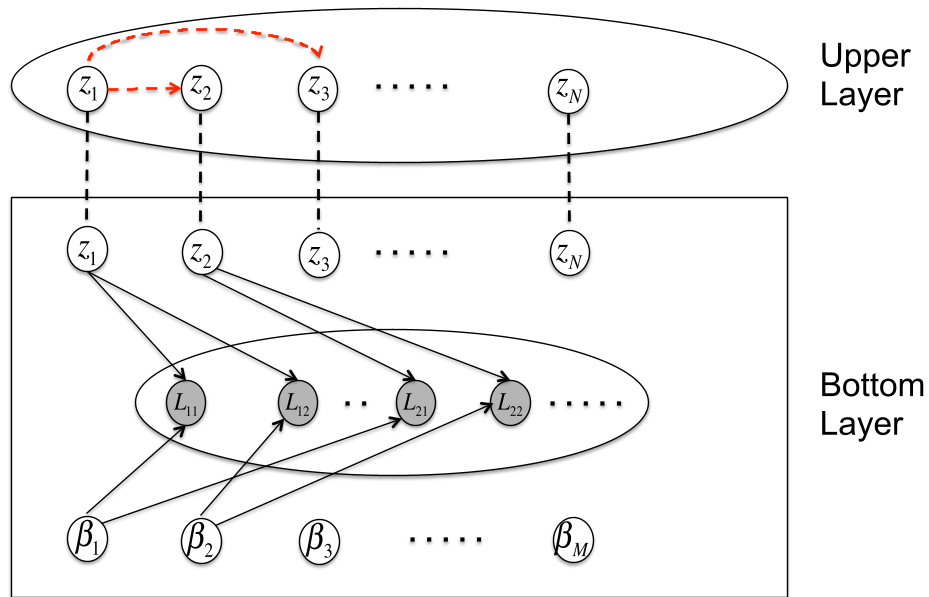
2. The Coupling Mechanism
The bridge between these layers is a "cost-function rule." The authors show that the traditional log-likelihood of the crowdsourcing model can be viewed as a potential function within a Generalized PSL (GPSL) framework. This allows them to treat the entire problem as a single optimization objective.
3. Scalable Inference via ADMM
To handle thousands of questions and workers, the paper utilizes ADMM (Alternating Direction Method of Multipliers). This breaks the global optimization problem into local sub-problems for each grounded rule, allowing the system to scale linearly across multiple machines—a crucial requirement for modern crowdsourcing platforms.
Experiments & Results
The framework was validated on two complex scenarios: Affective Text (emotion detection) and Fashion Social Dataset.
Key Findings:
- Recall Dominance: In the emotion dataset, TCDK's recall jumped to 75.00%, a massive leap from the 51.61% achieved by models without domain knowledge. This suggests that logical rules help recover "hidden" true labels that noisy workers missed.
- Consistency: Across all metrics (Precision, Recall, F1, Accuracy), TCDK consistently outperformed Majority Voting (MV) and standard Trust-aware (TC) models.
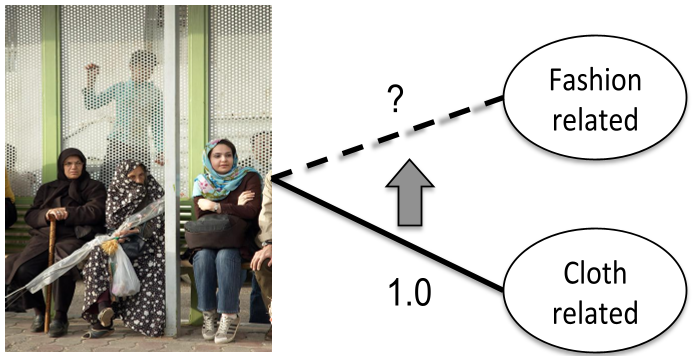 In the Fashion Social Dataset (Table III above), the inclusion of image similarity and category hierarchy logic pushed accuracy nearly 4% higher than the statistical baseline.
Critical Analysis & Conclusion
TCDK is a sophisticated "best of both worlds" solution. It acknowledges that while data-driven trust estimation is essential, it shouldn't ignore hard logical constraints.
Takeaway for Practitioners: If you are running a crowdsourcing pipeline where your labels have hierarchical relationships (e.g., taxonomies) or mutual exclusions, stop using simple majority votes. Injecting even a few high-level rules into a framework like TCDK can dramatically reduce the number of redundant samples you need to collect.
Limitations: Currently, the rule weights () must be provided by experts. Future iterations that automatically learn these weights from data (via Maximum Likelihood Estimation) would make the system more robust to "faulty" domain knowledge.