
TAPE: Quantifying Privacy Risks through the Lens of Trust and Reliability
Trust-aware privacy evaluation in online social networks
The paper introduces TAPE (Trust-Aware Privacy Evaluation), a quantitative framework for assessing privacy risk in Online Social Networks (OSNs). By mapping social network information diffusion to reliability graph analysis used in Wireless Sensor Networks (WSNs), TAPE calculates the probability of personal data leakage through a Binary Decision Diagram (BDD) approach.
TL;DR
Social network privacy is often treated as a binary setting—either you're private or you're not. However, the TAPE (Trust-Aware Privacy Evaluation) framework argues that privacy is a quantitative risk function. By borrowing reliability analysis techniques from Wireless Sensor Networks (WSNs), TAPE evaluates how information "leaks" through the social graph based on the Privacy Awareness of the owner and the Privacy Trust of their friends.
Background: Why Topological Analysis Isn't Enough
Most existing privacy tools focus on your own settings or the sheer distance between you and a stranger. However, they miss the "human factor." If you share a secret with a friend who has zero privacy awareness, that secret is at high risk of spreading. Conversely, a friend who values privacy (high trust) acts as a barrier. The researchers identified that social networks behave much like communication systems where nodes (users) and links (friendships) have specific failure/success probabilities for transmitting data—or in this case, leaking it.
Methodology: The TAPE Framework
The core innovation of TAPE lies in its decomposition of information leakage into measurable components:
1. Privacy Awareness (PA)
PA measures how much a user cares about their own data. TAPE uses a "Rank PA" algorithm: if your settings are tighter than 90% of the population, your PA is high. This is context-aware; if everyone hides their birthday, hiding yours doesn't make you "extra" aware—it makes you average.
2. Privacy Trust (PT)
This is a novel metric representing how likely a friend is to keep your information safe. It is calculated through "implicit recommendations." If a high-PA user trusts you with their data, it serves as a signal to the system that you are a trustworthy "node" in the network.
3. Reliability Graph Mapping
TAPE maps the social graph to a reliability model. In WSNs, we want to maximize the probability of a message reaching a destination. In privacy, we want to minimize the probability of a message reaching the Undesirable Group (UG).
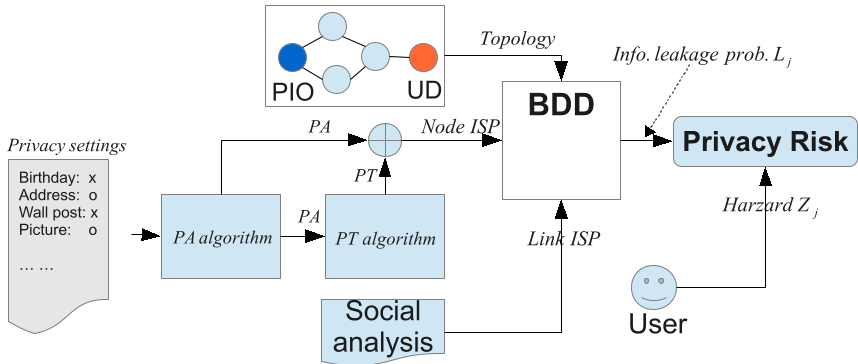 Figure 1: The architecture showing how PA, PT, and Topology converge to calculate Leakage Probability.
The "Word-of-Mouth" Diffusion Model
Instead of assuming information only spreads if a button is clicked, TAPE models "word-of-mouth" propagation. Using Binary Decision Diagrams (BDD), the framework calculates the cumulative probability across all possible paths from the Personal Information Owner (PIO) to the Undesirable Destination (UD).
Experimental Insights: Distance vs. Behavior
The researchers tested TAPE on real Facebook datasets. One of the most striking findings was that hop-distance is not the sole determinant of risk.
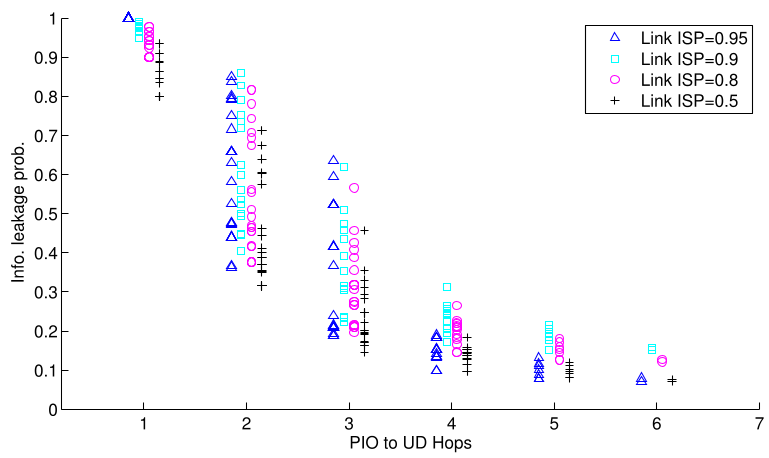 Figure 2: Information leakage probability decreases with distance, but varies wildly due to node behavior.
As seen in the chart above, a 1-hop neighbor (a direct friend) doesn't always have the highest leakage probability—multi-path effects (getting info from two different mutual friends) can actually amplify risk beyond the direct link's probability.
Critical Analysis & Takeaways
The paper successfully bridges the gap between social science (trust) and engineering (reliability analysis).
- The Strength: Unlike previous "Privacy Wizards," TAPE provides a mathematically sound way to say "Your risk level is 0.12," which can be used to trigger automated warnings or dynamic setting adjustments.
- The Limitation: The framework relies heavily on "word-of-mouth" as the primary diffusion channel. In the age of AI-driven scrapers and algorithmic feeds, information might spread through channels not captured by friendship-based reliability graphs.
- Future Impact: TAPE's approach to "Privacy Trust" could lead to a "credit-score-like" system for privacy, where users are incentivized to be trustworthy to maintain their social standing and access to information.
Conclusion
TAPE proves that privacy evaluation must go beyond static settings. By incorporating the awareness of the user and the trustworthiness of their social circle, we can finally move toward a "Privacy Weather Forecast" for our digital lives.