
Beyond the Five-Star Illusion: TACF and the Evolution of Trust-Aware Recommendations
Trust-Aware Recommendation for E-Commerce Associated with Social Networks
The paper introduces TACF (Trust-Aware Collaborative Filtering), a recommendation method for e-commerce that integrates semantic sentiment analysis and dynamic social interactions. By utilizing the "Douban" dataset, it demonstrates superior performance over traditional User-CF and Item-CF baselines in accuracy and personalization.
TL;DR
The "five-star" rating system in e-commerce is broken—over 99% of ratings are positive, masking true user preferences. This paper introduces TACF (Trust-Aware Collaborative Filtering), a framework that fixes broken ratings using semantic comment analysis and builds a "living" trust network from instant social interactions (likes, replies). The result? A significant boost in recommendation accuracy (F-measure) on real-world datasets like Douban.
The "All Good Reputation" Trap
In platforms like Amazon or Taobao, we often see products with near-perfect scores but polarizing reviews. This is the "all good reputation" problem. Users avoid leaving negative feedback to escape seller harassment or "retaliatory" negative ratings that damage their own buyer reputation.
From a data science perspective, this creates a massive low-variance noise problem. If every item is 4.8 stars, the recommendation algorithm loses its ability to distinguish between "truly Great" and "just Okay." Furthermore, traditional Social CF assumes your "friends" are your best influencers, ignoring the instant interactions—temporary but high-signal social touchpoints—that actually define current trust.
Methodology: Engineering a Better Rating
The authors attack this problem from two angles: the Value of the rating and the Strength of the social bond.
1. Rating Revamping (The Semantic Fix)
Instead of taking a '5/5' at face value, the system analyzes the feedback text. By extracting dimensions (service, delivery, quality), they calculate a Trust Score . The original rating is then adjusted: If a user leaves a 5-star rating but complains about "slow delivery" in the text, the revamped score drops, providing the granularity necessary for the CF engine.
2. Instant Trust Networks
Traditional familiarity is based on common friends. TACF introduces , derived from instant actions (e.g., replying to a thread, thumbs-up).
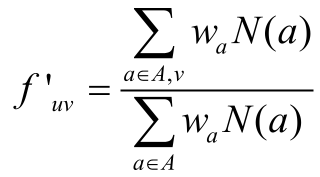 The final familiarity is a weighted fusion of steady friendship and these "instant" social signals, making the network more responsive to real-time user behavior.
Evaluating the Impact
The researchers tested TACF against standard User-based and Item-based Collaborative Filtering on the Douban dataset (books, ratings, and social tags).
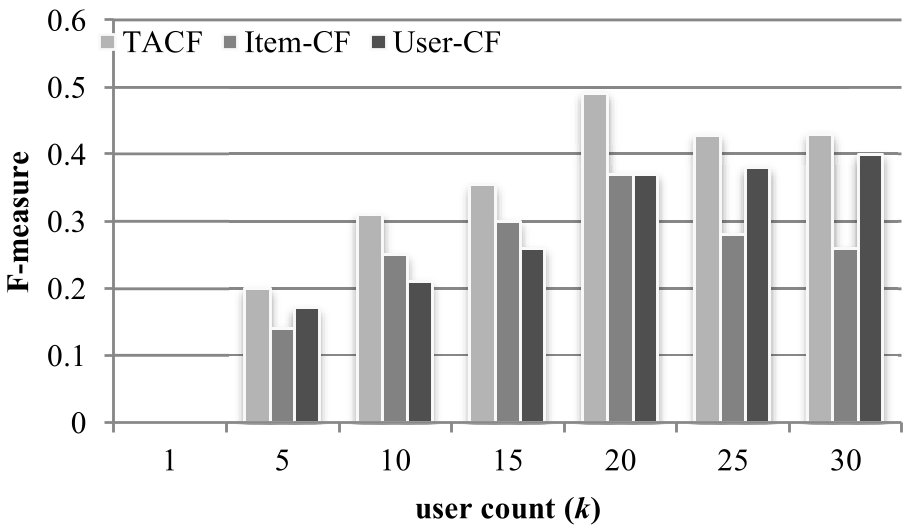
Key Findings:
- Peak Performance: TACF reaches its optimal F-measure at .
- Superiority Over Baselines: TACF consistently outperforms User-CF and Item-CF. While User-CF is generally better than Item-CF in this sparse environment, TACF's trust-aware layer provides a significant "lift" by filtering out the noise of fake positive ratings.
- Cold-Start Resilience: By leveraging social interactions, the system can provide meaningful recommendations even when the rating matrix is sparsely populated.
Critical Insight: Why This Matters
The core achievement of this paper is the quantification of "implicit" signals. In a world where explicit data (stars) is corrupted by social pressure, implicit data (text sentiment and interaction frequency) becomes the ground truth.
Limitations: The study currently treats trust as generally positive. However, "instant interactions" can sometimes be negative (e.g., arguments in comment sections). Future work needs to explore "distrust" modeling to further refine the network.
Conclusion
TACF proves that trust is not a static link in a social graph, but a dynamic value extracted from language and interaction. For developers building the next generation of e-commerce platforms, the message is clear: Stop trusting the stars; start reading between the lines.