
Collaborative Privacy: Using Social Trust and Bandit Algorithms to Protect Co-owned Data
Trust-based Collaborative Privacy Management in Online Social Networks
This paper introduces a trust-based collaborative privacy management mechanism for Online Social Networks (OSNs) to address privacy risks in co-owned data. It utilizes a trust-weighted voting scheme for data posting decisions and formulates a Multi-Armed Bandit (MAB) approach using the Upper Confidence Bound (UCB) policy to optimize the trade-off between personal data sharing benefits and privacy preservation.
TL;DR
Sharing a photo on Facebook often involves more than just the person who hits "post." This paper tackles the "co-owned data" problem by proposing a trust-weighted voting system. By treating the decision to post as a Multi-Armed Bandit problem, the authors show that users can maximize their social sharing benefits while minimizing privacy leaks through a dynamic, reputation-based trust model.
The Problem: The Unilateral Posting Trap
In current Online Social Networks (OSNs), the "owner" of a data item (the uploader) usually has sole control over its visibility. If User A posts a photo of User B, User A’s settings prevail. If User A shares it with colleagues while User B considers it private, User B suffers a privacy loss.
Prior attempts to solve this usually required a "trusted mediator" (like the OSN provider) to resolve conflicts. However, users are often reluctant to share their full privacy preferences with a central entity, and static rules fail to capture the nuances of evolving social trust.
Methodology: Trust as an Incentive Layer
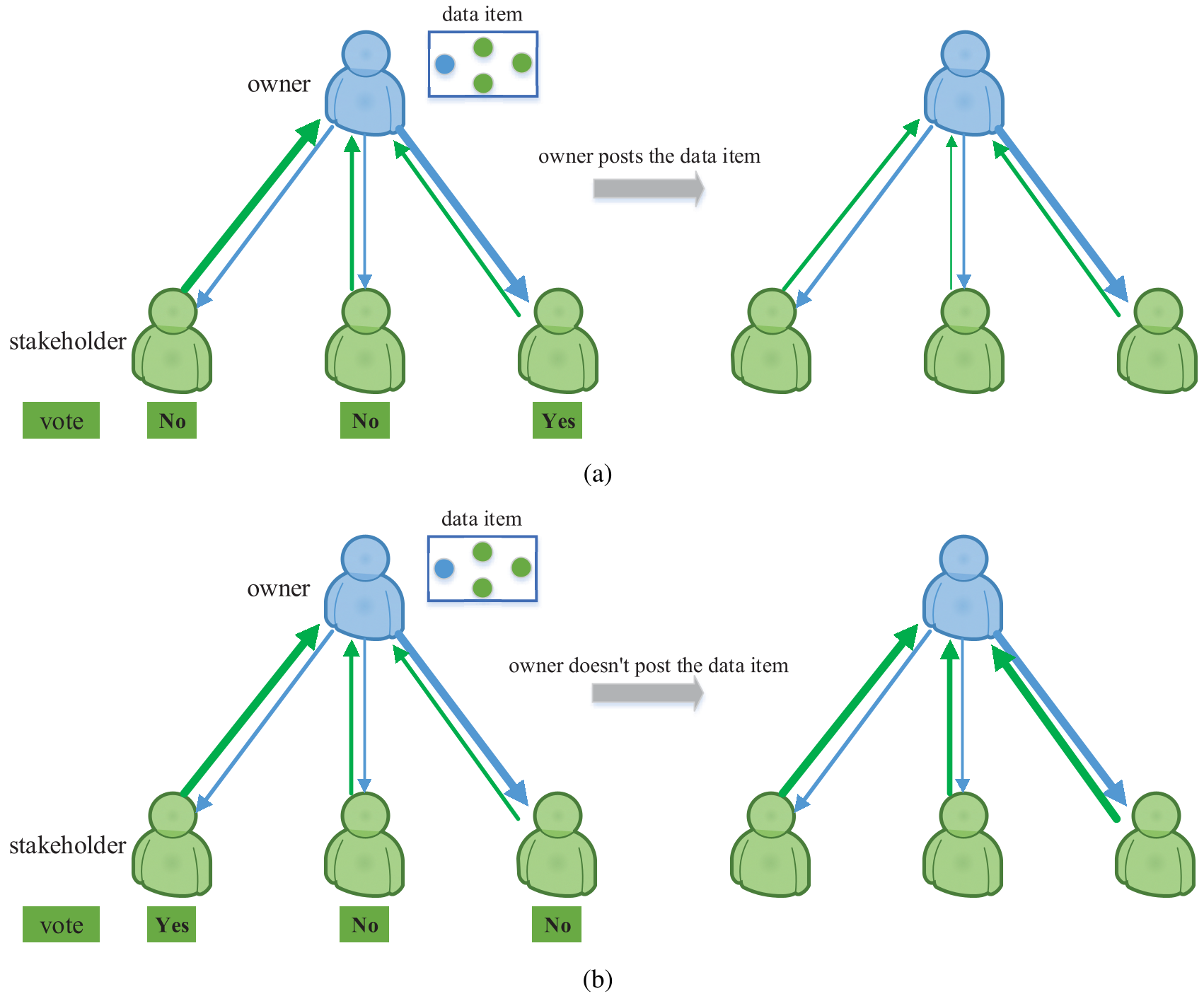
The authors introduce a decentralized mechanism where the owner solicits "votes" from stakeholders before posting.
1. Trust-Weighted Voting
Instead of a simple majority, the "aggregated opinion" () is calculated by weighting stakeholder votes by the owner's trust in them (): The data is only posted if exceeds a threshold .
2. Dynamic Trust Evolution
Trust isn't static. It acts as a "social currency":
- Loss: If an owner ignores a stakeholder's privacy (causing a leak), the stakeholder’s trust in the owner drops.
- Gain: If the owner respects the stakeholder's preferences, trust increases.
This creates a feedback loop: if you violate my privacy today, I will trust you less tomorrow, and consequently, I will ignore your privacy preferences when I post co-owned data in the future.
The Balancing Act: The Bandit Approach
A user faces a constant trade-off: Data Sharing Benefit vs. Privacy Loss.
- Setting too low leads to constant sharing but massive reputation loss and future privacy risk.
- Setting too high preserves privacy but stifles the social utility of the network.
The authors formulate the selection of as a Multi-Armed Bandit (MAB) problem. Specifically, they use the Upper Confidence Bound (UCB) algorithm. The user "explores" different thresholds (arms) and "exploits" the one that delivers the highest payoff (Benefit - Privacy Loss).
Experiments: Trust Wins
The researchers tested their model on synthetic scale-free and small-world networks, as well as real-world Facebook data.
Key Findings:
- Altruism is Selfishly Beneficial: Users who were more considerate of others (solicited opinions) ended up with lower cumulative privacy loss because they maintained a higher reputation.
- Trust Outperforms Equality: Weighting votes by trust resulted in better privacy outcomes than simple majority voting.
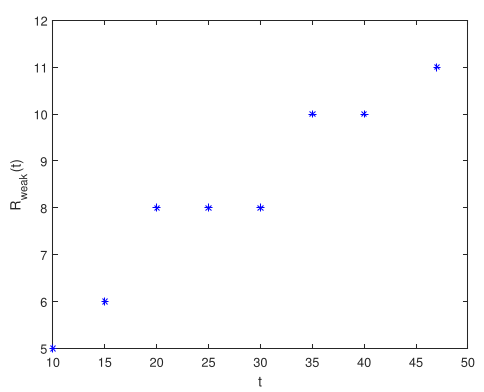
- UCB Adaptability: As shown in the performance graphs, the UCB policy consistently outperformed fixed or random strategies, effectively learning the "sweet spot" for sharing.
Deep Insight & Conclusion
The core takeaway of this work is the mathematical validation of "Social Reputation" as a mechanism for privacy. By linking the act of posting to a dynamic trust value, the authors transform privacy management from a static permission check into a strategic, long-term game.
The use of Bandit Algorithms is particularly clever here because it acknowledges that "perfect privacy" is not the goal of a social network—"optimized sharing" is. While the model currently focuses on binary "post/don't post" decisions, the framework could easily scale to more granular access control levels in the future.