
TLIM: Balancing Trust and Time in the Quest for Social Influence
Trust based latency aware influence maximization in social networks
The paper introduces TLIM (Trust-based Latency aware Influence Maximization), a novel framework for identifying influential nodes in social networks by jointly modeling temporal dynamics and trust/distrust relationships. It extends the classic Independent Cascade (IC) model to include negative influence and propagation delays, achieving superior performance on real-world datasets like Wikipedia, Slashdot, and Epinions.
Executive Summary
TL;DR: The paper presents TLIM, the first influence maximization model to simultaneously tackle the "When" (Latency) and the "Who" (Trust vs. Distrust) of social propagation. By extending the Independent Cascade model to account for negative feedback and time delays, the authors provide a more realistic framework for viral marketing and opinion dynamics.
Positioning: This work serves as a critical "bridge" between classic discrete optimization and the messy reality of social trust networks. It moves beyond simple graph reachability by treating influence as a probabilistic state that can be revoked by distrusted neighbors.
Problem & Motivation: The Flaw in "Instant" Positivity
Most influence maximization (IM) research operates under two dangerous assumptions:
- Positivity Bias: It assumes all interactions are helpful. In reality, a "foes" relationship in Slashdot or a "dislike" in Epinions can actively suppress the spread of an idea.
- Temporal Blindness: It assumes influence is fixed per step. Real-world "word-of-mouth" has uneven delays—some people react in hours, others in days.
The authors argue that ignoring these factors leads to "mediocre performance." If you pick a seed that is highly connected but widely distrusted, your "viral" campaign might actually trigger a wave of negative sentiment.
Methodology: The TLIC Model and State Trees
The core innovation is the Trust-based Latency aware Independent Cascade (TLIC) model.
1. The State Transition Logic
Unlike the classic IC model where a node stays "active" forever, TLIC allows a node to oscillate between positive and negative states. A trusted neighbor can persuade you (Positive State), but a distrusted peer doing the same action might push you to the opposite opinion (Negative State).
2. Trust and Distrust Paths
The authors define two critical structures:
- Trust Path (TP): A sequence of exclusively positive links.
- Distrust Path (DP): A sequence ending in a negative link, representing "the enemy of my friend is someone I don't trust."
3. The State Tree (ST) Structure
To avoid the computational nightmare of Monte Carlo simulations, the authors propose the State Tree.
 Fig: The State Tree structure used to calculate the probability of a node's state at time T.
This binary tree tracks the probability of being in a positive or negative state at each time step . Each level represents a time unit, and the transitions are weighted by the accumulated probabilities from TPs and DPs.
Experiments: Superior Quality and Scalability
The authors tested TLIM against MISP (a latency-aware but trust-blind model) and TBHD (a trust-aware but time-blind heuristic).
SOTA Comparison
In Wikipedia, Slashdot, and Epinions, TLIM consistently dominated. As the seed set size grows, the gap between TLIM and its competitors widens.
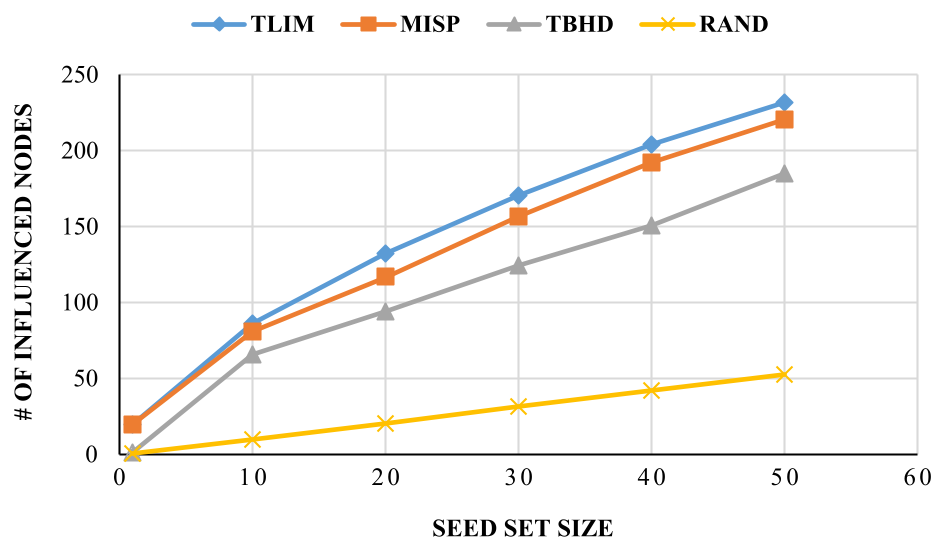 Fig: Influence spread on Wikivote dataset showing TLIM's clear advantage.
The Impact of Time ()
A fascinating finding is how the deadline changes the seed set. As shown in the paper's overlap tables, the "optimal" nodes for a 2-day campaign are vastly different from those for a 10-day campaign. TLIM adapts to this, whereas simple degree-based methods (TBHD) remain static and inefficient.
Critical Analysis & Conclusion
Takeaway
TLIM proves that trust is a filter for influence. In the age of polarized social media, modeling the "negative" edge is no longer optional—it's the only way to get an accurate prediction of information flow.
Limitations & Future Work
- Greedy Bottleneck: While the marginal estimation helps, the initial calculation for every single node in large networks is still heavy (~2700s for Wikivote).
- Binary States: The model uses discrete states (Positive/Negative). Future research could explore "Continuous States" (e.g., degree of belief).
- Intelligent Search: Replacing the hill-climbing greedy approach with more advanced meta-heuristics could further improve performance in hyper-scale graphs.
Final verdict: A foundational read for anyone working on Signed Social Networks and Time-Critical Viral Marketing.