
The Trust Blueprint: Reshaping OSN Privacy Through Dynamic Graph Models
A Trust based Privacy Providing Model for Online Social Networks
The paper introduces a hybrid privacy protection model for Online Social Networks (OSNs) that integrates Trust evaluation, Role-Based Access Control (RBAC), and Information Flow Control. By combining these three phases, the system provides automated, more precise sharing decisions to prevent unintentional data leakage to adversaries or unknown "friends of friends."
TL;DR
Social media privacy is often a "leaky bucket" where your data isn't just exposed by who you know, but by what your friends do. This paper presents an integrated model that combines Trust scores, Role-Based Access, and Information Flow Control. By using graph algorithms like MST and Max-Flow, it automatically filters out potential adversaries and ensures your data stays within a verified "Trustworthy Network."
Strategic Positioning: This work bridges the gap between static access control (RBAC) and complex network topology analysis, providing a practical framework for automated privacy management in modern social platforms.
The "Friend-of-a-Friend" Paradox
The fundamental motivation for this research is the Information Leakage problem. You might trust "Alice," but when Alice "likes" your photo, her entire network—including people you don't know—suddenly gains access.
Current OSN settings are:
- Too Binary: You're either a "friend" or you're not.
- Too Static: Trust doesn't change over time in the system, even if your real-world relationship does.
- Human-Dependent: It assumes users can predict how data flows through a graph, which is mathematically impossible for a human to visualize at scale.
Methodology: The Three-Phase Defense
The authors break down the solution into three distinct technical layers:
Phase I: Quantifying Trust (UTV)
Instead of just a "friend" label, every connection is assigned a User Trust Value (UTV). This is calculated using two categories of data:
- User Credibility (): Features like Account Age (seniority) and Total Number of Friends.
- Connection Strength (): Features like Friendship Duration, Mutual Friends, and Interaction Ratios (Inflow/Outflow).
Phase II: Filtering by Role and Threshold
The model applies Role-Based Access Control (RBAC) but adds a dynamic twist: even if you have the "Family" role, you are blocked if your UTV falls below a specific threshold (e.g., 0.745).
Phase III: Pruning the Graph (Information Flow)
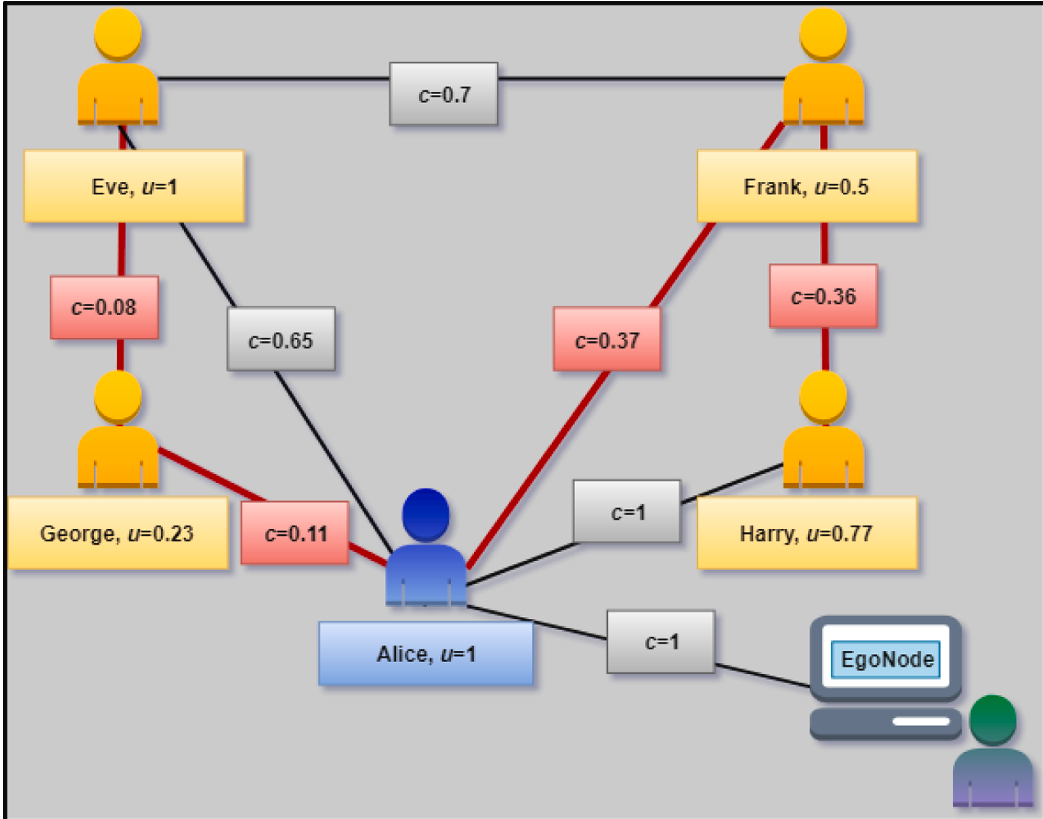
This is the most technically sophisticated part. To prevent leakage to second-degree connections, the model uses two algorithmic approaches:
- Minimum Spanning Tree (MST): It identifies the weakest links in your social sub-graph and "cuts" them to ensure information only travels through the most robust trust paths.
- Dinic’s Algorithm: Used to find all possible paths from you (the source) to a target user. If no single path meets a Minimal Path Trust Value (MPTV), the target is flagged as an adversary.
Experimental Results: Machines vs. Human Intuition
The researchers validated their model against 282 real-world Facebook users. Key insights include:
- Parameter Accuracy: Users generally agreed that "Total Friends" and "Friendship Duration" were the most critical indicators of credibility.
- Decision Correlation: The model's automated "Allow/Deny" decisions had a high correlation with the participants' subjective trust ratings (STV).
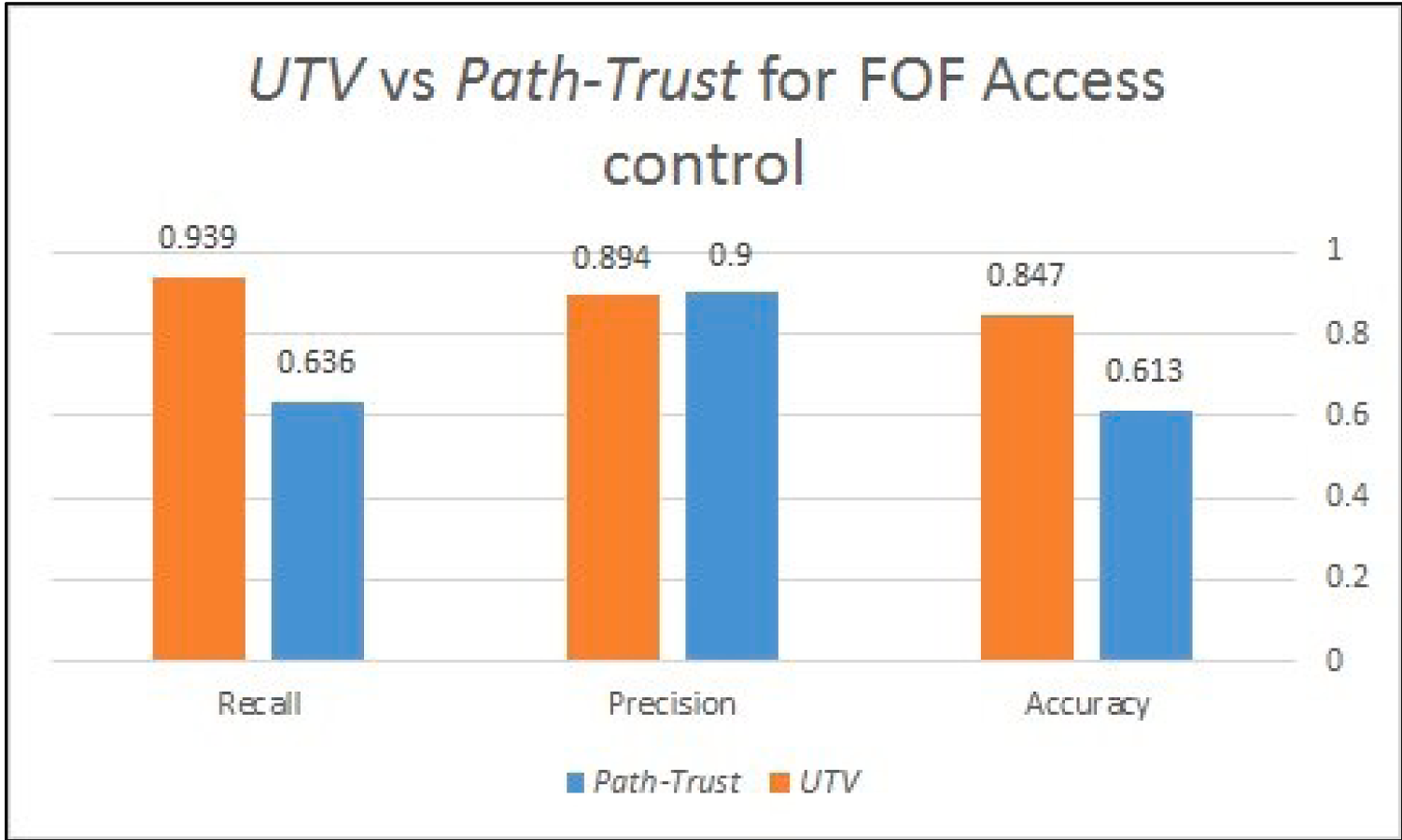
- Performance Metrics: The UTV method proved superior to the "Path-Trust" method, which the authors noted was often "too conservative," blocking legitimate acquaintances because it multiplied trust factors across hops, exponentially reducing the final score.
Critical Insight & Future Outlook
The beauty of this model lies in its scalability. By focusing on a user's "Ego-network" (usually 2-3 hops away), the computational overhead remains manageable even for platforms with millions of users.
Limitations: The model faces a "Cold Start" problem. New, legitimate users with low friend counts or young accounts might be incorrectly flagged as spammers. The authors suggest using "Inflow/Outflow ratios" to mitigate this, but more work is needed to balance security for new members.
The Takeaway: The future of digital privacy isn't more "privacy toggles"; it's automated graph hygiene. By quantifying trust, we can finally build OSNs that understand "closeness" as well as humans do.