
Trust-Aware Collaborative Filtering: Elevating Recommendation Quality in Social Networks
Contents Recommendation Scheme Considering Trust and Collaborative Filtering in Online Social Networks
This paper presents a Content Recommendation Scheme that integrates User Trust and Content Trust into a Collaborative Filtering (CF) framework for Online Social Networks (OSNs). By analyzing multi-dimensional social activities, the method filters out low-trust users and prioritizes content based on user expertise, achieving state-of-the-art accuracy on the MovieLens dataset.
TL;DR
Recommender systems often fail because they trust every user input equally. This paper introduces a Dual-Trust Recommendation Scheme that filters out "noisy" users by analyzing their social reputation and boosts high-quality content by evaluating the expertise of its creators. By integrating these trust metrics into Collaborative Filtering, the authors achieved up to a 14% reduction in error (MAE) over traditional baselines.
Problem & Motivation: The "Trust Gap" in Social Data
Online Social Networks (OSNs) are gold mines for user preferences, but they are also filled with low-quality data or "shilling" behaviors. Traditional Collaborative Filtering (CF) relies heavily on similarity scores (e.g., Pearson Correlation), but similarity does not equal reliability. If a user with low expertise or poor social standing provides a rating, using that data to recommend content to others degrades the system.
The authors argue that existing schemes ignore the rich breadth of human activity—like "likes" received, follower-to-following ratios, and category-specific expertise—which are essential for establishing a Trust Hierarchy.
Methodology: The Dual Pillars of Trust
The proposed system operates in two distinct phases: filtering the "who" and prioritizing the "what."
1. User Trust (The Gatekeeper)
Before calculating similarities, the system filters out untrustworthy users. User Trust () is calculated using three vectors:
- Social Activity (): The ratio of likes received from others.
- Content Usage (): The volume of active interactions.
- Social Relationships (): The follower ratio.
Only users exceeding a specific threshold are used for the Pearson similarity calculation.
2. Content Trust (The Ranker)
Even among trusted users, expertise varies. A movie buff's rating should carry more weight in the "Cinema" category than a casual observer's. The system identifies Category Experts and uses Implicit Activity Analysis (positive vs. negative interactions) to assign a content trust score (), which dictates the final recommendation priority.
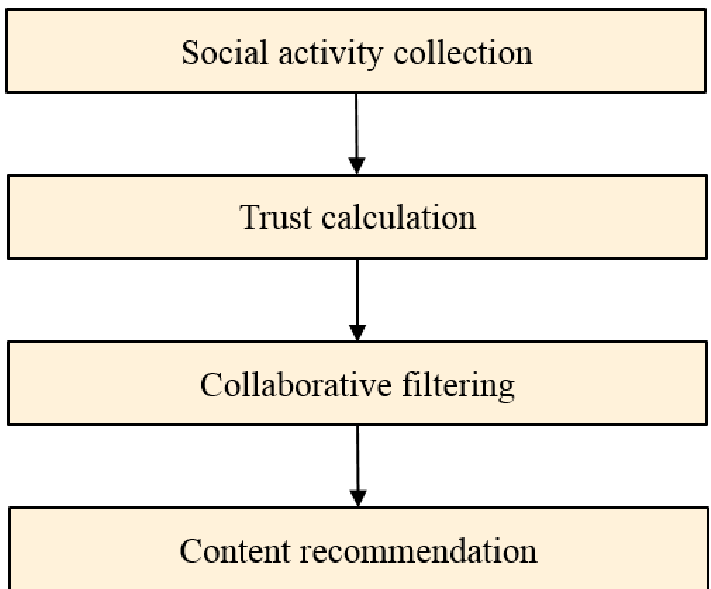 Figure 1: The system architecture showing the flow from raw OSN data to filtered, prioritized recommendations.
Experiments: Proving the Advantage
The authors tested their method against three major benchmarks:
- Item-based CF
- User-based CF
- RTCF (Reliability-based Trust-aware CF)
Using the MovieLens dataset, they measured performance via Mean Absolute Error (MAE) and Root Mean Square Error (RMSE).
Key Metrics:
- Accuracy (MAE): The proposed method outperformed standard CF by 14% and the competitive RTCF by 7%.
- Precision (RMSE): A 3-7% improvement was observed across the board, proving that trust-based filtering significantly reduces "wild" predictions.
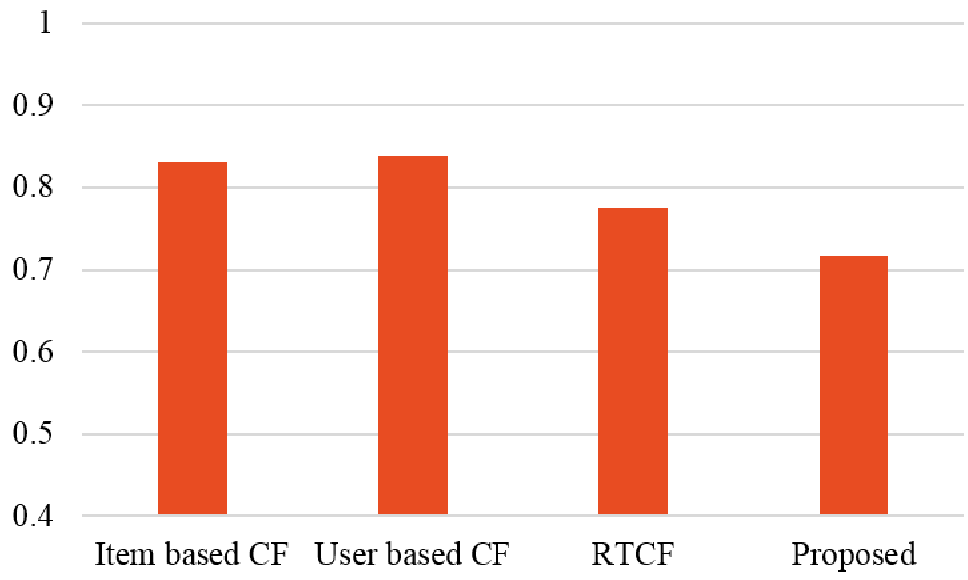 Figure 2: MAE Comparison - Lower values indicate higher recommendation accuracy.
Critical Analysis & Conclusion
Takeaway
The core insight is that trust is multi-dimensional. By separating social reputation (User Trust) from domain authority (Content Trust), the system effectively purges noise without losing the benefits of collaborative patterns.
Limitations & Future Work
While the results are impressive, the paper relies on the MovieLens dataset, which is a static rating dataset. In a real-time OSN (like Twitter/X), trust is dynamic and can decay over time. The authors acknowledge this and suggest that future versions of the algorithm will incorporate user feedback loops and evolving preferences to maintain the "freshness" of the trust scores.
For practitioners, this research serves as a reminder: in the age of bots and social engineering, a recommendation system is only as good as the trust it places in its users.