
Trust and Compactness: The Secret Sauce for Stable Social Communities
Trust and Compactness in Social Network Groups
This paper introduces a novel measure of group "compactness" for Online Social Networks (OSNs), integrating both user similarity and mutual trustworthiness. The authors propose the Users-to-Groups (U2G) algorithm, a distributed multi-agent matching framework that optimizes group stability and member satisfaction, achieving a 14-15% improvement in Mean Average Compactness (MAC) on the Epinions and Ciao datasets.
TL;DR
In the digital age, we don't just join groups because we like the same things; we stay because we trust the people in them. This paper introduces the U2G (Users-to-Groups) algorithm, which redefines "Group Compactness" by combining semantic similarity with asymmetric trust measures. Unlike traditional clustering models that eventually fall apart, this trust-aware approach increases group stability and satisfies users by matching them with communities they are likely to remain loyal to.
The Missing Link: Why Similarity is Not Enough
Most social network algorithms operate on a simple "homophily" principle: if you like sci-fi and I like sci-fi, we should be in a group together. However, the authors argue that this overlooks stability over time.
Prior works often treat community formation as a static clustering problem. The pain point? In the real world, groups are dynamic. High similarity might bring people together, but a lack of mutual trustworthiness causes them to leave. The authors' core insight is that compactness—the measure of how tightly a group holds together—must account for the perceived reliability of its members.
Methodology: Engineering Compactness
The paper formalizes compactness through a multi-agent architecture where every user and group has a dedicated software agent.
1. The Compactness Equation
Compactness () is calculated as: Where:
- : Similarity across four dimensions (Interests, Access Modes, Behaviors, and Social Ties).
- : Trust, computed by blending direct reliability (observed interactions) with global reputation.
- : A weight coefficient allowing users to balance similarity vs. trust.
2. The U2G Algorithm
To handle massive networks where no agent has "global knowledge," the authors utilize a heuristic rooted in the Secretary Problem. Agents sample groups and only join if the new group "beats" the worst group in their current top-N list.
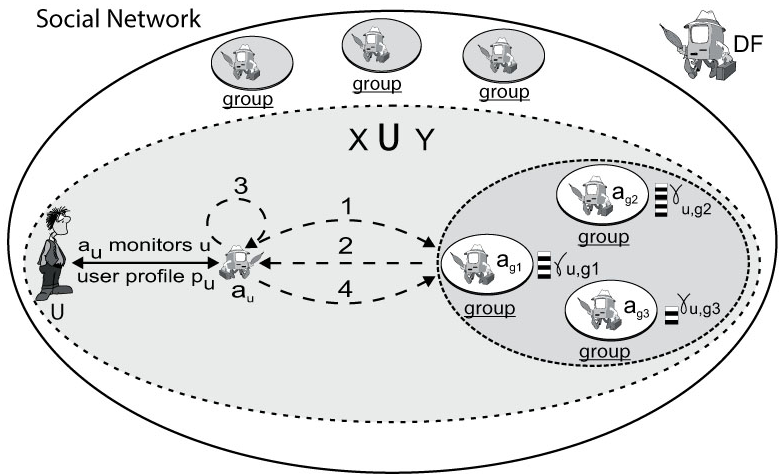 Figure 1: The distributed interaction between User and Group agents to optimize matching.
Experiments: Real-World Evidence
The researchers tested their theory using datasets from EPINIONS and CIAO, two platforms where trust is explicit.
Key Identifications:
- The Trust Advantage: The U2G-comp (Trust + Similarity) version showed a steady increase in Mean Average Compactness (MAC).
- The Failure of Similarity-Only: Surprisingly, when trust was removed (U2G-diff), group compactness actually decreased over time as users were forced into groups that looked good on paper but felt unreliable in practice.
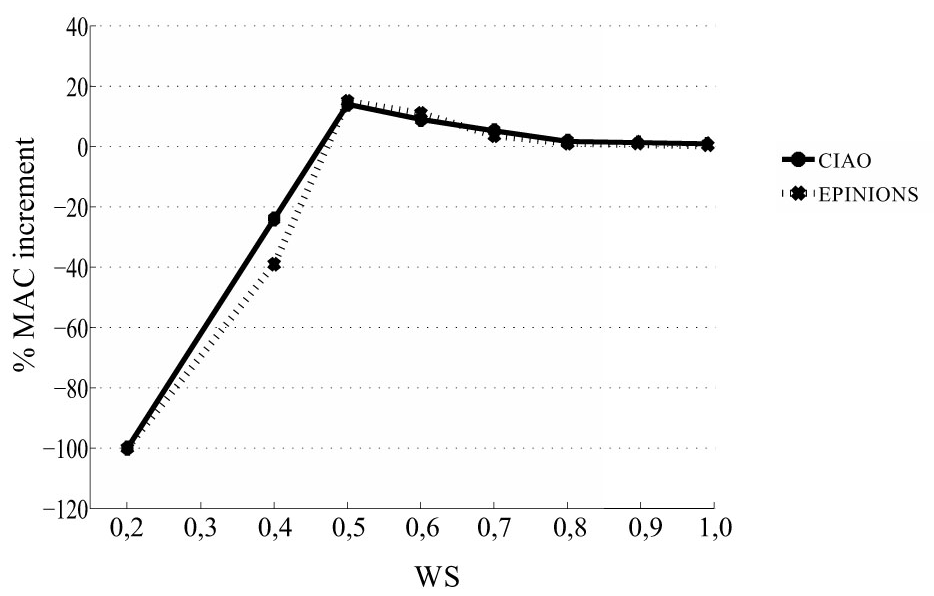 Figure 2: MAC variation comparing trust-based vs. similarity-only matching.
Stability Test
By training on 40,000 interactions and testing on the subsequent 10,000, the authors proved that groups formed with trust remain stable. This addresses the "churn" problem prevalent in modern OSNs.
Critical Analysis & Conclusion
This work shifts the paradigm of group formation from "What do they do?" to "Who do they trust?".
Strengths:
- Decentralization: The multi-agent approach is highly scalable for platforms with millions of users.
- Mathematical Rigor: Proving that the greedy heuristic handles incomplete knowledge within a constant factor () of the optimal solution provides strong theoretical confidence.
Limitations:
- The "Cold Start" for Trust: How do we measure trust in new groups where no interaction history exists? The paper relies on global reputation, but this might lead to "popularity bias."
- Weight Subjectivity: The model assumes users know how to weight , but in practice, users might need the system to learn these preferences automatically.
Future Outlook: This research highlights that the next generation of social AI won't just be better at finding "relevant" content; it will be better at finding "safe" and "reliable" social circles.