
TSG: Enhancing LBSN Recommendations through Trust, Distrust, and Geography
Trust-Distrust-Aware Point-of-Interest Recommendation in Location-Based Social Network
This paper presents a hybrid Point-of-Interest (POI) recommendation framework named TSG, which integrates user preferences, geographic power-law distributions, and social trust-distrust relationships. By leveraging explicit distrust links and their propagation, the system achieves superior accuracy and robustness in Location-Based Social Networks (LBSNs).
TL;DR
Researchers have developed TSG, a hybrid recommendation framework that goes beyond simple "friendship" links. By incorporating distrust propagation, geographic power-law distributions, and user check-in similarity, the system significantly improves Point-of-Interest (POI) recommendation accuracy on platforms like Foursquare and Gowalla, while providing a robust defense against malicious "fake" reviews.
The Motivation: Why Similarity Isn't Enough
In the world of Location-Based Social Networks (LBSNs), traditional Collaborative Filtering (CF) operates on a simple premise: if User A and User B visited the same coffee shop, they will likely enjoy the same museum. However, this logic fails under two conditions:
- Data Sparsity: Most users only visit a tiny fraction of available POIs, making the "overlap" between users nearly zero.
- The "Mean Friend" Problem: Not all social connections are positive. Standard models ignore the fact that we often disagree with certain people. If someone you distrust recommends a place, you are actually less likely to go.
The authors argue that by ignoring Distrust and Physical Distance, traditional CF models lose the context that defines human mobility.
Methodology: The Trinity of POI Recommendation
The TSG framework scores a candidate POI based on three distinct dimensions:
1. Social Trust & Distrust Propagation
Instead of treating trust as a binary (0 or 1), the paper uses a modified Jaccard coefficient.
- Trust Propagation: If A trusts B and B trusts C, A likely trusts C.
- Distrust Propagation: The authors focus on 2-level paths. For instance, if A distrusts B, and B trusts C, the negative sentiment propagates. This helps in "filtering out" recommendations from untrustworthy clusters.
2. Geographic Influence (The Tobler Law)
The model adheres to Tobler’s First Law of Geography: "Near things are more related than distant things." It uses a Power Law Distribution to model the likelihood of a visit based on the distance between a user's home/previous check-ins and the target POI.
3. Hybrid Fusion
The final recommendation score is a weighted linear combination: Where is similarity, is geography, and is trust/distrust.
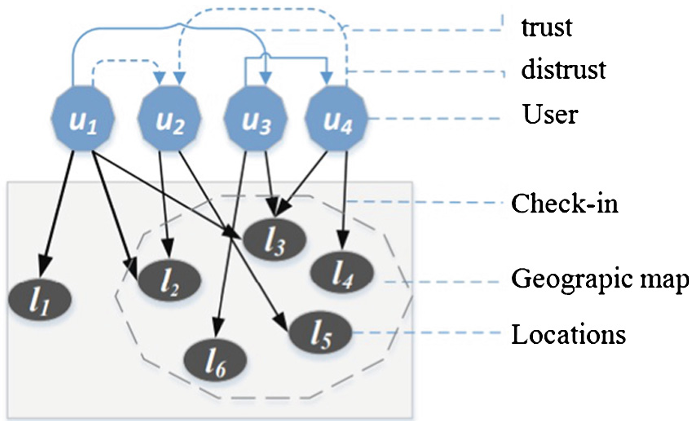 (Caption: Interaction between users, check-ins, and trust/distrust links in an LBSN.)
Experimental Results: The Power of No
The authors tested TSG on Foursquare and Gowalla.
Key Findings:
- TSG vs. Traditional CF: The hybrid model (TSG) significantly outperformed User-based CF and pure Geographic Distance models.
- The Distrust Factor: In a crucial ablation study, the "TSG-all" model (which includes distrust) outperformed "TSG" (trust only). This proves that knowing who a user doesn't like is highly predictive of where they won't go, effectively narrowing the search space for relevant POIs.
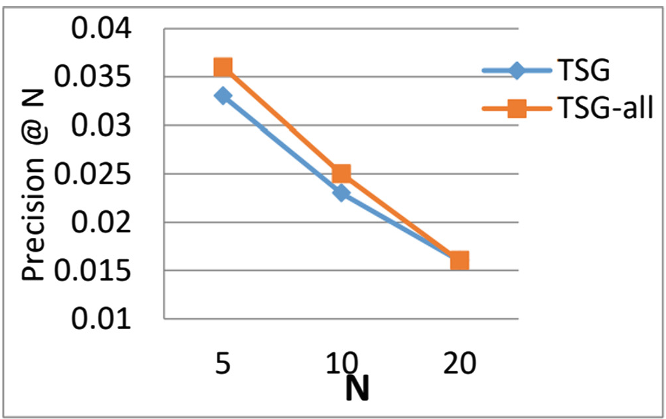 (Caption: Comparative results showing TSG's superiority in Precision and Recall on real-world datasets.)
Critical Analysis & Future Outlook
The introduction of explicit distrust propagation is the standout contribution here. In an era of "recommendation attacks" where bot accounts inflate POI ratings, a distrust-aware system provides a mathematical shield against manipulation.
Limitations:
- The model relies on explicit distrust links, which are rare in modern UI/UX (most apps only have a "Follow" button, not a "Distrust" button).
- The hybrid weights () require manual tuning, which might vary across different cities or cultures.
Future Work: Integrating this trust-distrust logic into a Graph Neural Network (GNN) could allow for even deeper propagation and automated feature weighting, potentially solving the manual tuning issue identified in this study.
Summary Takeaway: By combining the "where" (Geography) with the "who" (Trust) and the "who-not" (Distrust), TSG provides a more human-centric approach to spatial discovery.