
PolarityTrust: Decoding the Web of Distrust to Silence Social Media Trolls
Propagation of trust and distrust for the detection of trolls in a social network
The paper introduces PolarityTrust, a novel Trust and Reputation System (TRS) for social networks that propagates both positive and negative opinions to compute user trustworthiness. By extending the PolarityRank algorithm, it effectively demotes malicious users (trolls) even under complex attack scenarios such as orchestrated slandering or camouflaging.
TL;DR
Researchers from the University of Seville have developed PolarityTrust, a sophisticated ranking algorithm that treats "distrust" as a first-class citizen in social network analysis. Unlike standard algorithms that only look at who you follow, PolarityTrust analyzes the coherence of your opinions. If you back a user who is widely considered a troll, the system "reacts" by slashing your own reputation.
Problem & Motivation: The Symmetrical Failure of Trust
Current Trust and Reputation Systems (TRSs) are often "blind in one eye." They are designed to find the "good guys" through positive reinforcement (PageRank, EigenTrust) but fail to systematically handle negative signals. This creates several vulnerabilities:
- Orchestrated Attacks: Groups of trolls voting for each other to create a "reputation bubble."
- Spies & Camouflage: Malicious users who act normally to gain trust, only to use that influence to promote other trolls or slander legitimate users.
- The Scalability Paradox: Human moderators can't keep up with millions of users, but automated systems are easily gamed.
The authors' core insight is that trust is transitive, but distrust is transformative. To build a robust system, we must not only propagate who is trusted but also penalize those whose judgments conflict with the collective "moral" compass of the network.
Methodology: The Mechanics of Polarity
PolarityTrust is built on the foundation of PolarityRank. It assigns every user two values: (Positive) and (Negative). The final trust score is a normalized difference between the two.
1. The Transitivity of Distrust
The system operates on a "Multiplicative Distrust" model:
- If a trusted user dislikes you, your distrust score increases.
- Crucially: If a highly distrusted user dislikes you, your trust score might actually increase (the "enemy of my enemy" logic).
2. Defensive Strategies
To prevent trolls from hijacking the math, the authors introduced two key filters:
- Non-Negative Propagation (PRNN): Once a user is identified as "bad," their negative opinions are ignored by the system so they cannot harm innocent users.
- Action-Reaction (PRAR): This is a dynamic penalty. If user A votes positively for user B, but the network at large distrusts user B, user A is flagged for "Positive Dishonesty" and their negative polarity is increased as a penalty.
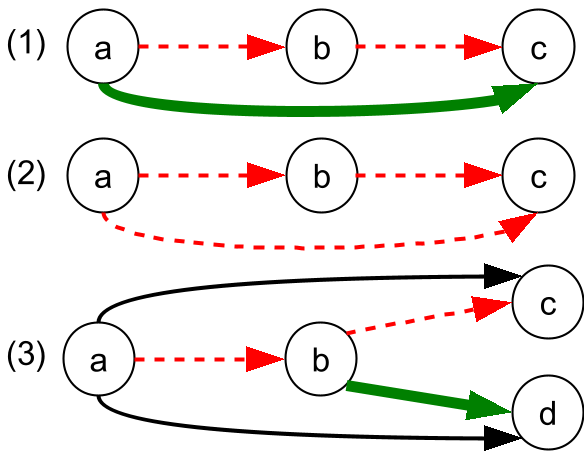 Figure 1: Comparison of Trust/Distrust transitivity models including Multiplicative, Additive, and Neutral assumptions.
Experiments & Results: Testing Under Fire
The authors didn't just test on clean data; they subjected the algorithm to Threat Models A through E, which include individual malice, collectives, spies, and slandering.
Real-World Performance: The Slashdot Zoo
Using a crawl of Slashdot.org (71,500 users, 510,000 links), PolarityTrust was tasked with identifying the "NoMoreTrolls" list.
- PolarityTrust (PT) achieved an nDCG of 0.588, significantly outperforming the standard EigenTrust (0.310).
- Even when "trolling" the Slashdot dataset with synthetic malicious edges to simulate a coordinated attack, PolarityTrust's performance remained stable while other methods' error rates skyrocketed.
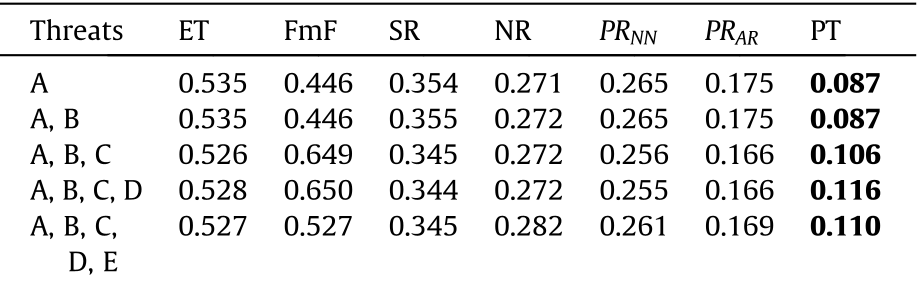 Table 1: Error rates of various algorithms. PT shows the lowest error across all combined threat scenarios.
The Power of "Sources of Distrust"
A unique feature of this study is the use of seed nodes. By manually flagging just 5 known trolls as "Sources of Distrust," the algorithm's ability to demote other malicious users improved by nearly 40% in some scenarios.
Critical Insight: Why This Matters
The genius of PolarityTrust lies in its Action-Reaction mechanism. Most systems try to identify trolls by their actions (what they post). PolarityTrust identifies them by their judgments.
Limitations:
- The system relies on a few "Sources of Trust" (like moderators or founders) to kickstart the propagation. In a completely flat, anonymous network, it might struggle with a "cold start."
- It assumes a binary world of "friend" and "foe," whereas real human relationships are often more nuanced or contextual.
Future Work: The authors suggest looking into Playbook Sequences—where trolls use long-term, complex sequences of actions to mimic legitimate users over months before attacking. Detecting these will require adding a temporal dimension to the PolarityTrust graph.
Conclusion
PolarityTrust provides a mathematically rigorous way to handle "haters" and "trolls" not by censorship, but by decreasing their "weight" in the social fabric. It proves that in the digital world, your reputation is defined not just by who likes you, but by who you like.