
Beyond Homogeneity: Inferring Trust in Multi-Relational Social Networks
Towards a Model for Inferring Trust in Heterogeneous Social Networks
This paper introduces a novel framework for inferring trust in heterogeneous social networks by leveraging multiple types of relations (e.g., friendship, university affiliation). It proposes a Genetic Algorithm (GA) for relation extraction and a Dijkstra-based trust inference algorithm that outperforms the state-of-the-art Tidal model in accuracy.
TL;DR
Trust is the currency of social interaction, yet most AI models treat social links as uniform. This paper breaks that mold by proposing a system that "extracts" trust from heterogeneous relations (like shared hobbies or schools) using a Genetic Algorithm and a refined Dijkstra-based inference engine. The result? A 20% reduction in error compared to the classic Tidal algorithm.
Background: The Homogeneity Trap
In the digital world, we often model social networks as simple graphs where an edge exists or doesn't. However, real human trust is nuanced. You might trust a colleague's technical advice because you went to the same university, not just because you are "connected."
Most prior work (like Golbeck’s Tidal) focuses on homogeneous networks, assuming all paths are created equal. The authors of this paper argue that to truly predict trust, we must look at the heterogeneous nature of our lives—the multiple overlapping communities we belong to.
Methodology: The Core Engine
The paper introduces a two-stage approach: Relation Extraction and Trust Inference.
1. Relation Extraction via Genetic Algorithm (GA)
The goal here is to find which "base relations" (e.g., "same music taste," "same insurance company") actually contribute to trust.
- The Problem: If you have 2,000 types of relations, which ones matter?
- The GA Solution: Each "chromosome" represents a set of coefficients for these relations. The algorithm evolves these coefficients to minimize the difference (Frobenius norm) between the predicted trust and a small sample of known trust values.
- Sparsity (The K-Constraint): Unlike standard regression, the GA restricts the solution to the K most important relations, making the model highly interpretable for humans.
2. The Trust Inference Algorithm
When no direct link exists between User A and User B, the model must find a path. While Tidal uses a simple BFS/Shortest Path, this paper proposes a cost function based on Dijkstra’s:
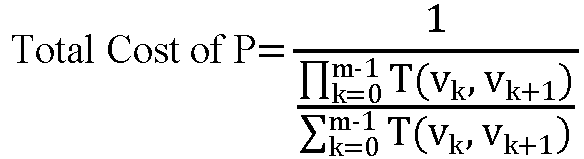
- Physical Intuition: This formula balances the product of trust (reliability along the chain) against the sum of trust, ensuring the algorithm doesn't just pick the shortest path, but the "strongest" one.
Performance & Experiments
The authors tested their model on a real-world dataset of 43 users across 27 communities (e.g., a "Java" programming community).
Key Findings:
- Lower Error Growth: As shown in the performance charts, the average error stays remarkably low even when only 10% of the network is known.
- Head-to-Head vs. Tidal:
- Proposed Model Error: 1.53
- Tidal Model Error: 1.92
- Complexity: The GA approach offers a time complexity of , making it more scalable than traditional regression methods when dealing with thousands of base relations.
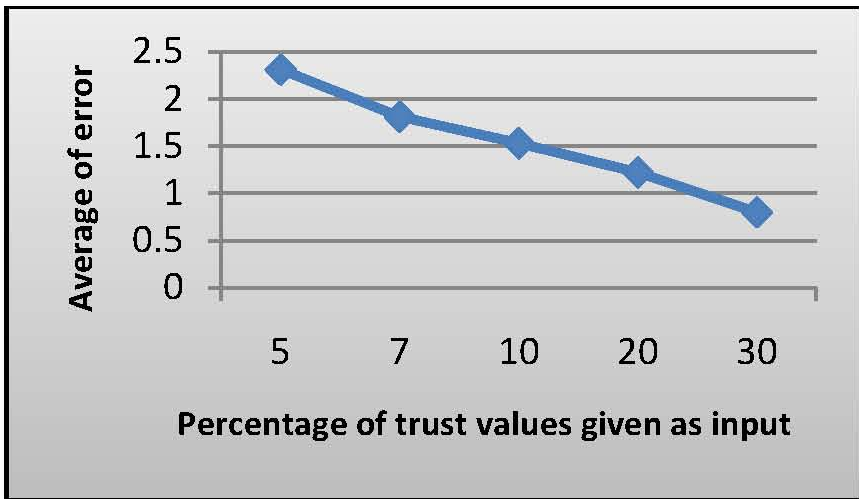 Figure: Average error of the proposed model across different random runs.
Critical Insight & Future Outlook
The most profound takeaway is the interpretability. In a world of black-box AI, this model can tell you: "User A trusts User B primarily because of their shared educational background, while their shared gender had zero statistical impact."
Limitations: The model currently relies on linear combinations. The authors admit that logical operators (e.g., "Trust = Uni AND (NOT same gender)") might be more effective for specific tasks like matrimonial suggestions or niche marketing.
Conclusion: By combining evolutionary computing with graph theory, this research provides a robust blueprint for the next generation of recommendation engines where trust is context-aware and mathematically grounded.