
Trust in the Social Internet of Things: Beyond Digital IDs to Social Behavior
Trust Management in the Social Internet of Things
This paper proposes a multifaceted Trust Management scheme for the Social Internet of Things (SIoT) to ensure reliable autonomous communication between intelligent objects. The model integrates five key dimensions—Direct Observation, Indirect Recommendations, Centrality, Energy, and Service Score—outperforming existing Fuzzy-based and SOA-based trust models in detecting malicious behavior.
TL;DR
As billons of devices become "socially conscious" entities, the risk of deceptive nodes rises. This paper introduces a comprehensive trust management framework that combines social reputation with physical device health (like energy levels) to identify and isolate malicious nodes—particularly those performing "On-Off" attacks—much faster than current industry standards.
Contextualizing the SIoT
The Social Internet of Things (SIoT) isn't just about devices talking; it's about devices forming relationships. Whether it's a Parental relationship (same manufacturer) or a Social relationship (devices of friends), these connections form a "Small World" network. However, in such a decentralized web, how does a sensor know if a peer is a reliable relay or a malicious sinkhole?
The Problem: The "On-Off" Deception
Most trust models are binary or slow to react. A particularly nasty threat is the On-Off Selective Forwarding Attack. Here, a node behaves perfectly to build reputation, then intermittently drops packets to save its own energy or disrupt the network, only to return to "good" behavior before it gets caught. This oscillation makes traditional "Average Reputation" scores easy to manipulate.
Methodology: The Five Pillars of Trust
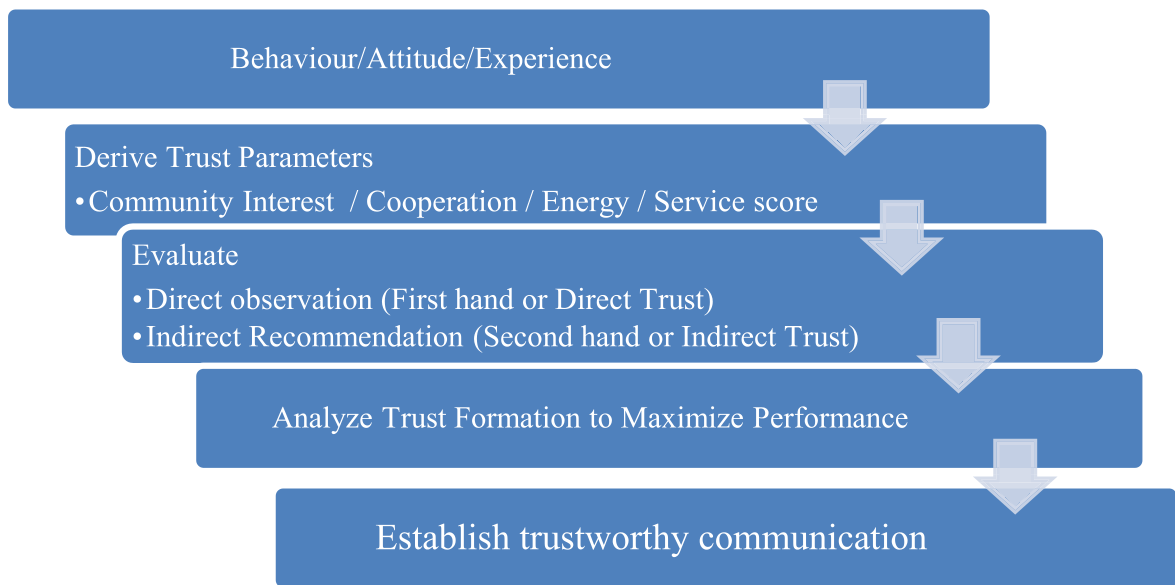
The authors propose a multi-dimensional trust score that doesn't just look at whether a packet was delivered, but why and where it happened.
1. The Trust Equation
The core innovation lies in the weighted integration of multiple metrics:
- Direct Trust (): First-hand experience.
- Centrality (): Prevents "Sybil-like" behavior where a node tries to become too important too quickly.
- Energy (): A "Physical " Checkup. If a node claims to be busy but its energy remains suspiciously high, it might be an On-Off attacker "resting" during its Off-cycle.
- Service Score (): A reward/penalty system that heavily punishes failures (penalty is twice the reward value).
Experimental Proof: Speed of Isolation
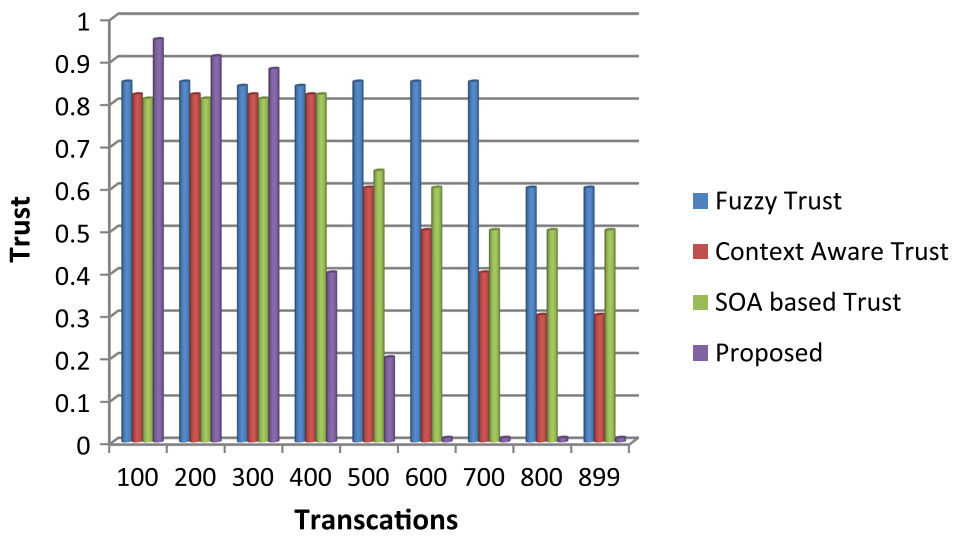
Using real-world traces from the SIGCOMM 2009 Mobiclique dataset, the researchers simulated 899 transactions among 100 smart objects.
Key Findings:
- Attack Detection: The proposed model detected On-Off attacks by the 400th transaction.
- Isolation: By the 600th transaction, the malicious node's trust fell below the 0.4 threshold and was completely isolated.
- Comparison: Competitors like Saied et al. (Context-Aware Trust) didn't detect the same attack until the 800th transaction—and even then, they failed to isolate the node, allowing the attacker to potentially "heal" its reputation and attack again.
Critical Insight: The "Energy" Smokescreen
The most brilliant technical intuition in this paper is using Energy as a proxy for honesty. In resource-constrained IoT environments, forwarding packets is expensive. If a node is behaving "well" but isn't losing energy at the same rate as its peers, it is likely cheating the system.
Conclusion and Future Outlook
While the current model is highly effective at isolation, the authors acknowledge a potential drawback: it might be too unforgiving. Future work aims to allow "rehabilitation" for nodes whose trust drops due to legitimate issues (like temporary signal interference) rather than malice.
In the era of autonomous smart cities, this research provides the necessary "social immune system" for the things that live among us.
Takeaway: Trust is not just about what a node says, but how it consumes its lifeblood (energy) and fits into the social fabric of the network.