
Trust in the Fold: Detecting Twitter Malice via Heterogeneous Graph Propagation
Using Trust Model for Detecting Malicious Activities in Twitter
2014-01-01
Summary
Problem
Method
Results
Takeaways
Abstract
The paper presents an extended trust model and a novel heterogeneous social graph for detecting malicious activities on Twitter. By modeling interactions like retweets and mentions as a graph, it utilizes a backward trustworthiness propagation algorithm to achieve an F-1 score exceeding 0.95.
## TL;DR
Twitter is a breeding ground for spammers and rumor-mongers, yet manual reporting is too slow and feature-based ML is too shallow. This paper introduces a **Heterogeneous Social Graph** that links users, tweets, and hashtags, using a **Backward Trustworthiness Propagation** algorithm to sniff out malicious actors. By treating "trust" as a flowable resource, the authors boosted detection F-1 scores to an impressive **95.8%**.
## Background: The Limits of Isolation
In the fight against cybercrime, most platforms play a game of "whack-a-mole" using manual reports or simple filters. The core problem? Malicious users are clever—they mimic human profiles and vary their content.
The authors argue that the missing link is **Contextual Integration**. A spammer doesn't just exist as a profile; they exist through their retweets, the hashtags they hijack, and the users they target. Previous methods failed because they looked at these entities in isolation.
## Methodology: The Power of Heterogeneity
### 1. The Heterogeneous Social Graph
Instead of a simple "User-Follows-User" graph, the authors construct a multi-modal network. They identify five critical edges that define the Twitter experience:
* **User $\rightarrow$ User**: Following relationships.
* **User $\rightarrow$ Tweet**: Authorship.
* **Tweet $\rightarrow$ Hashtag**: Topic coverage.
* **Tweet $\rightarrow$ Tweet**: Retweeting (information flow).
* **Tweet $\rightarrow$ User**: Mentions (direct interaction).
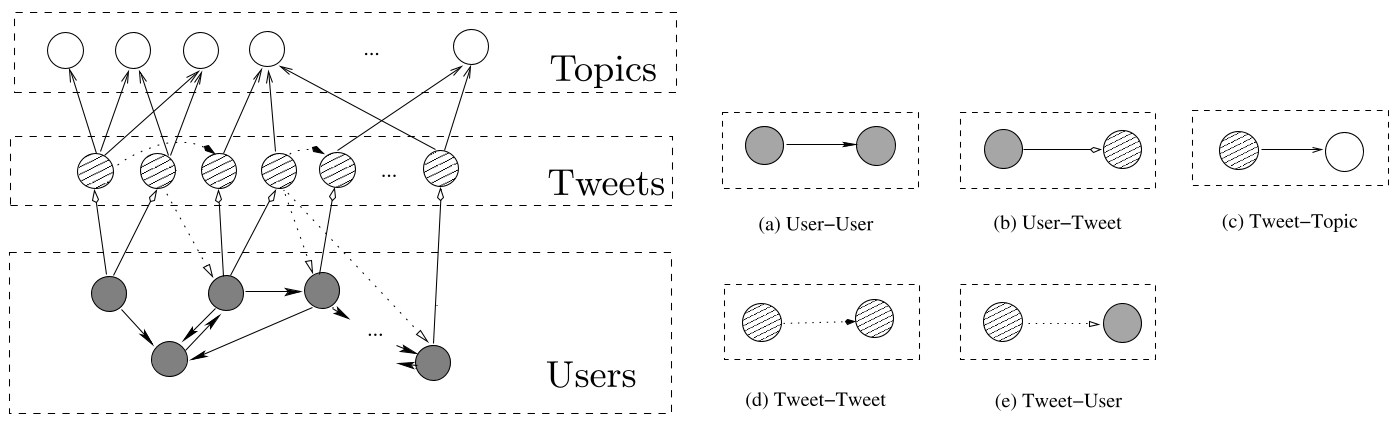
*Figure 1: The unified heterogeneous graph representation capturing diverse social activities.*
### 2. Backward Trust Propagation
The technical intuition here is a "Guilt by Association" logic applied through a PageRank-style iteration. In standard PageRank, an edge from A to B is an endorsement (B gets trust). In this **Backward Model**, if vertex B is determined to be untrustworthy, that lack of trust propagates back to A.
The authors propose two versions:
* **Normal Trustworthiness Score**: All nodes start at a neutral 0.5.
* **Biased Trustworthiness Score**: Incorporates "Ground Truth" (whitelists/blacklists) by pinning known legitimate users to 1.0 and known bad actors to 0.0 before starting the propagation.
## Experiments and Professional Insights
The team crawled 5.5 million users and manually labeled 10,000 as ground truth. The results highlight a critical threshold effect: when the threshold $ heta$ is set to 0.4, the model perfectly balances precision and recall.
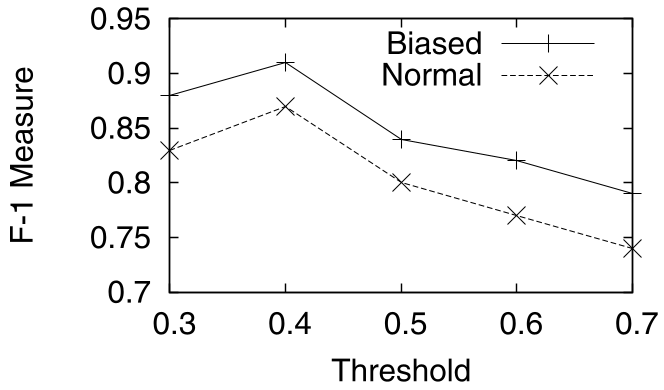
*Figure 2: Performance comparison of Normal vs. Biased trustworthiness scores across different thresholds. The Biased model (dotted line) consistently provides higher F-1 stability.*
### Key Technical Takeaway:
The most striking result isn't just the graph's performance alone, but its utility as a **Feature**. When the Trustworthiness Score was added to a standard Decision Tree (WEKA), the performance jumped from ~89% to nearly 96%. This proves that **topological trust** provides orthogonal information that profile metadata (like follower count) simply cannot capture.
## Critical Analysis & Conclusion
### Strengths
* **Holistic Modeling**: By including Hashtags and Retweets, the model captures the *intent* of a campaign, not just the *content*.
* **Scalability**: The iterative propagation is computationally efficient, much like the original Google PageRank.
### Limitations
* **Cold Start**: The model relies on some level of connectivity. A brand-new malicious account with no followers or retweets might fly under the radar until it joins the "heterogeneous" conversation.
* **Temporal Dynamics**: The paper uses a static snapshot. Malicious behavior is often bursty and temporal; adding time-decay to edges could be a potent future improvement.
### Final Thoughts
This work serves as a foundational step toward **Structural Cybersecurity**. In an era of LLM-generated spam that can bypass traditional NLP filters, looking at the *structure* of how information moves—rather than just what the information says—remains our most robust defense.