
Trust Meets Deep RL: Automating the Privacy Paradox in Social Networks
Trust and privacy correlations in social networks: A deep learning framework
This paper introduces a Deep Reinforcement Learning (DRL) framework for automating privacy management in Online Social Networks (OSNs). By utilizing Neural Fitted Q Iteration (NFQ) with LSTM networks, the system dynamically generates personalized privacy labels based on multi-dimensional trust scores, effectively correlating social trust with data exposure policies.
TL;DR
Managing privacy on platforms like Facebook is a cognitive burden. This paper presents a Deep Reinforcement Learning framework that treats trust as a "reward." Using an LSTM-based Neural Fitted Q (NFQ) iteration, it learns to automatically adjust privacy labels and data sharing percentages for friends, ensuring that high-trust interactions lead to higher data exposure while protecting users from less-trusted contacts.
The "Privacy Paradox" and Manual Fatigue
For years, Online Social Networks (OSNs) have relied on manual privacy settings. Users are expected to categorize friends into lists (Close Friends, Acquaintances, etc.), but social dynamics are too fluid for static labels.
The core pain point identified by the authors is two-fold:
- Interaction Exposure: Users accidentally expose activities (likes, event interests) to "friends" who aren't actually trusted.
- Propagational Privacy: User updates leak to indirect friends (Friends of Friends) through the interactions of direct friends.
Previous "Privacy Wizards" were semi-supervised—they still required users to do the heavy lifting of initial labeling. This paper asks: Can an AI agent learn who you trust by watching how you interact?
Methodology: The Architecture of Trust
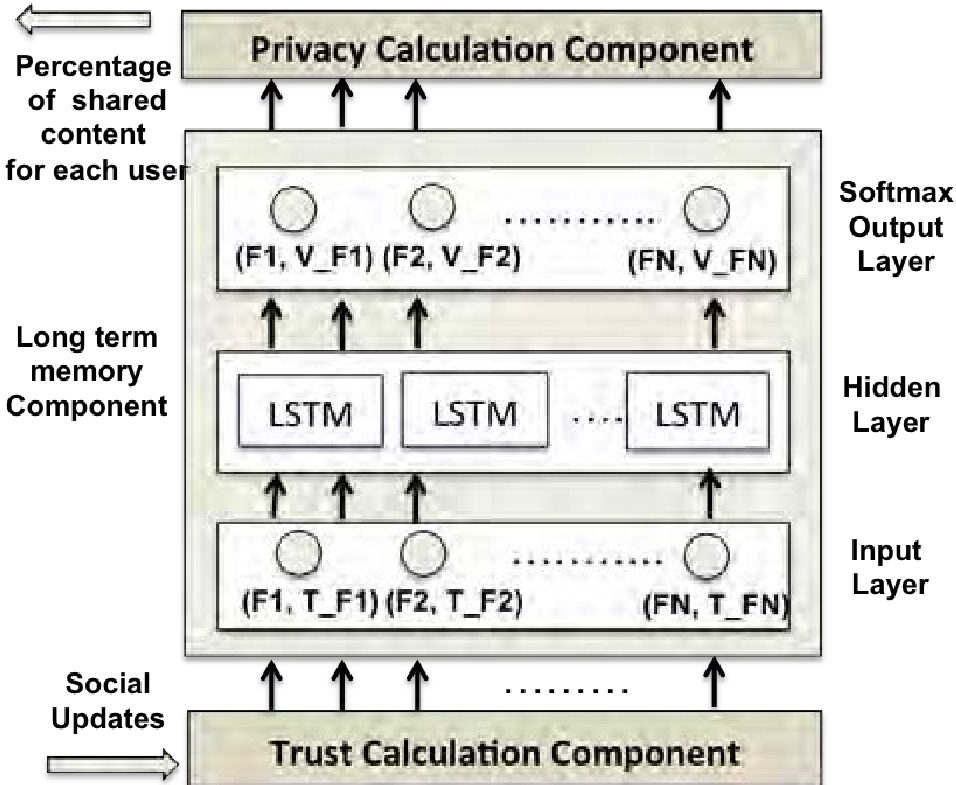
The framework is built as a closed-loop system where social interactions feed into a deep brain that outputs privacy policies.
1. The Multi-Dimensional Trust Engine
Instead of just looking at mutual friends, the model uses a hybrid trust score:
- Network Similarity: The overlap of friendship graphs.
- Profile Similarity: Shared interests and demographic data.
- Interaction Ratios: Specific metrics for "Likes" and "Comments" received from a friend relative to the total.
2. Neural Fitted Q Iteration (NFQ) with LSTM
This is the "Brain" of the operation. By mapping the social graph as a state-space, the agent explores different "data propagation" actions.
- Why LSTM? Trust isn't a snapshot; it has a history. LSTMs are used to approximate the action-value function because they can maintain long-term dependencies in interaction sequences.
- Why NFQ? Standard Q-learning can be slow to converge. NFQ allows for more efficient training with fewer samples by reusing transition experiences.
Experimental Insights
The researchers tested the framework on a substantial Facebook dataset featuring 75 seed users and their extended network of 13,000 profiles.
Key Findings:
The success of the RL agent was measured by how well its "Sharing Frequency" (the policy) matched the calculated "Trust" levels.
- Positive Correlation: The model achieved a Spearman’s r of 0.66 for high-frequency interactions. This indicates that the AI's "advantage" values (deciding who to share more with) aligned closely with established trust metrics.
- Adaptive Learning: The -greedy strategy ensured the model didn't just stick to a few friends; it occasionally "explored" other friends to see if trust levels had evolved, reflecting the dynamic nature of real-world friendships.

Critical Analysis & Conclusion
Takeaway
The shift from "Manual Labeling" to "Reinforcement Learning" is a significant step toward Zero-touch Privacy. By quantifying trust through interactions (likes/comments) and network structure, the framework creates a fluid privacy boundary that breathes with the user's social life.
Limitations
- Cold Start: The model relies on interaction data. New friends with zero history might be unfairly restricted until enough data is gathered.
- Computation: Training LSTMs for every user's personal social graph is computationally expensive at the scale of billions of users.
Future Outlook
The next frontier is extending this to Indirect Privacy. If my friend "likes" my photo, it might appear on the feed of a stranger (his friend). Applying this RL framework to multi-hop propagation could finally solve the "leaky" nature of modern social media algorithms.