
Trusting the Eahouker: The Social Fabric of Smart Home Management
A Discussion on Trust Requirements for a Social Network of Eahoukers
This paper introduces the trust requirements for the "SandS" (Social and Smart) project, which develops a social network of "eahoukers" (easy house workers). It categorizes trust properties and metrics to facilitate socially generated knowledge sharing for domestic appliance management.
TL;DR
The "SandS" project introduces the concept of eahoukers—house workers empowered by a social network of smart appliances. This paper explores the essential trust requirements needed to make such a network viable, moving beyond simple security to look at how user satisfaction and reputation can guide automated home management.
Background: Why Trust Matters in the Kitchen
Imagine your oven "learns" a new recipe from a stranger's social feed. Do you trust it not to burn your house down? As we transition to the Social and Smart (SandS) vision, common appliances become nodes in a social network. The core challenge is not just connectivity, but the uncertainty of outcomes. If we lack reliable information sources, we assume high risk. Trust, therefore, becomes the "subjective belief" that allows a user to follow a recipe recommended by the network.
The Anatomy of Trust
The authors break down trust into several technical properties that form the basis for their algorithms:
- Asymmetry: A supervisor may trust an employee, but the employee's trust in the supervisor follows a different logic.
- Transitivity Limits: If Alice trusts Bob and Bob trusts Carol, it does not mean Alice automatically trusts Carol's appliance settings.
- Time and Distance Aging: Older information is less reliable, and recommendations from "distant" nodes (strangers) carry less weight than those from closer peers.
Methodology: The SandS Session
To understand how trust integrates into daily life, the paper maps out a typical "SandS Session" using a conceptual map.
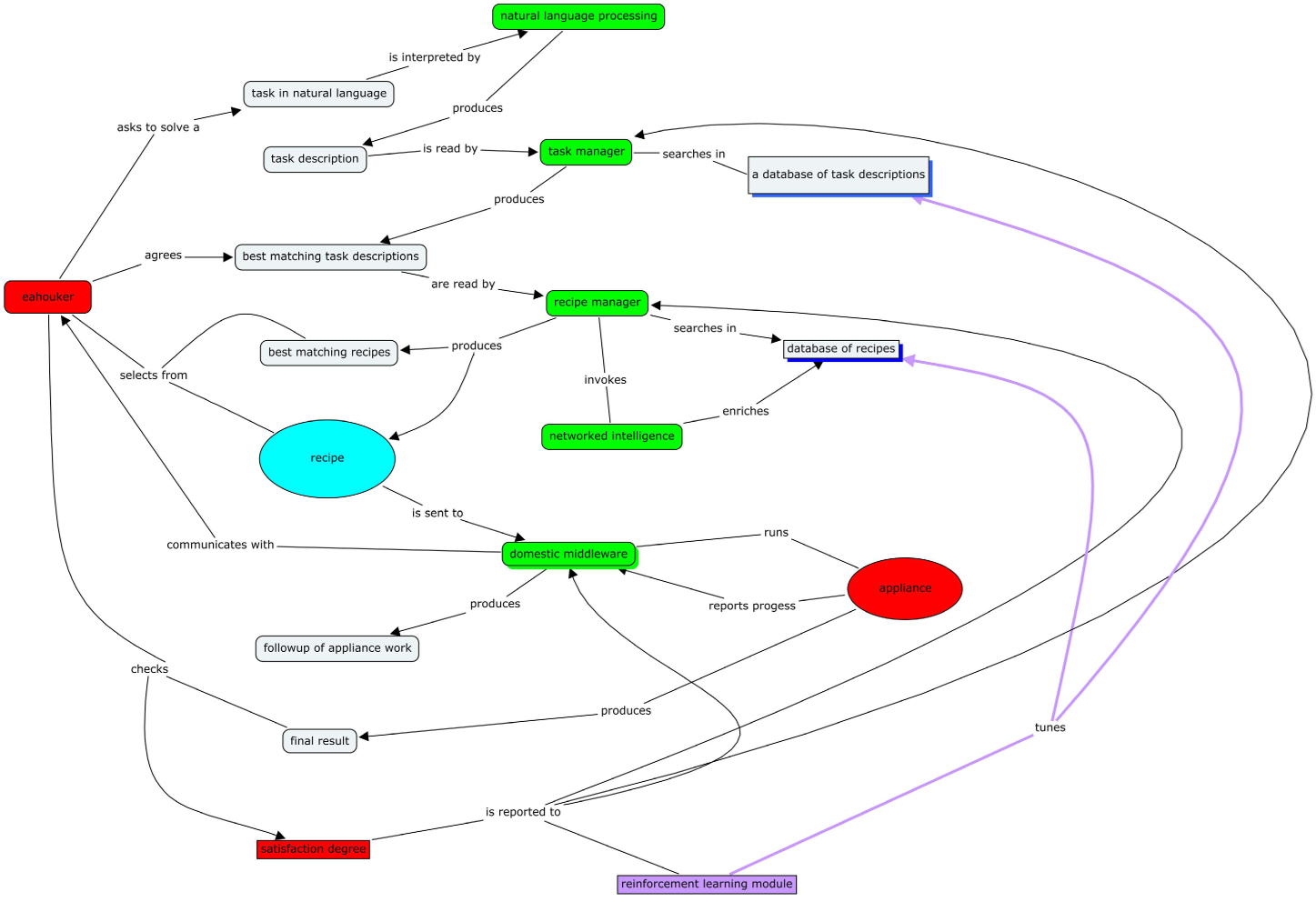
The workflow proceeds as follows:
- Intent: The eahouker states a task in Natural Language.
- Matching: The system searches for the best "Appliance Recipe."
- Intelligence: If no exact match exists, a Networked Intelligence layer generates a new solution.
- Feedback: The user's eventual satisfaction acts as a "Reward Value" for a Reinforcement Learning (RL) module.
Experimental Insight: Filtering the Social Noise
The paper highlights that trust is the primary filter in three areas:
- Rogue Detection: Identifying malicious users attempting to "sabotage" appliance databases.
- Quality Assessment: Recognizing that while most eahoukers are helpful, many are "unknowing and misleading" amateurs.
- Personal Consensus: A recipe that works for one user might not meet the quality standards of another, requiring a Personalization-Subjectivity approach.
Deep Insight & Future Outlook
The most intriguing takeaway is the role of the Reinforcement Learning module. By using satisfaction as a reward, the system can perform a "backward propagation" of trust. This creates a self-healing social network where successful interactions strengthen the reputation of certain recipes and contributors, while failures prune the network or trigger adaptations.
Limitations: The paper is primarily a requirements discussion. The "Bucket Brigade" problem—how to correctly attribute credit or blame across a complex chain of automated decisions—remains a significant hurdle for future implementation.
Conclusion
The move toward "Social and Smart" domesticity requires more than just better sensors; it requires a robust, dynamic model of human trust. By treating trust as a continuous, context-dependent variable, the SandS project paves the way for a domestic environment that learns not just from data, but from social consensus.