
TSSR: Bridging Trust and Semantics for Robust Social Recommendation
A trust and semantic based approach for social recommendation
The paper proposes TSSR (Trust and Semantic-based Social Recommendation), a matrix factorization framework that fuses explicit social trust with implicit semantic relationships. By constructing a Heterogeneous Information Network (HIN) and utilizing metapath2vec for node embedding, TSSR achieves SOTA performance in rating prediction and personalized ranking.
TL;DR
The TSSR (Trust and Semantic-based Social Recommendation) approach addresses the chronic "cold-start" problem in recommendation systems by looking beyond explicit friend lists. It combines a sophisticated trust propagation model with HIN (Heterogeneous Information Network) embeddings to identify "semantic friends"—users with identical tastes who aren't necessarily connected. This hybrid approach yields superior accuracy (RMSE 0.826) on the FilmTrust benchmark.
Problem & Motivation: The "Stranger Danger" in Data
Most recommendation engines fail when a new user joins (Cold-start) or when users have only rated a handful of items (Sparsity). While social recommendation—using your friends' tastes to predict yours—was a breakthrough, it carries a fundamental flaw: not all friends are equal.
Current SOTA methods often struggle because:
- Explicit bias: They assume every "follower" link carries the same weight.
- Transitivity neglect: They fail to capture the "friend-of-a-friend" influence effectively.
- Missing Links: They overlook "Semantic Friends"—users who share your soul-level taste in niche cinema but aren't in your contact list.
Methodology: The TSSR Architecture
The authors propose a dual-track regularization framework for Matrix Factorization (MF).
1. Influential User Computation (Explicit Track)
Instead of binary trust, TSSR calculates Weighted Trust (WT). It factors in:
- Direct Trust (DT): Existing social links.
- Indirect Trust (IT): Propagated trust across multiple hops (transitivity).
- Pearson Correlation (S): Ensuring that trust is only high if the users actually have similar rating behaviors.
2. Semantic Friend Discovery (Implicit Track)
TSSR constructs a Heterogeneous Information Network (HIN). This graph contains multiple node types (Users, Movies, Genres) and relationship types (Ratings, Trust, Membership).
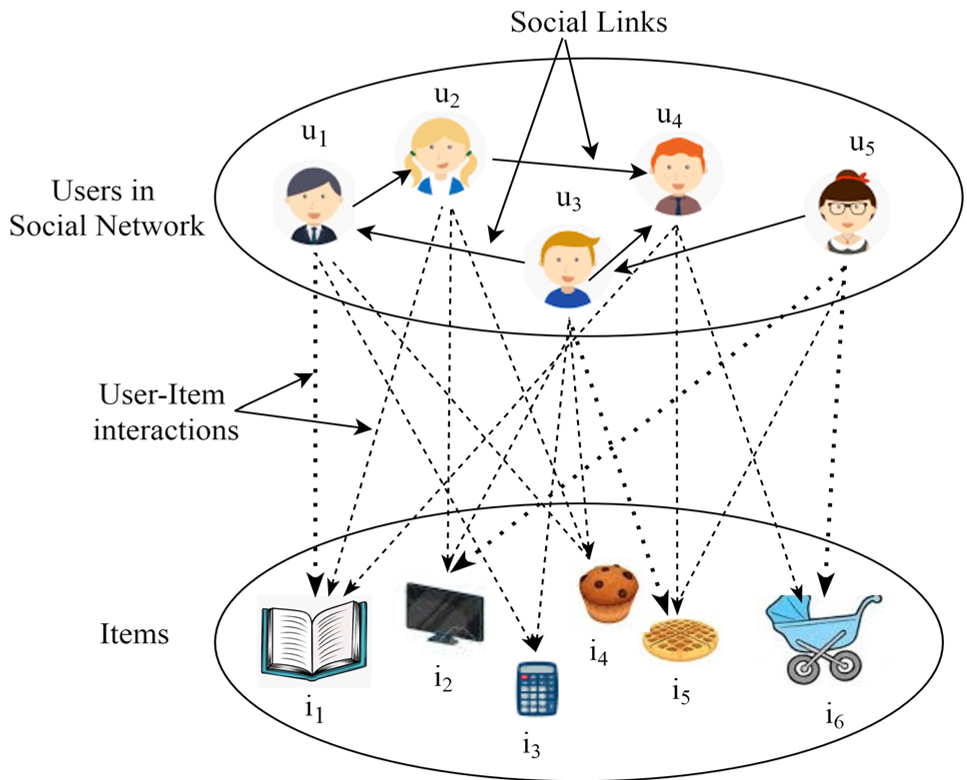
The system then uses Meta-paths (like User -> Movie -> User) to perform biased random walks. These walks are fed into a Skip-gram model (metapath2vec) to learn latent embeddings for each user. Users close in this embedding space are "Top-K Semantic Friends."
3. Integrated Matrix Factorization
The final objective function incorporates three types of regularizers:
- Model Regularizer: Standard to prevent overfitting.
- Explicit Social Regularizer: Pulls a user's latent vector closer to their trusted friends.
- Semantic Social Regularizer: Pulls closer to their discovered semantic friends.
Experiments & Results: Crushing the Cold-Start
The model was validated on the FilmTrust dataset against heavyweights like SocialMF, TrustSVD, and CUNE-MF.
Key Findings:
- SOTA Performance: TSSR consistently achieved lower Error (RMSE/MAE) across different latent factor dimensions (d=5, d=10).
- Cold-Start Resilience: For users with <5 ratings, TSSR showed a dramatic improvement. While standard models struggle with near-zero data, TSSR uses the semantic network to "borrow" preferences from similar users.
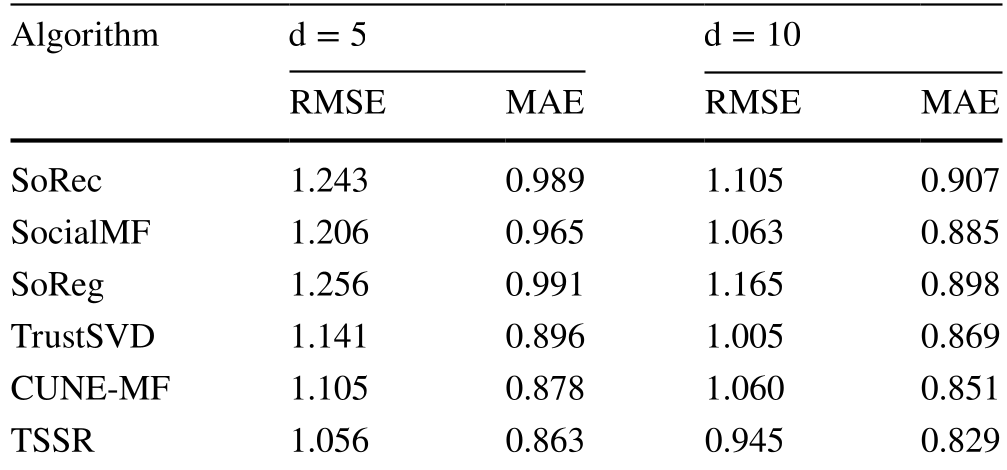 Table: TSSR performance compared to baselines for Cold-start users.
- The "K" Factor: The authors found that setting (number of semantic friends) to approximately 40 is optimal. Adding more than 40 friends introduces "noise" that degrades recommendation quality.
Critical Insight: Why it Works
The brilliance of TSSR isn't just in the math; it's in the Inductive Bias. By forcing the Matrix Factorization to respect both the social graph and the semantic embedding space, the model creates a much more dense and informative latent space for users. Even if the rating matrix is empty, the social and semantic bridges allow the model to propagate information from "experts" to "novices."
Future Outlook
While TSSR is powerful, the authors note it doesn't yet account for Distrust (users whose tastes are the opposite of yours) or Temporal Dynamics (how tastes change over time). Future iterations integrating these could lead to a truly "context-aware" social intelligence for e-commerce.
Takeaway: In the era of Big Data, the most valuable signal isn't what you did, but who you are like—even if you've never met them.