
TSE Model: Decentralizing Trust in Social Networks via Cryptographic Integrity
Research and Application of Trusted Service Evaluation Model in Social Network
The paper introduces a novel Trusted Service Evaluation (TSE) model for service-oriented social networks that eliminates the need for a third-party trusted authority. It leverages a custom digital signature scheme based on the Discrete Logarithm Problem to ensure the integrity and authenticity of user reviews.
Executive Summary
TL;DR: This paper tackles the "dishonest vendor" problem in distributed social networks by introducing a Trusted Service Evaluation (TSE) model. It removes the middleman (Third Trusted Authority) and uses a robust digital signature scheme to ensure that once a user submits a review, the service provider cannot alter or delete it without detection.
Academic Positioning: This work bridges the gap between distributed network security and social reputation systems. It situates itself as an evolution of mobile social network (MSN) security, moving from centralized verification to user-centric cryptographic proof.
The Core Dilemma: Who Polices the Local Vendor?
In emerging service-oriented social networks (like location-based services found in smart cities), we often lack a "Big Brother" (like a central Yelp or eBay server) to verify reviews. If a local restaurant manages its own review database, what stops them from deleting every 1-star rating? This is known as the Comment Modification/Rejection Attack. Existing models are often too heavy for handheld devices or require a constant connection to a central authority that might not exist in autonomous sub-networks.
Methodology: Math as the "Trustee"
The authors' insight is to replace human oversight with a Digital Signature Scheme based on the hardness of the discrete logarithm problem.
1. The Architecture
The system involves three key entities:
- Key Generator Center (KGC): Issues pseudonyms to protect user privacy while ensuring each user is legitimate.
- Users: Generate reviews () locally and sign them using unique private keys.
- Service Providers (Suppliers): Must host the reviews but cannot forge the signature required to "legitimize" a modification.

2. The Signature Logic
The signature is verified using the equation: This ensures that any modification to the message () would immediately invalidate the signature. Because the service provider does not possess the user's private key (), they cannot "re-sign" a modified comment.
Experimental Performance
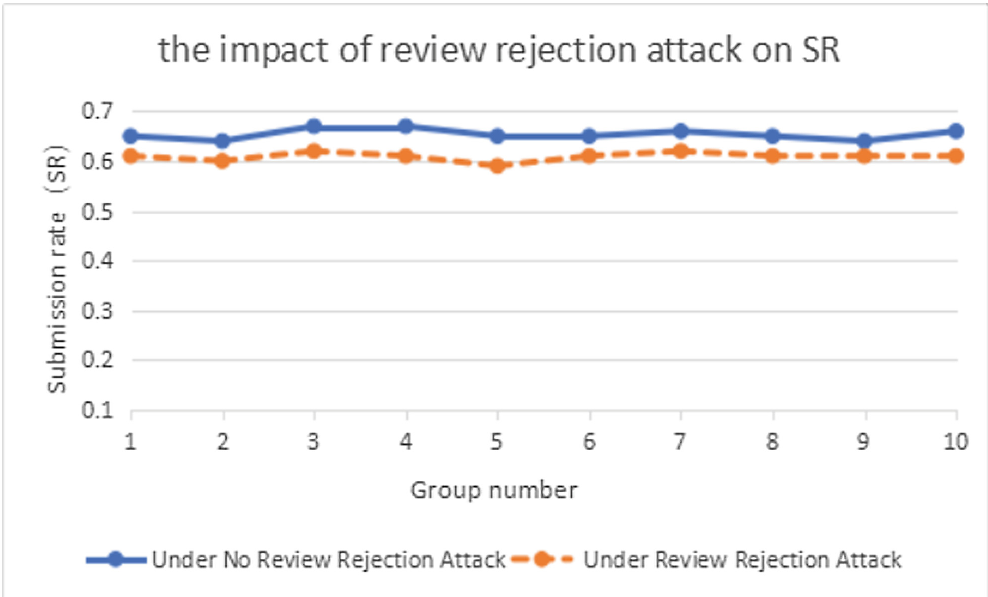
The researchers tested the model against Comment Rejection Attacks (where a vendor simply ignores a submitted review).
Key Findings:
- Submission Rate (SR): Even in adversarial environments, the success rate remained high.
- Resilience: The impact of rejection attacks was minimal, with only a ~5% drop in successful submissions compared to an ideal environment.
Critical Insight & Conclusion
The significance of this work lies in its Inductive Bias toward decentralization. By shifting the "source of truth" from a central database to the users' cryptographic signatures, it forces service providers to remain honest—not because they want to, but because the protocol makes it mathematically impossible to be effectively dishonest.
Limitations: While the model handles integrity well, it still faces challenges regarding "Sybil Attacks" (one user creating many pseudonyms), though the KGC mitigates this significantly. Future work could explore integrating this with decentralized storage (like IPFS) to ensure that the storage of reviews is as distributed as the verification of them.
Takeaway: For developers of decentralized apps (dApps), this paper provides a lightweight blueprint for implementing "bulletproof" user feedback loops without the overhead of a full blockchain or a centralized auditor.