
Trusting the Crowd: Leveraging Social Distance for Resilient Coalition Formation
Trusting Groups in Coalition Formation Using Social Distance
The paper investigates coalition formation in decentralized multi-agent systems using trust as social capital. It introduces new heuristics based on social position and "Social Distance" to decide whether an agent should join a group, achieving up to 60% task completion rates in environments with frequent defections.
TL;DR
In the world of decentralized systems (P2P, Grid Computing, Sensor Networks), forming groups is easy—keeping them together is hard. This paper moves beyond simple peer-to-peer trust by introducing Social Position and Social Distance as metrics for agents to decide when to join a group. By analyzing where an agent sits in the social graph relative to a group's "cluster," the proposed heuristics improve task completion rates from a dismal 12% (random) to a robust 60% in environments plagued by agent defections.
The Problem at the Core: The "Stranger" Penalty
Most multi-agent systems (MAS) treat trust as a linear 1-on-1 interaction. However, in the real world, joining a group is a social act. If you are an outsider (a "stranger") trying to enter a tight-knit cluster, yours and the group's risks are asymmetrical.
Existing models like Regret or PeerTrust track reputations but often fail to account for:
- Defections: Agents leaving one task for a higher utility one.
- Group Norms: The collective trustworthiness of a coalition compared to an individual's local neighborhood.
- Topological Bias: How an agent's location in a network graph dictates their "Social Capital."
Methodology: From Direct Trust to Social Norms
The authors propose that trust is not just a value but a form of "Social Capital." They define several key heuristics to bridge the gap between individual metrics and group dynamics:
1. Social Norms vs. Local Neighbourhood
The "Social Norm" of a group is defined as the average of all trust relationships within that group. An agent only joins if the group's internal trust exceeds the average trust the agent has in its own immediate neighbors.
2. Social Distance Heuristic
This is the most innovative contribution. An agent identifies a "Cluster" (a set of trusted peers) and its "Boundary."
- Negative Social Distance: The agent is deep inside a cluster (well-protected).
- Zero Social Distance: The agent is on the boundary.
- Positive Social Distance: The agent is an outsider looking in.
The probability of accepting an invitation is scaled based on this distance, effectively modeling the "Entry Requirement" for outsiders.
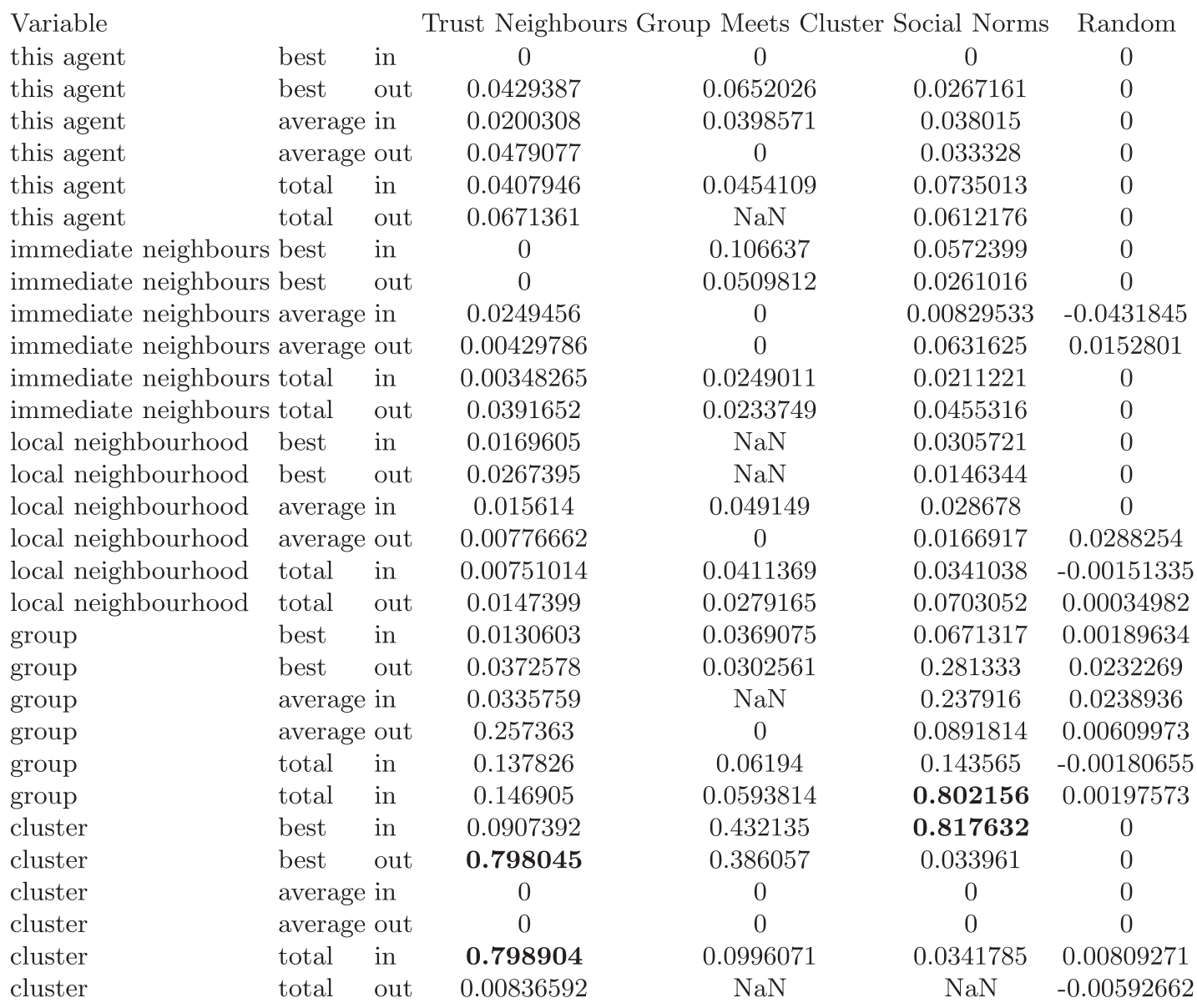 Table 1: Correlations between an agent's social position variables and the success of various strategies.
Experiments & Results: Stability in Chaos
The researchers simulated a 100-node graph with 800 trust edges, introducing 1,000 tasks over time.
Key Findings:
- Organizational Performance: The "Social Distance" and "Correlation" heuristics significantly outperformed random joining. The system stabilized as agents learned the trust values of their peers, reaching a performance plateau around 60%.
- Agent Participation: Interestingly, while both methods achieved similar global utility, the Using Correlations method allowed for much broader participation across the society. The Social Distance method tended to favor well-positioned agents, creating a "tighter" distribution of success.
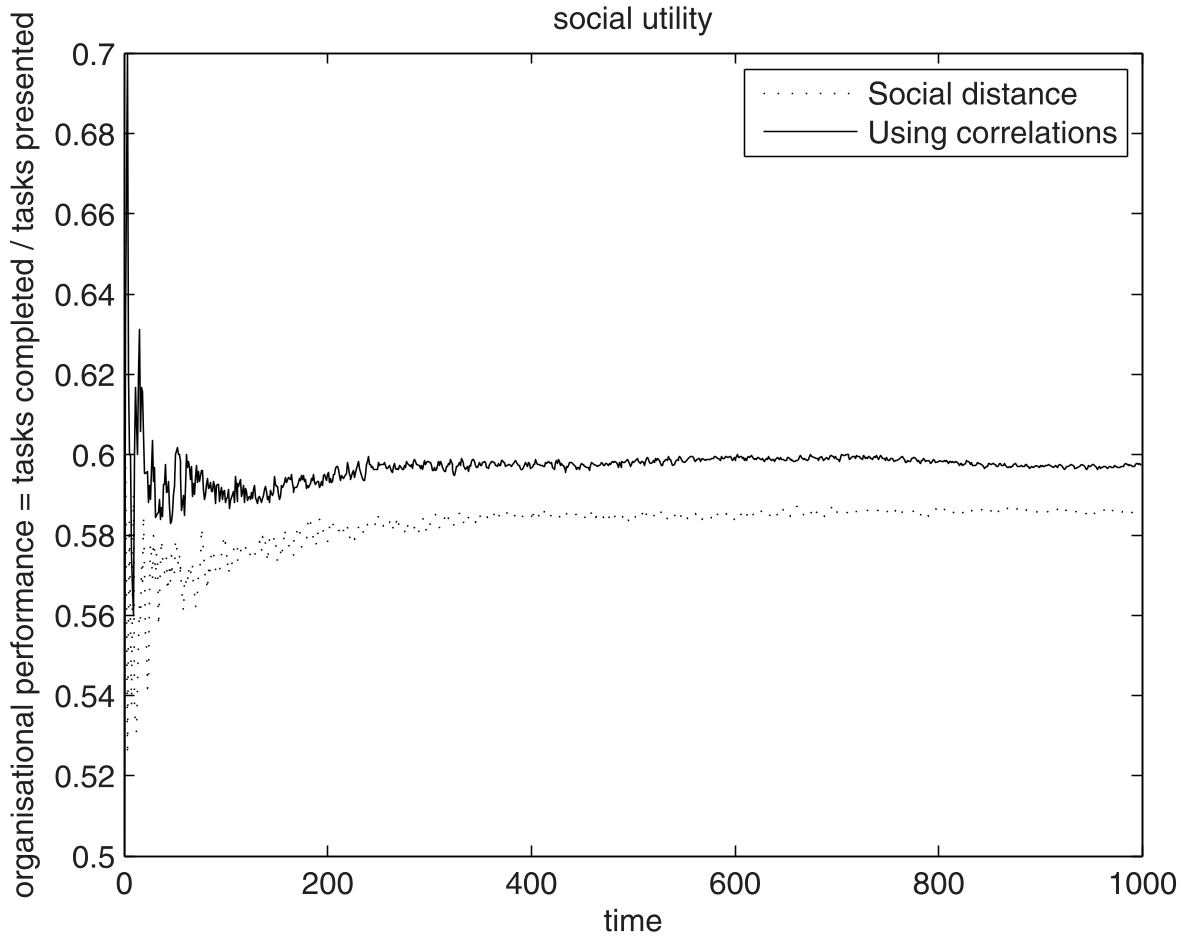 Fig 3: Comparison of organizational performance (tasks completed/presented) over time.
Critical Insight: Why Does Position Matter?
The paper proves that a "one-size-fits-all" trust threshold is sub-optimal. An agent's "reach" (out-edges) and its "popularity" (in-edges) determine its risk profile. If an agent is a "boundary spanner"—connecting different parts of the network—its decision to join or defect has a cascading effect on the system's overall social capital.
Conclusion & Future Look
Shaw, Sage, and Milligan demonstrate that Social Distance is a viable metric for autonomous decision-making in open systems. However, the study has limitations: the network was static, and the skills required for tasks were identical.
The next frontier for this research involves:
- Dynamic Topologies: How do these heuristics hold up when relationships (edges) are constantly being formed and broken?
- Local Knowledge Constraints: Implementing these sophisticated global graph calculations using only the information an agent can gather from its immediate peers.
This work serves as a foundational step toward building "Gregarious Machines" that understand not just who to trust, but how their social context dictates the value of that trust.