
TSM: Redefining Digital Trust through Negative Feedback and Risk Involvement
Trustingness & trustworthiness: a pair of complementary trust measures in a social network
This paper introduces TSM (Trust Scores in Social Media), an iterative matrix convergence algorithm that measures "Trustingness" and "Trustworthiness" in social networks. By incorporating a "Involvement" parameter and a negative feedback mechanism, it achieves a 5% average improvement over state-of-the-art methods in trust prediction tasks across platforms like Twitter, Epinions, and EverQuest II.
TL;DR
In the digital age, trust is often oversimplified into a single "reputation" score. This paper breakthroughs this by introducing the TSM (Trust Scores in Social Media) algorithm. It models trust as a dual-metric system—Trustingness and Trustworthiness—integrated with a "Negative Feedback" loop. The result? A system that recognizes that a "promiscuous" truster’s vote is worth less than a "selective" one, leading to a 5% accuracy boost in predicting social links.
Problem & Motivation: The Flaw of Positive Reinforcement
Most ranking algorithms, such as PageRank or HITS, operate on a principle of positive reinforcement: if a high-authority node links to you, your authority increases. While this works for web pages, it fails for human trust.
In social networks, there are "easy trusters"—actors who follow or trust almost anyone. If an algorithm treats their "trust vote" the same as a vote from a highly skeptical, selective user, the system becomes prone to manipulation and inaccuracy. The authors identify a missing link in trust modeling: Involvement. This represents the risk inherent in a link (e.g., giving someone access to your virtual house in a game is riskier than retweeting a joke).
Methodology: The Trustingness-Trustworthiness Duality
The TSM algorithm moves away from single-score metrics. Instead, it assigns every node two values that are updated iteratively:
- Trustingness (): An actor's propensity to trust others.
- Trustworthiness (): The network's willingness to trust that actor.
The "secret sauce" is the Negative Feedback Property. The more people a user trusts (high trustingness), the less their individual trust "vote" benefits the recipient's trustworthiness.
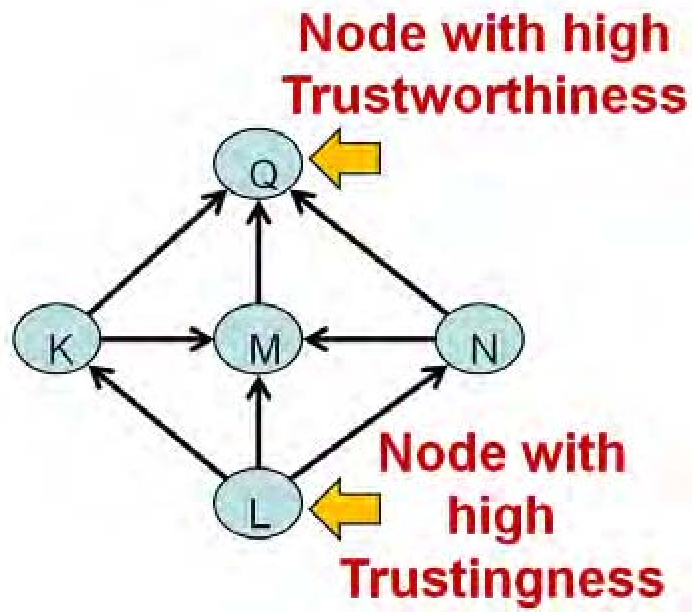 Fig 1. In this graph, Node L trusts many, so its vote carries less weight than Node M, who is more selective.
The Mathematical Intuition
The dependency is modeled using a decay function influenced by the Involvement Score ():
If (no risk), trust is just a count of connections. If (high risk), the skepticism of the source becomes a powerful multiplier.
Experiments & Results: Proving the Hypothesis
The authors tested TSM against Epinions, Twitter, and EverQuest II (a gaming dataset where trust involves "house access"—a high-stakes risk).
SOTA Comparison
The algorithm was compared against Bias-Deserve, HITS, and EigenTrust. In nearly all scenarios, the "Adjusted Trust Scores" (TSM with involvement) outperformed the competition.
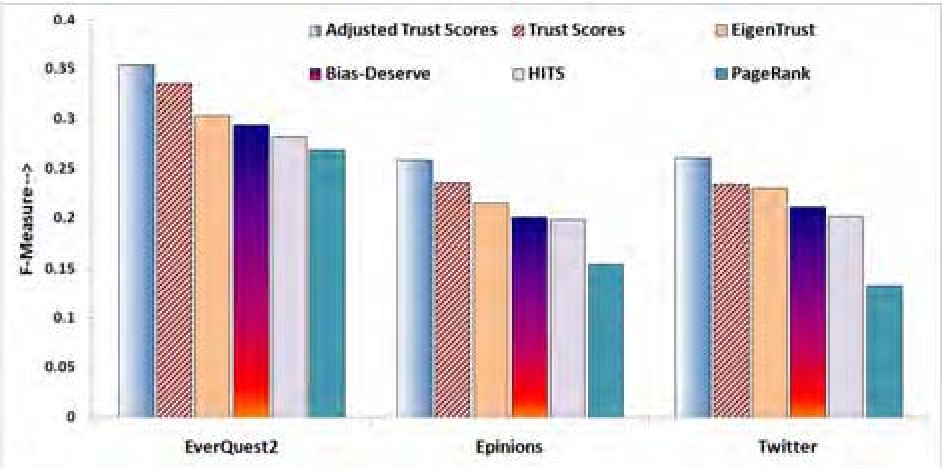 Fig 2. F-measures showing TSM's superior link prediction capability across different social datasets.
The paper also demonstrates Precision@K results, proving that the highest-ranked trustingness-trustworthiness pairs are significantly more likely to form actual social links in the future.
Critical Analysis & Conclusion
Takeaway
TSM effectively mathematically formalizes the psychological intuition that "trust from a skeptic is worth more than trust from a fan." By introducing the Involvement parameter, it allows the model to adapt to different social contexts—from casual social media to high-stakes gaming environments.
Limitations & Future Work
The primary hurdle for TSM is the dependency on User Surveys to determine the involvement score (). In real-world products, conducting surveys for every network sub-type is impractical. Future research could aim to automatically infer involvement from network topology or interaction frequency, removing the need for manual data collection. Additionally, transitioning from a static "cross-sectional" view to a longitudinal (temporal) view would allow TSM to track how trust evolves over time.