
Trustless Broker: Striking the Balance Between Privacy and Performance in Proximity Social Networks
A Trustless Broker Based Protocol to Discover Friends in Proximity-Based Mobile Social Networks
This paper introduces a trustless broker-based protocol for Profile Matchmaking in Proximity-Based Mobile Social Networks (PMSN). It leverages the Paillier Homomorphic Encryption scheme and a non-deterministic broker to compute the intersection of user interests without revealing sensitive attributes or location data, achieving SOTA-level privacy in decentralized settings.
TL;DR
Proximity-Based Mobile Social Networks (PMSN) allow users to find friends based on physical closeness and shared interests. However, sharing profiles often leads to "honest-but-curious" eavesdropping or identity theft. This paper proposes a protocol that uses a Trustless Broker and Paillier Additive Homomorphic Encryption to find the "best match" without a central server ever seeing the raw data, and without draining a smartphone's battery.
The Core Conflict: Privacy vs. Resource Constraints
Current matchmaking solutions face a "trilemma" of privacy, trust, and performance:
- Centralized (TTP): Fast, but requires you to hand over your personal "Interest Vector" to a server.
- Distributed (P2P): No server, but forces the mobile device to handle heavy cryptographic computations and risks exposing data to malicious neighbors.
- Deterministic Encryption: Protocols like Commutative Encryption are efficient but weak; an attacker can pre-compute common interest hashes to "guess" your profile.
The authors' insight is to create a blind intermediary. The broker acts as a calculator that can add numbers without knowing what the numbers represent.
Methodology: The "Blind Calculator" Approach
The protocol transforms user interests into a binary vector (1 for interested, 0 for not). The magic happens through the Paillier Cryptosystem, an additive homomorphic scheme.
The Workflow:
- Encryption: Users encrypt their interest vectors using Paillier. Because it is non-deterministic, encrypting "1" twice results in two completely different ciphertexts, preventing brute-force dictionary attacks.
- Blind Computation: The broker receives these ciphertexts and uses the homomorphic property: The broker sums the encrypted attributes of the initiator and potential friends.
- Validation: The broker shuffles the results (to prevent pattern recognition) and sends them back. Users decrypt locally to find their match scores.
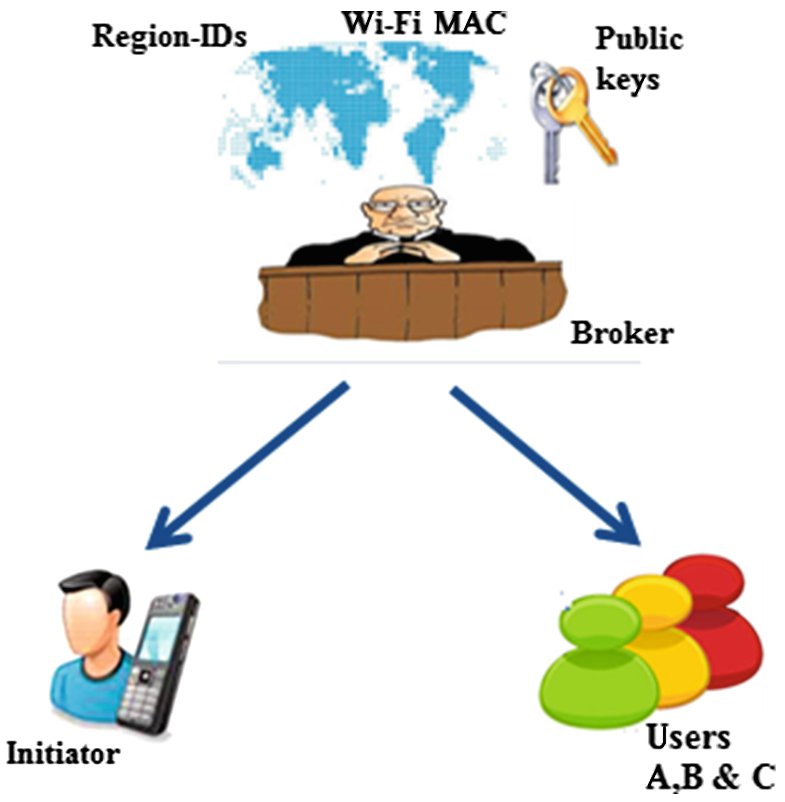 Figure 1: The system architecture showing the Initiator, Broker, and proximity-based users.
Experimental Results
The authors validated the concept using a real-world Android application (ADT) and an Intel i7 broker.
- Low Latency: Even as the number of interests increases up to 30, the computation time on the broker stays below 0.06 milliseconds.
- Storage Efficiency: By using serialized (.ser) files and compression, the entire encrypted profile is reduced to 1.5 KB, making it viable for slow 3G or constrained Wi-Fi connections.
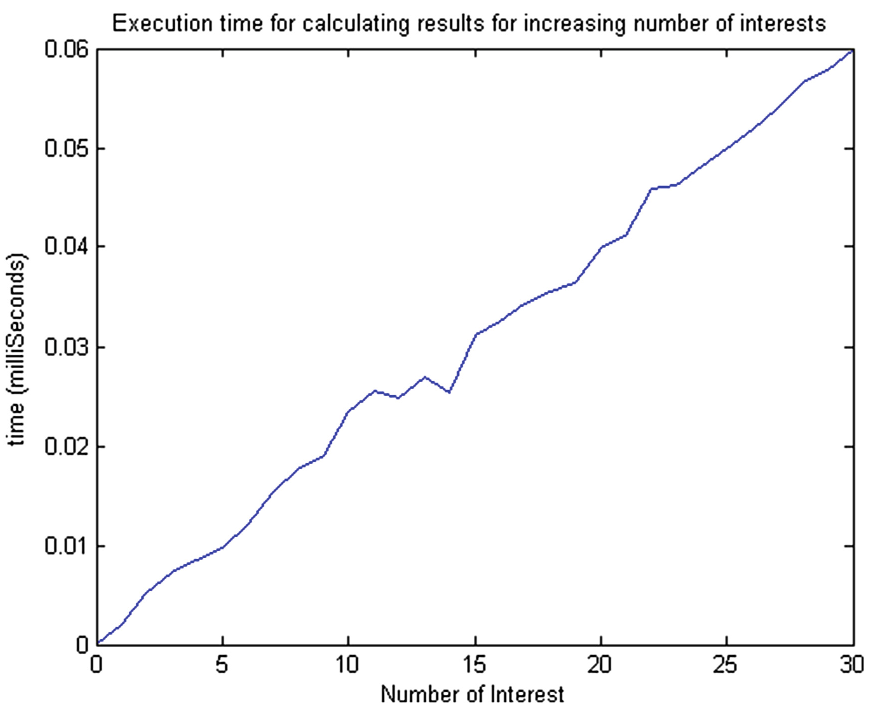 Figure 2: Execution time on the broker showing near-linear scaling with the number of attributes.
Critical Insight & Conclusion
The true value of this work lies in the Inductive Bias that a broker does not need to be trusted if the math is robust. By using non-deterministic encryption, the broker can hold MAC addresses and Region-IDs for security (blocking malicious actors) without ever having the "key" to the users' social lives.
Limitations: While the protocol handles semi-honest users well, a fully malicious broker could still potentially perform traffic analysis or collude with a subset of users, though the authors suggest using Tor/Orbot to mitigate location tracking. For future work, exploring Multi-Party Computation (MPC) could further decentralize the power of the broker.