
TCSC: Breaking Centralized Censorship in Mobile Social Classifieds
Trustworthy and Communal Social Classifieds Using HTTP and Wi-Fi
The paper introduces TCSC (Trustworthy and Communal Social Classifieds), a decentralized P2P framework for mobile classified ads. By integrating a WiFi-HTTP bridge and Google Cloud Messaging (GCM), it enables uncensored, cross-network data sharing between mobile Wi-Fi nodes and static HTTP nodes while maintaining user privacy.
TL;DR
In a world where digital marketplaces are either highly centralized (and thus censored) or dangerously anonymous, Trustworthy and Communal Social Classifieds (TCSC) offers a third way. By combining the flexibility of Wi-Fi with the reach of HTTP, TCSC creates a decentralized P2P network for buying and selling that bypasses administrative control and provides a reputation-based trust layer.
Academic Positioning: This work sits at the intersection of Distributed Systems and Mobile Computing, specifically focusing on the "Connectivity Bridge" problem between mobile ad-hoc environments and the static web.
The Problem: The Dual Threat of Censorship and Risk
The author identifies two critical failures in current digital commerce:
- Centralization (The Facebook/eBay Problem): Centralized servers are single points of failure and easy targets for government censorship.
- Anonymity Risk (The Craigslist Problem): Purely local classifieds lack accountability, leading to security issues like fraud or even physical threats.
- The Technical Gap: Mobile devices have dynamic IPs and frequent disconnections, making a standard P2P "Server" model impossible for phones.
Methodology: The WiFi-HTTP Bridge
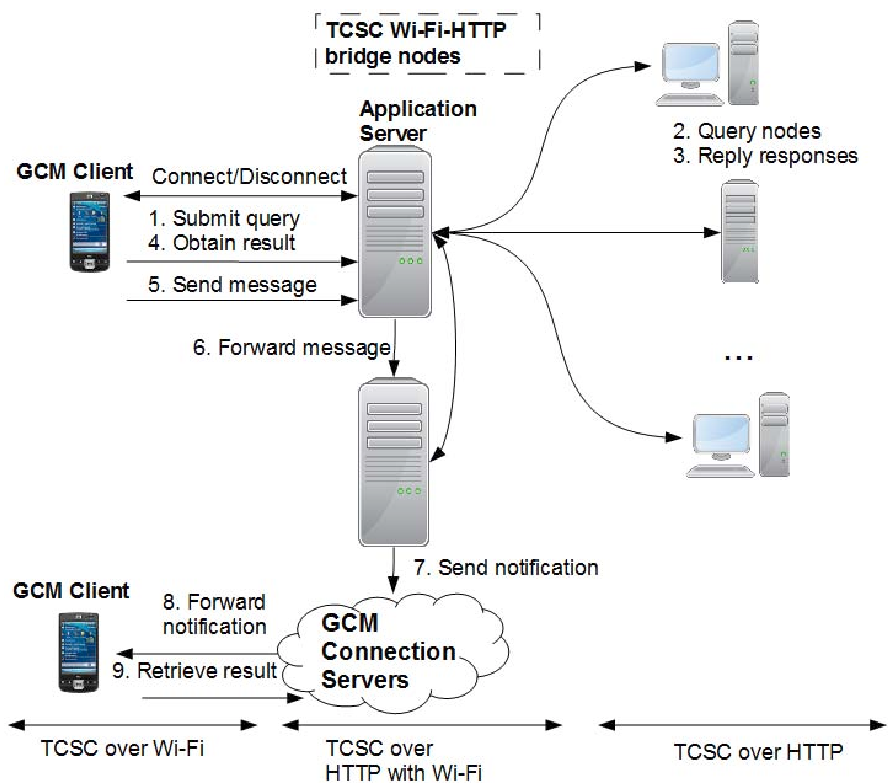
The core innovation is the TCSC WiFi-HTTP Bridge. This architecture allows a smartphone (the GCM Client) to participate in a global P2P network even when its IP address changes or it goes offline.
Architecture Breakdown
The system is split into three distinct layers:
- TCSC over Wi-Fi: Mobile nodes (Android) that generate queries and post ads.
- TCSC over HTTP: Static nodes (Desktops/Servers) that store metadata and perform distributed search.
- The Bridge: Utilizes Google Cloud Messaging (GCM) to enable the application server to "push" data to mobile nodes. This solves the dynamic IP issue by having the mobile client register a unique
regIDwith GCM.
Membership & Trust
Unlike structured P2P networks (like DHTs), TCSC uses an unstructured approach based on randomization and "gossiping." This makes it more resilient to targeted attacks. To prevent the "Craigslist risk," TCSC implements a Reputation Request protocol: before a transaction, a node queries the network for the history of a source node to calculate a trust score.
Experimental Validation: Hypergeometric Success
To prove the system's reliability, the author modeled the probability of finding a "match" (a relevant ad) using the Hypergeometric Distribution. This is critical because in P2P networks, we need to know how many nodes () we must query to find an item distributed across nodes.
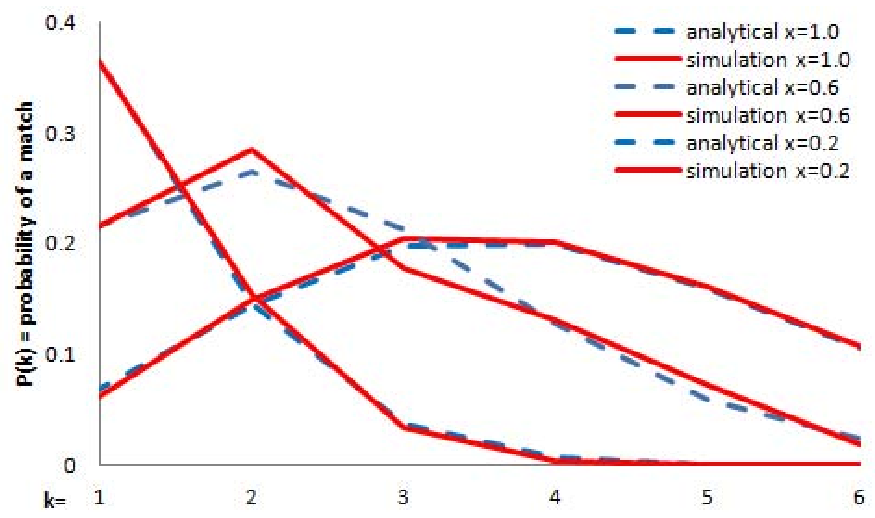
Key Insight from Results: The simulation (with nodes) proved that even when 80% of the network is offline (x=0.2), the system still successfully retrieves results. The overlap between the mathematical model and the simulation confirms that decentralized searching in TCSC is predictable and efficient.
Critical Insight & Future Outlook
The true value of TCSC lies in its robustness against churn. In mobile environments, nodes "leave" constantly. TCSC handles this by piggybacking membership updates on top of regular query messages, reducing overhead.
Limitations: The system still relies on GCM (a Google-controlled service) as a bridge, which introduces a slight paradox given the author's anti-censorship motivation.
Future Directions: The author points toward Wi-Fi Direct and Mesh Networking. This would allow TCSC to function in "Dark Net" scenarios where the internet and cellular networks are entirely unavailable, such as during natural disasters or political unrest.
Conclusion
TCSC proves that decentralization isn't just a political ideal—it’s a viable technical architecture. By bridging the gap between volatile mobile clients and the static web, this framework provides a blueprint for a more resilient, uncensored digital economy.