
TDP: Secure and Autonomous D2D Pairing for the Crowdsourcing Era
14765_Trustworthy Device Pairing for Opportunistic Device-to-Device Communications in Mobile Crowdsourcing Systems.
The paper introduces TDP (Trustworthy Device Pairing), a novel framework for Mobile Crowdsourcing Systems (MCS) that enables secure, user-transparent D2D communication. It combines Certificateless Public Key Cryptography (CL-PKC) for key negotiation with a multi-dimensional trust evaluation mechanism to identify reliable peers among multiple candidates.
TL;DR
Mobile Crowdsourcing Systems (MCS) rely on the "wisdom of the crowd," yet the underlying Device-to-Device (D2D) communication often hits a wall: manual pairing is tedious, and trust in opportunistic strangers is non-existent. TDP (Trustworthy Device Pairing) solves this by automating secure key negotiation using Certificateless Cryptography and identifying the "truest" peers via a clever multi-dimensional trust-scoring algorithm.
Problem & Motivation: The Friction of Opportunism
In a typical MCS scenario, your smartphone might need to offload a task to a nearby device or exchange sensing data. Standard protocols like Bluetooth or WiFi Direct are designed for intentional pairing—think of the "enter this PIN" prompt. In high-density, opportunistic environments:
- User Overhead: Users won't manually approve every 10-second encounter.
- Trust Deficit: How do you know the device next to you isn't a malicious node trying to feed you fake data or steal your traffic?
- Collusion: Malicious nodes can group up to "vouch" for each other, inflating their trust scores artificially.
Methodology: Cryptography Meets Social Reliability
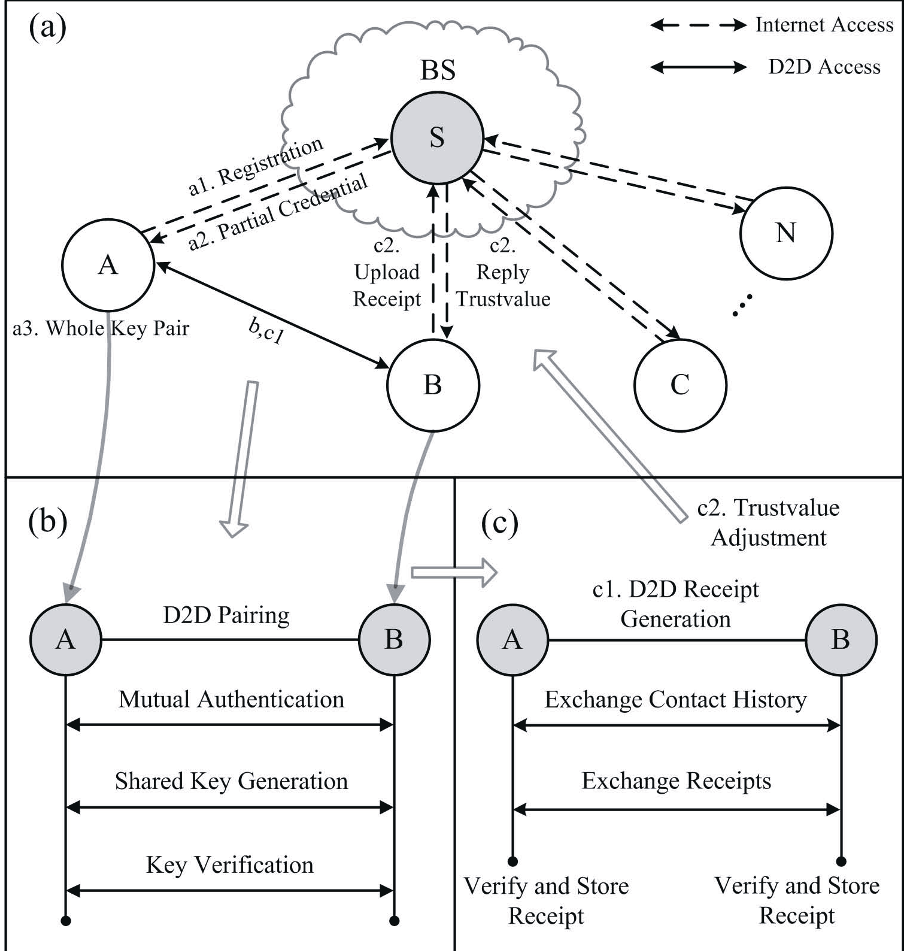
1. Transparent Key Negotiation
TDP utilizes Certificateless Public Key Cryptography (CL-PKC). Unlike standard PKI, it removes the heavy certificate management burden while solving the "Key Escrow" problem (where the server knows everyone's secret).
- Cooperative Generation: Both the Backend Server (BS) and the device contribute to the private key.
- Result: The server can verify identities but cannot eavesdrop on the D2D traffic.
2. The Trust Formula
When multiple peer candidates exist, TDP uses a Trustvalue Vector. The core innovation lies in the Confidence Level (Cre) calculation:
- Relative Diversity (Div): Does this device pair with a wide variety of people, or just a small circle?
- Similarity (Sim): Is its feedback consistent with the community's consensus? These metrics are mathematically blended to prevent Collusive Attacks, where a group of nodes tries to manipulate the trust ecosystem.
Implementation and Experiments
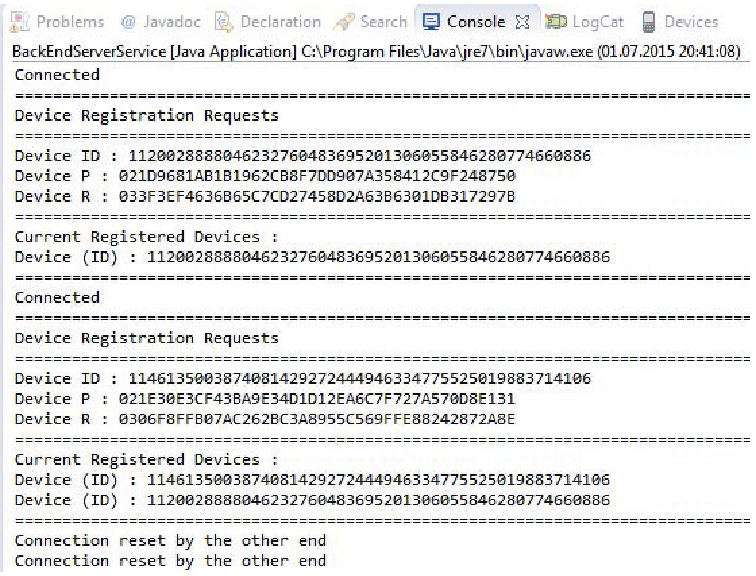
The authors built a prototype using a Windows workstation as the Backend Server and Android devices (Google Nexus 7 & Samsung Galaxy Note 3) for the D2D nodes.
- Security: Achieved secp160r1 standard security level.
- User Experience: The pairing happens in the background as a "security service" running over Bluetooth, requiring zero user taps.
- Efficiency: Key negotiation is faster than contemporary non-interactive schemes by reducing the handshake rounds.
Critical Analysis & Conclusion
TDP bridges the gap between passive security (encryption) and active reliability (trust). By integrating trust into the connection layer, it ensures that D2D is not just secure, but also "smart."
Limitations:
- The current implementation is tested on Bluetooth, which has limited range and bandwidth.
- Trust updates are "delay-tolerant" (waiting for Internet access), which might create a window for temporary exploits before the server updates the global trust profile.
Future Outlook: The move toward WiFi Direct and 5G Sidelink will allow TDP to scale to high-bandwidth tasks like collaborative video processing or distributed AI training at the edge.