
Trustworthy Service Composition: Navigating the Chaos of Mobile Social Networks
Trustworthy Service Composition in Service-Oriented Mobile Social Networks
The paper introduces a decentralized framework for Trustworthy Service Composition in Service-oriented Mobile Social Networks (S-MSN). It leverages a lattice-based trust model and Program Dependency Graphs (PDG) to evaluate service reliability and establishes a "trust-aware acquaintance graph" to facilitate secure message relay among opportunistic mobile participants.
TL;DR
In the world of Service-oriented Mobile Social Networks (S-MSN), services are not just static endpoints but dynamic, opportunistic chains of interactions. This paper tackles the challenge of Trustworthy Service Composition by introducing a decentralized evaluation method based on Lattice-based Trust Models and Program Dependency Graphs. By modeling how data flows through service components and mobile participants, the authors ensure that sensitive information never touches untrustworthy hands.
Background: The S-MSN Challenge
Mobile Social Networks bring Location-Based Services (LBS) to our pockets, allowing neighbors to share and compose services via WiFi or Bluetooth. However, S-MSN is inherently unstable:
- Opportunistic Connectivity: Participants move, and connections drop.
- Opaque Structures: Users often don't know if a service is "atomic" or a "composite" of many sub-services.
- Trust Subjectivity: Consumers and vendors have shifting requirements for data security.
Current State-of-the-Art (SOTA) often relies on central directories that can't track the "viral" nature of service chains. This paper moves the trust logic into the architecture itself.
Problem & Motivation
The core issue is Trust Degradation. Imagine a high-security request being passed to a service that, unknown to the user, outsources part of its computation to a low-trust component.
The authors identified that existing reputation systems are too reactive. They needed a proactive way to analyze dependencies before the data is sent. Their insight? Treat service logic like software code and perform Program Slicing to see where the data could go.
Methodology: The Core Mechanics
1. The Data Flow Service Model
Each service is treated as a computation function . The authors represent this using a Program Dependency Graph (PDG). By using backward slicing, they can identify every component that an output object depends on.
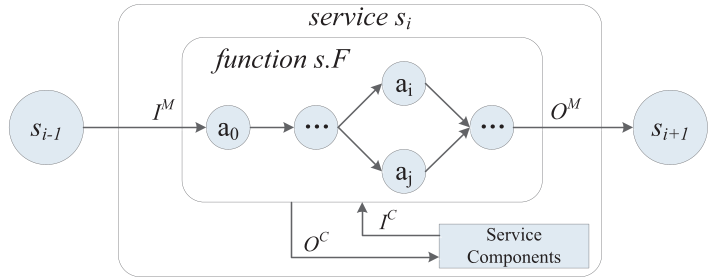 Fig 1 & 2: Illustrating how services and participants form a 'Service Path' through opportunistic relay.
2. Decentralized Trust Evaluation
The paper defines trust degrees within a Lattice (TD, ≤). To ensure a service is "Trustworthy" (Definition 3), the trust degree of the output must be equal to or higher than the maximum trust required by its dependent inputs:
This formula ensures that high-trust data only flows through components capable of maintaining that trust level.
3. Trust-Aware Acquaintance Graph
Since nodes are mobile, the system forms a Trust-Aware Acquaintance Graph (TG). It uses a "closeness degree" that increases with each introducer. A decay factor is applied to reflect that "a friend of a friend is less trusted than a direct friend":
Experiments & Results
The authors propose a composition algorithm that:
- Acquires candidates from a Directory Server (DS).
- Sorts them by distance to minimize "hop" costs.
- Iteratively evaluates each link in the Service Path.
The theoretical foundation (Theorem 2) proves that if each individual service is evaluated as trustworthy based on its local/intra-dependencies, the entire global Service Path is mathematically guaranteed to be trustworthy.
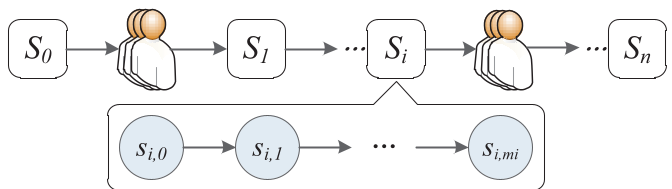 Fig 2: The structure of a sequential Service Path involving services (S) and participants (P).
Critical Analysis & Conclusion
Takeaway
The paper's strength lies in its hybrid approach: it combines formal software analysis (PDGs) with social network dynamics (acquaintance graphs). This bridges the gap between "hard" security (data flow) and "soft" security (social trust).
Limitations
- Privacy Concerns: While IDs are replaced with keys, the propagation of acquaintance maps could still leak metadata about social circles.
- Computational Overhead: Generating PDGs and performing backward slicing in real-time on mobile devices with limited battery might be challenging.
Future Work
The authors plan to test this framework on real-world social datasets and explore privacy-preserving mechanisms to hide the social graph from the Directory Server, ensuring that even the "introducers" remain anonymous.