
EOW: Revolutionizing Trustworthy Website Detection with Social Network Logic
Trustworthy Website Detection Based on Social Hyperlink Network Analysis
The paper introduces Enhanced OpinionWalk (EOW), a graph-based algorithm that models website hyperlinks as a social trust network. Using Three-Valued Subjective Logic (3VSL), it quantifies trustworthiness to promote reliable websites and demote spams, outperforming the state-of-the-art TrustRank in detection accuracy and computational efficiency.
TL;DR
In the battle against web spam, the Enhanced OpinionWalk (EOW) algorithm treats the entire internet as one giant social network. By moving away from simple "ranking scores" to a nuanced "trust opinion" (Belief, Distrust, Uncertainty), EOW identifies up to 16.5% more trustworthy sites than TrustRank and runs 27.1% faster than its predecessors.
Motivation: The Flaw in Simple Link Analysis
Ever wonder why low-quality sites sometimes rank at the top of your search results? This is often due to link spamming, where sites create a web of artificial connections to fool algorithms like PageRank.
Prior work like TrustRank attempted to solve this by "propagating" trust from a human-verified seed set. However, TrustRank treats trust as a simple number. In reality, trust is complex: we might trust a site, distrust it, or simply not have enough information yet (Uncertainty). EOW exploits this psychological intuition using Three-Valued Subjective Logic (3VSL).
Methodology: Social Logic and Hyperlinks
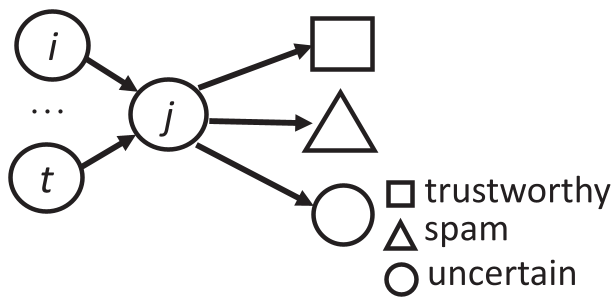
The authors treat a website as a person and a hyperlink as a social recommendation. The core innovation lies in the Opinion Vector: Where:
- (Belief): Likelihood the site is legitimate.
- (Distrust): Likelihood the site is spam.
- (Uncertainty): Based on links to unknown/unlabeled sites.
- (Prior uncertainty): A "safety" buffer.
The Algorithm "Walk"
EOW initializes an Opinion Matrix by looking at "who points to whom." If a site points to many known spams, its distrust value () spiked. If it points to verified "good" sites, its belief value () rises.
The Efficiency Breakthrough
Standard OpinionWalk updates every single node in every iteration. EOW uses a Boolean vector to track which nodes actually had their trust values changed. Only the neighbors of those nodes are updated in the next step. This "selective updating" cuts execution time by nearly a third.
Experiments: Real-World Performance
Using the WEBSPAM-UK2006 dataset (over 77 million pages), the authors compared EOW against TrustRank and PageRank.
1. Superior Detection
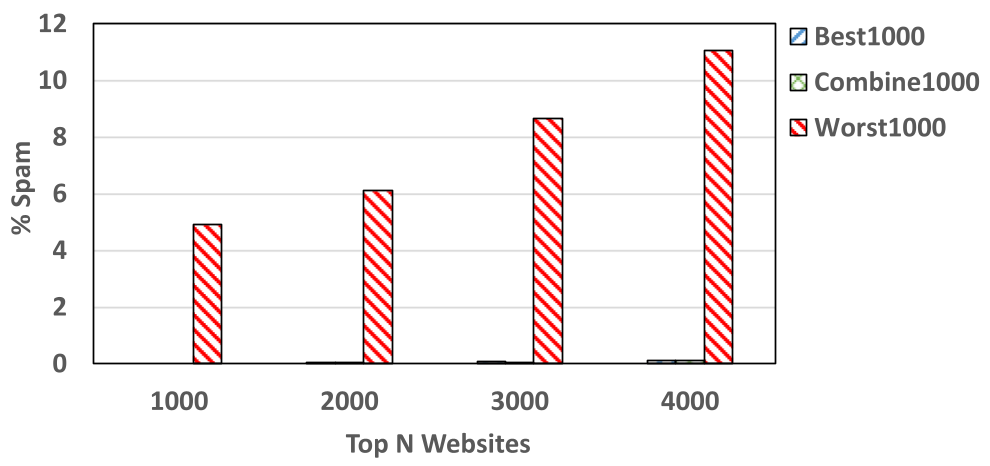
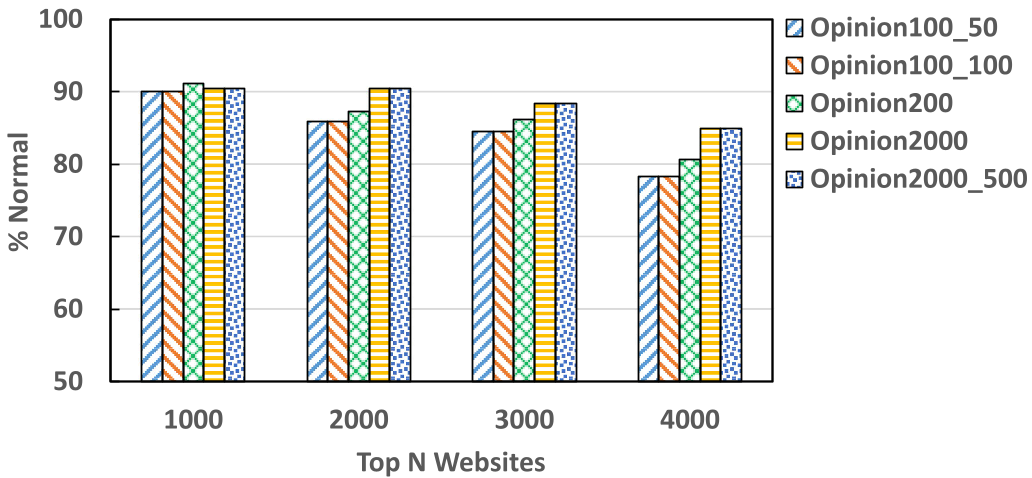
EOW consistently outperformed TrustRank. With only 200 normal seeds, it found considerably more "Good" sites in the Top 1000 list than any other method.
2. The "Six Degrees of Separation" in Web Space
The authors found a fascinating parallel to sociology: searching 6 levels deep into the hyperlink network was the "sweet spot." Searching deeper (e.g., 20 levels) didn't significantly improve accuracy but massively increased the computation time.
Critical Insight: Why it Works
EOW works because it explicitly models Uncertainty. Most algorithms force a binary choice: is this site good or bad? By allowing for an "I don't know" state, EOW prevents the "poisoning" of the trust pool that occurs when one bad site accidentally links to a good one, or vice versa.
Key Takeaways
- Seed Selection Matters: Using sites with high PageRank as seeds works better than Inverse PageRank.
- Small World Web: The hyperlink structure follows social graph properties—trust is usually established within 6 hops.
- Speed + Accuracy: The Boolean tracking mechanism proves that we don't need to sacrifice speed for high-fidelity trust assessment.
Conclusion and Future
EOW is a powerful reminder that "Trust" is more than just a scalar value. In the future, the authors suggest combining this link-logic with Content Analysis (NLP) to create a truly unhackable search ranking system.