
Cooperative Crowdsourcing: How to Ensure Truthfulness When Tasks Require a Village
Truthful incentive mechanisms for crowdsourcing
This paper introduces three novel truthful incentive mechanisms (IMC-SS, IMC-SM, and IMC-MM) for crowdsourcing markets where tasks require the cooperation of multiple service providers. The authors successfully generalized existing user-centric models and proved that their mechanisms achieve individual rationality, budget-balance, and computational efficiency while guaranteeing truthfulness.
TL;DR
In the world of crowdsourcing, we usually assume one person can do one job. This paper shatters that assumption, tackling complex jobs that require the cooperation of multiple providers. By designing three distinct models (SS, SM, and MM), the authors provide a mathematical framework that ensures no one can "game the system" (Truthfulness), everyone gets paid fairly (Individual Rationality), and the platform doesn't go broke (Budget-Balance).
The Problem: The "Monopoly" Trap
In traditional crowdsourcing, if you want a photo of a landmark, you hire one person. But what if you need a signal map of an entire shopping mall? No single provider has the battery, time, or access to do it alone.
When multiple people must cooperate, a dangerous phenomenon emerges: The Monopoly Provider. If Provider A is the only person who can finish the last 5% of a job, they can demand an astronomical price, holding the requester hostage. Current SOTA (State-of-the-Art) mechanisms often ignore this or fail to maintain a balanced budget when payments escalate.
The Core Insight: Greedy Selection and Critical Values
The authors propose a clever three-step workflow to solve this:
- Job Selection without Monopolies: Before starting, the platform identifies which jobs can be done. Crucially, it only accepts a job if it can be finished even if any single provider leaves. This kills the leverage of would-be monopolists.
- Greedy Winning Selection: Providers are chosen based on the "efficiency" of their bids (cost per task contributed).
- Critical Value Pricing: Instead of paying providers exactly what they asked, the platform calculates a "critical value"—the maximum price they could have asked and still won. This is the secret sauce for Truthfulness; since your payment is determined by others' bids, you have no incentive to lie about your costs.
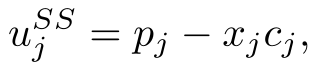 The mathematical definition of utility ensures that providers gain nothing by misreporting their private costs.
Methodology: From Single to Multiple Requesters
The paper evolves through three increasingly complex models:
- SS-Model (Single-bid): A provider bids on one specific set of tasks.
- SM-Model (Multiple-bid): A provider can offer different "packages" of tasks (e.g., "I'll do 2 tasks for 10").
- MM-Model (Multiple-requester): Includes competition between requesters. This is a "Double Auction" where both buyers and sellers compete.
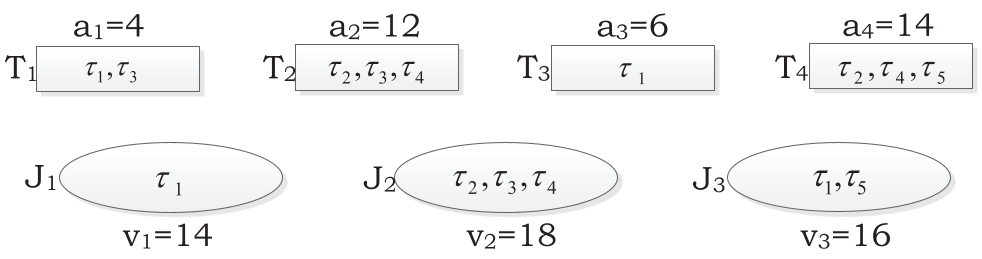 In this example, the mechanism selects Jobs 1 and 2, ensuring that even if P4 (a potential monopoly) is removed, the tasks can still be covered by others.
Performance & Battle-Testing
The simulations show that as the number of providers () increases, the average provider utility drops. Why? Because competition works! More providers mean the "critical value" (the price set by the next-best competitor) lowers, benefiting the platform.
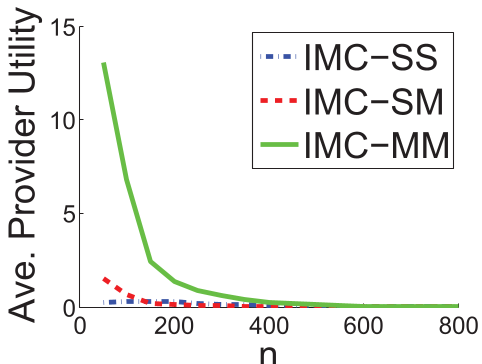 Experimental results show that even with 800 participants, the mechanism remains computationally efficient, scaling at roughly .
Technical Takeaways
The most impressive part of this work is the Budget-Balance guarantee. Usually, truthful mechanisms (like VCG) require the platform to subsidize the auction (lose money). By using a surrogate value —an upper bound on payments—and comparing it against the total valuation during the selection phase, the authors ensure the platform always stays in the black.
Future Outlook
While the current models assume tasks are indivisible and valuations are static, the shift toward cooperative crowdsourcing is inevitable. As we move toward more complex distributed tasks like "Data Labeling for LLMs" or "Edge Sensing," these incentive structures will become the backbone of the gig economy 2.0.
Limitations: The greedy selection is an approximation since the optimal job selection is NP-Hard (a variation of the Knapsack Problem). Future work might explore better approximation ratios using deep reinforcement learning for job selection.