
Truthful Interval Cover: Optimizing Strategic Crowdsourcing for Linear Tasks
Truthful Interval Cover Mechanisms for Crowdsourcing Applications
The paper introduces Truthful Interval Cover Mechanisms, a framework for cost-effective task allocation in crowdsourcing applications where tasks have a linear spatial or temporal ordering. It proposes a novel monotone approximation algorithm for heterogeneous crowdworkers, achieving a 2-rmax approximation factor and ensuring truthful bidding through a critical payment scheme.
TL;DR
Crowdsourcing tasks like pollution monitoring or traffic sensing aren't random; they follow a linear path (a road or a timeline). This paper presents a mechanism to select the best "intervals" from workers who might lie about their costs. Specifically, it introduces a monotone approximation algorithm for workers of varying quality, ensuring that honesty is the best strategy while keeping costs within a provable bound of the optimum.
Perspective: The Architecture of Truth in Crowdsourcing
Most crowdsourcing systems assume workers are passive or that the requester knows the "market price." In reality, specialized sensing tasks (e.g., tracking a disease outbreak along a trade route) involve workers with private costs and varying reliability. The authors position this work at the intersection of Algorithmic Game Theory and Pervasive Sensing, addressing a critical gap: how to satisfy an error tolerance limit for each task while minimizing the total budget in a strategic environment.
The Problem: Geometry and Strategy
The paper identifies a core structure: Linear Ordering.
- Interval Bids: Workers bid for contiguous segments (e.g., "I will monitor the road from mile 10 to mile 20").
- Quality Constraints: Each task has an error tolerance . Because workers are noisy, the requester must "cover" each task multiple times to achieve confidence via majority voting.
In the Heterogeneous Scenario, where Worker A has 90% accuracy and Worker B has 60%, the problem becomes NP-hard. Simple approximation algorithms often fail to be "monotone," meaning a worker might be penalized for lowering their bid—a flaw that invites strategic manipulation.
Methodology: The Monotone Iterative Algorithm
The core contribution is a monotone task allocation rule for heterogeneous workers.
1. The Homogeneous Case (The Starting Point)
If all workers have the same quality, the problem's constraint matrix satisfies the Consecutive-Ones Property. This means the matrix is Totally Unimodular (TUM), allowing us to solve the Integer Program using simple Linear Programming—a rare "free lunch" in optimization.
2. The Heterogeneous Case (The Innovation)
Since the problem is NP-hard here, the authors propose Algorithm 1. Instead of a one-shot Primal-Dual approach (which isn't monotone), they use an iterative greedy-like structure:
- Subroutine: Find the cheapest set of intervals to cover every task with at least one unit of remaining demand using Dynamic Programming.
- Iteration: Repeat this until the quality constraints (calculated via Chernoff-Hoeffding bounds) are satisfied for all tasks.
 Figure: The linear structure of tasks and interval bids.
Experiments and Insights
The researchers compared their algorithm against a standard Primal-Dual benchmark.
- Performance: Their algorithm stay well within the theoretical 2-rmax bound and often outperformed non-monotone benchmarks in practice.
- The Cost of Honesty: To make the mechanism "Truthful" (DSIC), they use Critical Payments (paying a winner the maximum they could have bid without losing). The Overpayment Factor—the extra "bonus" paid to ensure truthfulness—was found to be remarkably low (less than 6%).
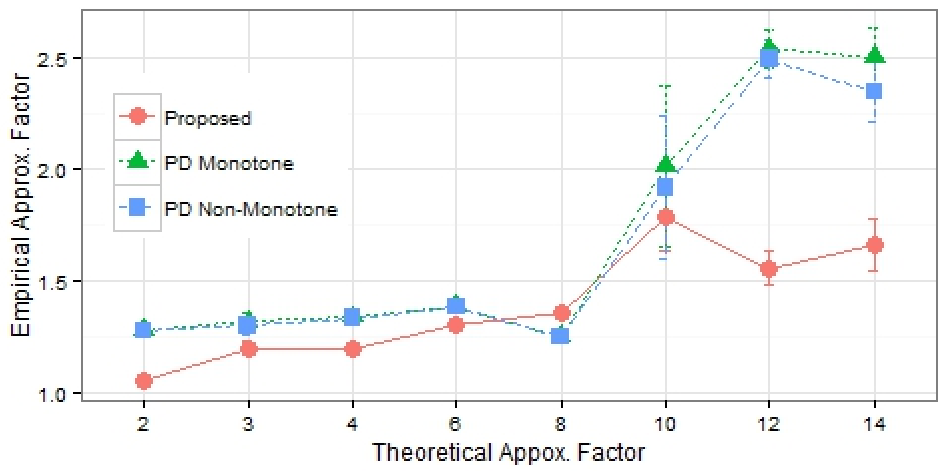 Figure: The proposed algorithm (green) consistently yields lower costs than Primal-Dual baselines.
Critical Analysis & Conclusion
Takeaway
The paper proves that for linear interval tasks, you don't need to sacrifice much efficiency to get truthfulness. By leveraging the physical structure of the problem (intervals), we can design mechanisms that are both computationally tractable and economically robust.
Limitations
- Single-Minded Bidders: The model assumes a worker bids on one interval or nothing. In reality, workers might offer multiple flexible "packages."
- Static Qualities: It assumes the requester knows the worker's quality perfectly. Future work should explore "Blind" mechanisms where quality is learned over time.
Future Outlook
As we move toward Smart Grids and Distributed Sensing, mechanisms like this will be vital for coordinating self-interested agents in a way that provides reliable, high-quality public data.