
Designing Truthful Auctions for the Dynamic World of Mobile Crowdsourcing
A Truthful Online Auction for Tempo-spatial Crowdsourcing Tasks
This paper proposes a near-optimal online incentive mechanism for mobile crowdsourcing that handles dynamic arrivals of both tasks and users. By integrating the Kuhn-Munkres algorithm with a VCG-based payment scheme, the authors achieve a mechanism that is truthful, computationally efficient, and highly competitive with offline optimal solutions.
TL;DR
Mobile crowdsourcing relies on motivating users to perform tasks via smartphones. Unlike traditional models, this paper introduces an online incentive mechanism that accounts for when and where tasks appear. By treating task allocation as a dynamic matching problem, the authors achieve near-optimal social welfare (98%+) while ensuring that users have no incentive to lie about their costs or availability.
Context: Why Static Models Fail
The paradigm of mobile crowdsourcing (e.g., traffic monitoring, noise mapping) is inherently fluid. In a city, sensing tasks arrive randomly, and users move in and out of active zones.
Previous research often focused on offline scenarios—where everyone's costs and locations are known upfront. But real-world platforms are online: they don't have a crystal ball. Existing online methods frequently ignored the "tempo-spatial" dimension (the window of time and specific location required), leading to inefficient allocations where a task might be missed because the only available user was assigned to a less constrained task earlier.
Methodology: The Core Engine
The authors solve this by framing the interaction as a Truthful Online Auction.
1. User Selection (Kuhn-Munkres Logic)
Rather than simple "lowest cost first" selection, the platform maintains an available user set. In every time slot, it constructs a Weighted Bipartite Graph where edges connect users to tasks they are physically capable of performing. The weight represents the calculated social welfare (Value - Bid).
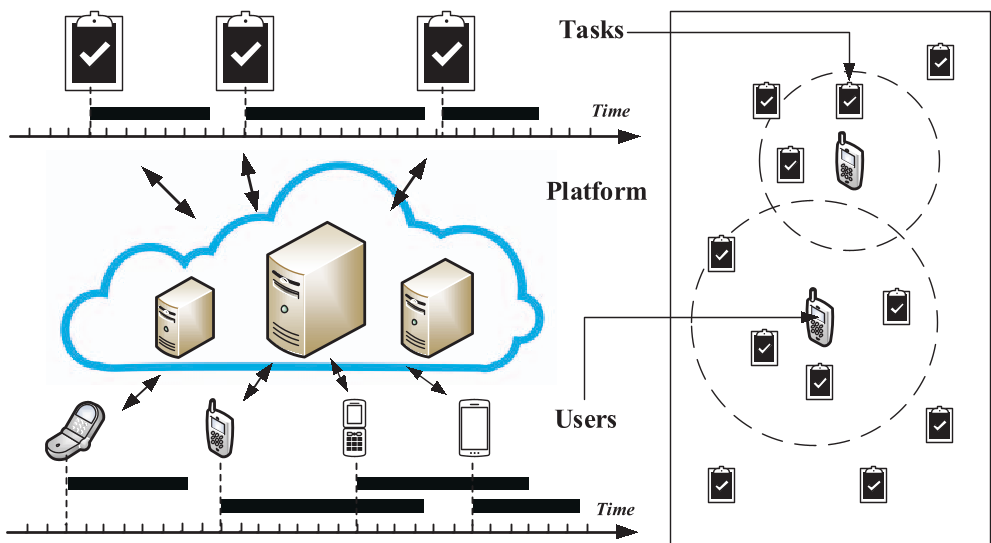 Fig 1: The dynamic interaction between the cloud platform, mobile users, and tempo-spatial tasks.
The mechanism uses the Kuhn-Munkres (KM) Algorithm to find the Maximum Perfect Matching. This ensures that the platform doesn't just pick the "cheapest" user, but the "best fit" to ensure maximum tasks are completed successfully under coverage constraints.
2. The Payment Scheme (VCG-Based)
To prevent users from "gaming the system" by bidding higher than their actual cost, the paper employs a payment scheme based on the Vickrey-Clarke-Groves (VCG) principle. A user is paid the exact "critical value"—the maximum price they could have bid and still been selected. This makes reporting the true cost the only rational strategy.
Experimental Insights
The authors validated their approach against an "Omniscient Offline Optimal" baseline (an ideal scenario where all future data is known).
- Efficiency: The social welfare gap between the online and offline models is nearly negligible (~2%), even as the number of time slots or user arrival rates increases.
- Cost Control: The platform's total payment remains stable, demonstrating that the mechanism doesn't "overpay" excessively for the benefit of speed.
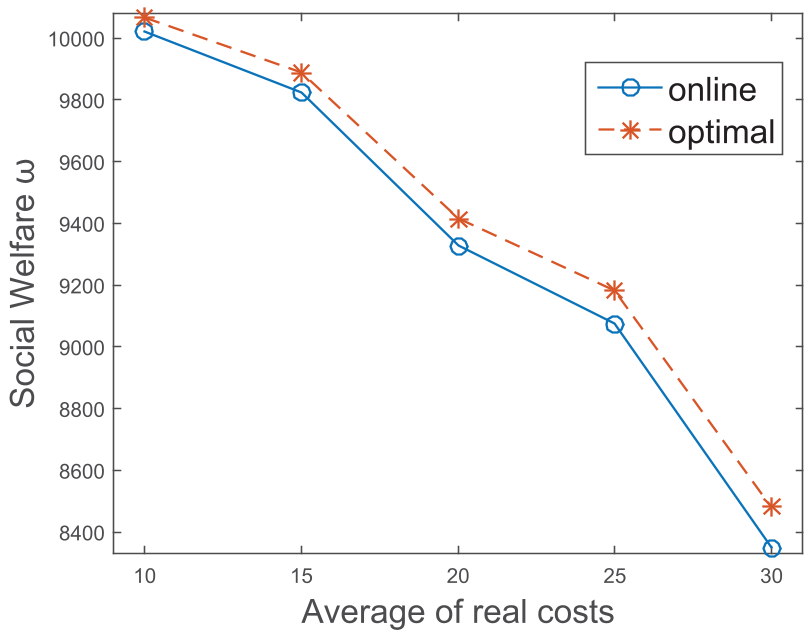 Fig 2: Social Welfare vs. Average Real Costs, showing the tight gap between Online and Offline optimums.
Critical Analysis & Takeaways
The brilliance of this work lies in its Monotonicity. Because the selection process is monotonic (if you're selected with a high cost, you'll definitely be selected with a lower one), and the payment is based on critical values, the platform becomes "cheat-proof."
Limitations: While the mechanism is computationally efficient (), in extreme-scale cities with millions of users and tasks per second, the cubic complexity of the standard KM algorithm might require further heuristic optimization or distributed processing.
The Future: This research transitions mobile crowdsourcing from theoretical "toy problems" into the messy, dynamic reality of urban sensing. For developers of gig-economy apps or smart city infrastructure, the message is clear: Truthfulness is achievable even when the data is dynamic.