
Beyond the Emotional Bond: Decoding the Turnover Crisis of Indian IS Professionals
Turnover Intentions of Indian IS Professionals
This study investigates the determinants of turnover intentions among Indian IS professionals, proposing a revised socio-behavioral model. Utilizing qualitative interviews with 25 professionals, the authors challenge Western-centric models and establish Job Satisfaction, Organizational Satisfaction, and Social Norms as the primary drivers of retention.
TL;DR
Why is turnover in the Indian IT sector as high as 100%? While Western management theories focus on "emotional attachment," this landmark study reveals that for Indian IS professionals, retention isn't about loving the company—it's about Organizational Satisfaction, Job Variety, and powerful Social Norms (family pressure).
Background Positioning
In the mid-2000s, India became the global hub for offshore IT services. However, the industry was plagued by a "turnover culture." This paper by Lacity et al. serves as a foundational cultural correction, shifting the academic focus from Western "Affective Commitment" to an India-specific model of professional behavior.
The Problem: The Failure of Western Templates
Traditional IS research, rooted in US and European contexts, posits that if an employee is "emotionally attached" to their company, they won't leave. However, in India's hyper-competitive job market, this "emotional bond" is often non-existent or secondary.
The authors discovered a critical disconnect: many Indian workers found the concept of being "bonded" to a legal entity laughable, preferring to focus on loyalty to their personal lives and families.
Methodology: Listening to 25 Voices
The researchers moved beyond rigid surveys, conducting 25 in-depth interviews with professionals across 13 different suppliers (including giants like Wipro and Infosys).
The Initial vs. Revised Model
Initially, the authors used a Western "Investment Model." After the interviews, they realized the model was broken.
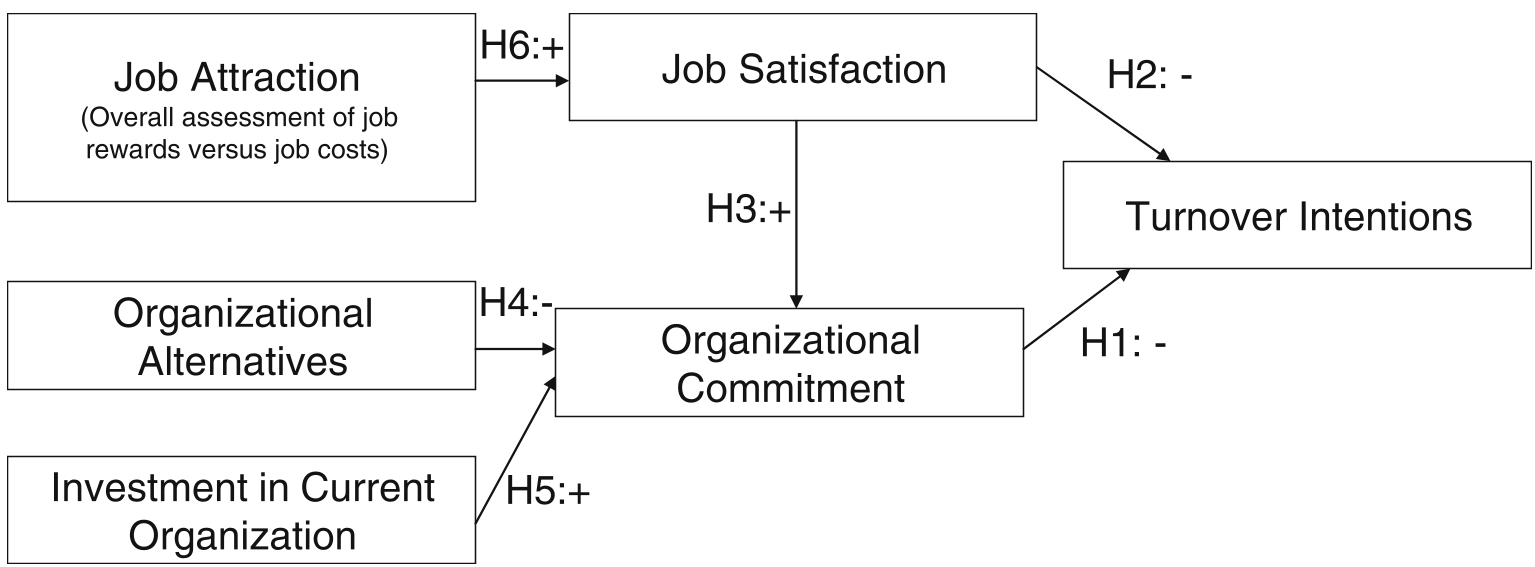 Fig 1: The Initial Model, which largely failed to correlate Organizational Commitment with Turnover Intentions.
Key Insights: What Actually Drives Turnover?
1. The Death of "Commitment," the Rise of "Satisfaction"
The study found that Indian professionals distinguish between the Job (the tasks) and the Organization (the environment).
- Insight: You can love your job but hate your company’s policies (leading to internal transfers).
- Insight: You can love your company but hate your job (leading to quitting for better work).
2. The "Social Norms" Factor
In Western literature, family is often seen as a "conflict" (Work-Family Conflict). In the Indian context, family is a Normative Pressure.
- If a company is in Bangalore but the family is in Delhi, the social pressure to relocate often trumps salary, benefits, and career growth.
3. The "Routine Work" Trap
Perhaps the most alarming finding for Western clients: Indian IS professionals despise routine maintenance.
- The Conflict: Western clients offshore routine work to keep their internal staff happy with "innovative" tasks.
- The Result: This creates a "turnover engine" in India, as the brightest local talent leaves as soon as they are assigned to repetitive coding or maintenance phases.
Experiments & Qualitative Evidence
The statistical coding showed a stark reality: Job Satisfaction and Job Attraction (rewards vs. costs) were the only strong quantitative predictors.
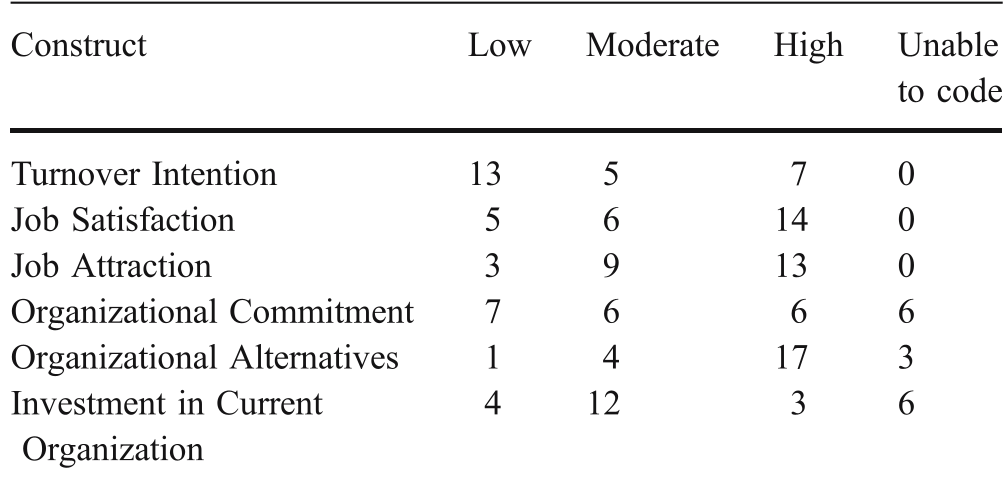 Table 1: Coding revealed that while Job Satisfaction (14 High) and Job Attraction (13 High) correlated with low turnover, Organizational Commitment was scattered and unreliable.
Implications for Practice
- Variety is King: Rotate staff every 18 months to prevent "maintenance burnout."
- Involve the Family: Successful Indian suppliers "recruit the family" by involving them in social functions or localizing offices to where the talent lives.
- Supportive Management: SATISFACTION is driven by Perceived Organizational Support (POS)—if the manager acts as a "guide," the worker stays.
Critical Analysis & Conclusion
This paper serves as a warning against "theoretical imperialism"—the assumption that Western psychological constructs apply universally.
Limitations: The sample size is small (n=25) and opportunistic, meaning it might not capture the full diversity of the Indian IS landscape.
Final Takeaway: To retain talent in India, companies must stop looking for "loyalty" and start providing meaningful work and location-sensitive HR policies.