
Tweeting Your Way to Recovery: How Positive Emotions at Work Buffer Exhaustion
The Role of Tweet-Related Emotion on the Exhaustion – Recovery from Work Relationship
This diary study investigates how the emotional quality of social media use (specifically Twitter) moderates the link between work exhaustion and leisure recovery. Using multilevel analysis, the research reveals that positive emotions experienced while tweeting at work buffer the negative impact of exhaustion on psychological detachment.
TL;DR
Is scrolling through Twitter at your desk a waste of time or a survival mechanism? This research suggests it depends on how it makes you feel. By tracking the real-time tweets and daily exhaustion levels of employees, the study finds that positive emotions elicited by tweeting during work hours can actually help exhausted employees detach from work during their leisure time.
Background: The Digital Recovery Crisis
In the modern workplace, the boundary between "work" and "life" is increasingly blurred by ICTs. While we know that exhaustion leads to a lack of energy for recovery, the role of social media remains a "double-edged sword." Some view it as a distraction that inhibits recovery, while others see it as a "micro-break" that recharges batteries. This paper moves beyond measuring how much we use social media to focus on the emotional quality of that use.
Problem & Motivation: Beyond the Screen Time Debate
Existing research often treats all social media use as equal. The authors argue that this is a mistake. Drawing on the Effort-Recovery Model and Broaden-and-Build Theory, they propose that the emotions we feel while posting—specifically on Twitter—serve as resources. If you are exhausted, you lack the "oomph" to switch off from work. Can a positive interaction on social media provide the necessary emotional resource to facilitate that detachment?
Methodology: A Tailored Diary Study
The researchers built a custom system to capture the actual tweets of 33 participants over five working days.
- Level 1 (Daily): Participants rated their exhaustion at the end of the day and their recovery experiences (Detachment and Relaxation).
- Level 2 (Tweet-based): For each tweet posted, participants rated the emotions it triggered (e.g., happy, energetic vs. sad, nervous).
- Analysis: Multilevel modeling was used to account for the nested nature of the data (tweets within days, days within people).
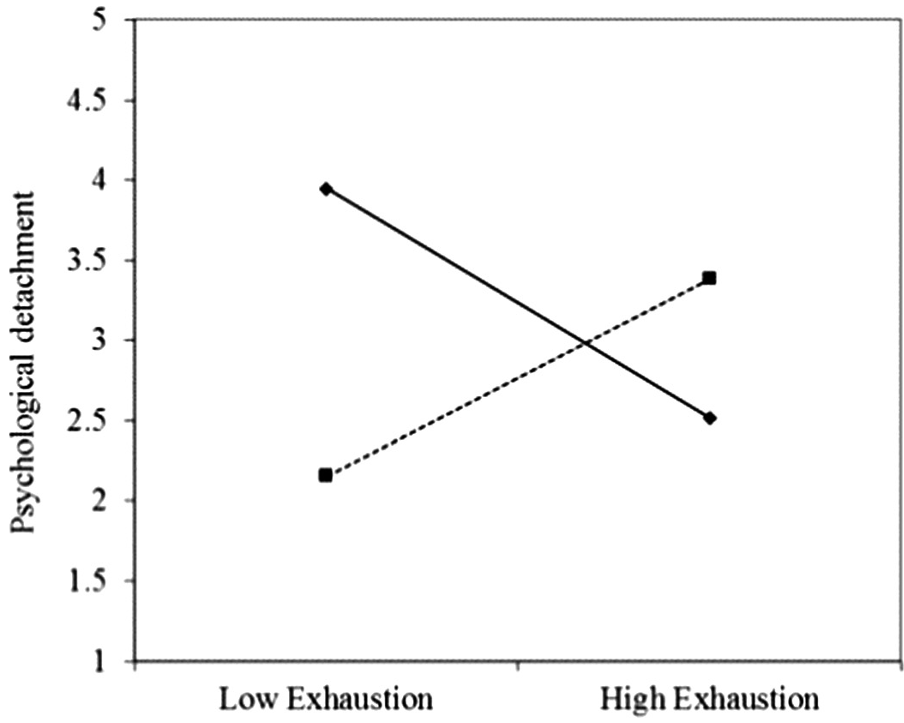 Figure 1: The moderation effect showing how positive emotions mitigate the impact of exhaustion on detachment.
Key Insights: The Buffering Effect of Joy
The most striking finding was the moderating role of positive emotion.
- The Buffer: For employees with low positive emotions from tweeting at work, exhaustion significantly hindered their ability to detach from work (p < .05).
- The Shield: For those experiencing high positive emotions from their tweets, the negative link between exhaustion and detachment disappeared. Social media became a "resource builder" that protected their personal time.
- The "Relaxation" Gap: Interestingly, positive emotions helped people "forget about work" (detachment) but didn't necessarily help them reach a state of low-activation (relaxation).
- Negative Emotion Paradox: Surprisingly, negative emotions from tweets did not significantly worsen the effects of exhaustion, suggesting that positive "micro-moments" are more impactful for recovery than negative ones are detrimental.
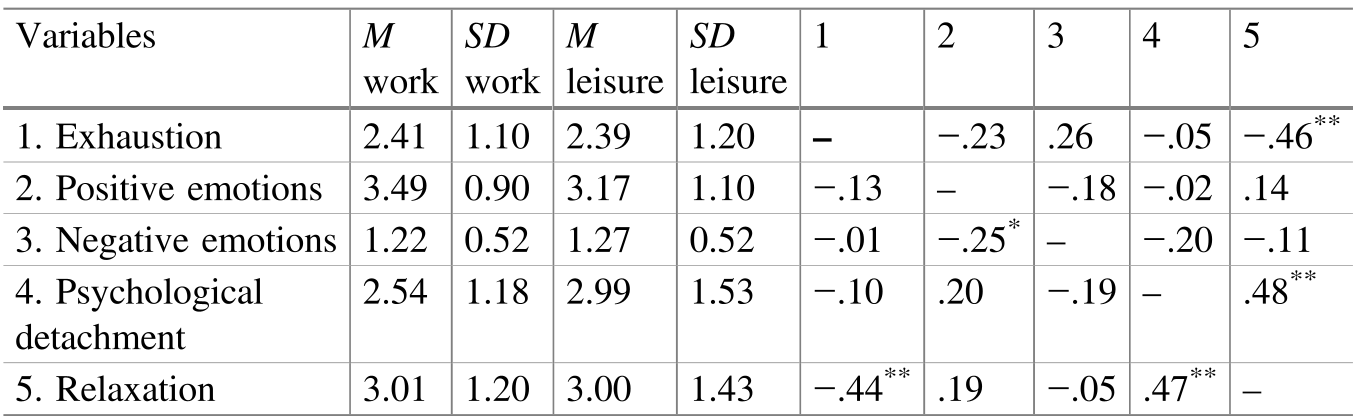 Table 1: Descriptive statistics and correlations between exhaustion, emotions, and recovery.
Critical Analysis & Conclusion
Takeaway
The quality of social media activity matters more than the quantity. Organizations should reconsider strict "no social media" policies, as these platforms can provide essential emotional breaks that improve employee well-being and long-term productivity.
Limitations
- Sample Size: With only 33 participants, the statistical power is limited, which might explain why Hypothesis 1 (the direct link between exhaustion and recovery) was not supported.
- Platform Specificity: Twitter's fast-paced, text-heavy nature might produce different emotional responses than visual platforms like Instagram or LinkedIn.
Future Outlook
Future research should look into discrete emotions (e.g., does "pride" from a professional tweet help more than "happiness" from a joke?) and expand to other social platforms. For managers, the message is clear: encouraging a positive, connected digital culture might be the key to helping your most exhausted workers finally "unplug."